
FMCSA HOS Rules for Carriers: 2026 Compliance Guide
Managing driver hours is one of the most operationally consequential responsibilities a carrier faces, and the FMCSA HOS framework is more nuanced than most teams realize until a violation surfaces. Hours of service rules govern not just how long a driver can operate a commercial motor vehicle, but when rest is required, how weekly accumulation is tracked, and which exceptions legitimately apply. Misreading any one of these parameters creates compounding risk: out-of-service orders, CSA score damage, and financial penalties that reach into five figures. This guide cuts through the ambiguity and gives transportation professionals a precise, current understanding of how fmcsa hours of service rules work in practice.
Table of Contents
- Key Takeaways
- Core FMCSA HOS rules for property-carrying drivers
- Sleeper berth provisions and HOS exemptions
- Applying HOS rules to real-world scheduling
- HOS violations, penalties, and enforcement
- My take on HOS compliance after years in this industry
- How Level5Fleet supports compliant freight execution
- FAQ
Key Takeaways
| Point | Details |
|---|---|
| 14-hour window is fixed | The on-duty window cannot be paused, so scheduling must account for all non-driving time within it. |
| Break rule has flexibility | The 30-minute break after 8 hours of driving can be satisfied by on-duty not-driving time, not just off-duty. |
| Sleeper berth logging matters | Incorrect ELD coding of sleeper berth splits voids the provision and forces a full 10-hour reset. |
| Adverse conditions has limits | The exception extends driving time by up to 2 hours but does not extend the 14-hour on-duty window. |
| Violations carry serious costs | FMCSA penalties for HOS violations range from $1,200 to $16,000, with falsified logs at the high end. |
Core FMCSA HOS rules for property-carrying drivers
Understanding the foundational structure of fmcsa hours of service regulations is the starting point for every compliance decision a carrier makes. These rules apply to commercial motor vehicle drivers transporting property, and each limit serves a distinct purpose within the broader safety architecture.
The 11-hour driving limit and 14-hour window
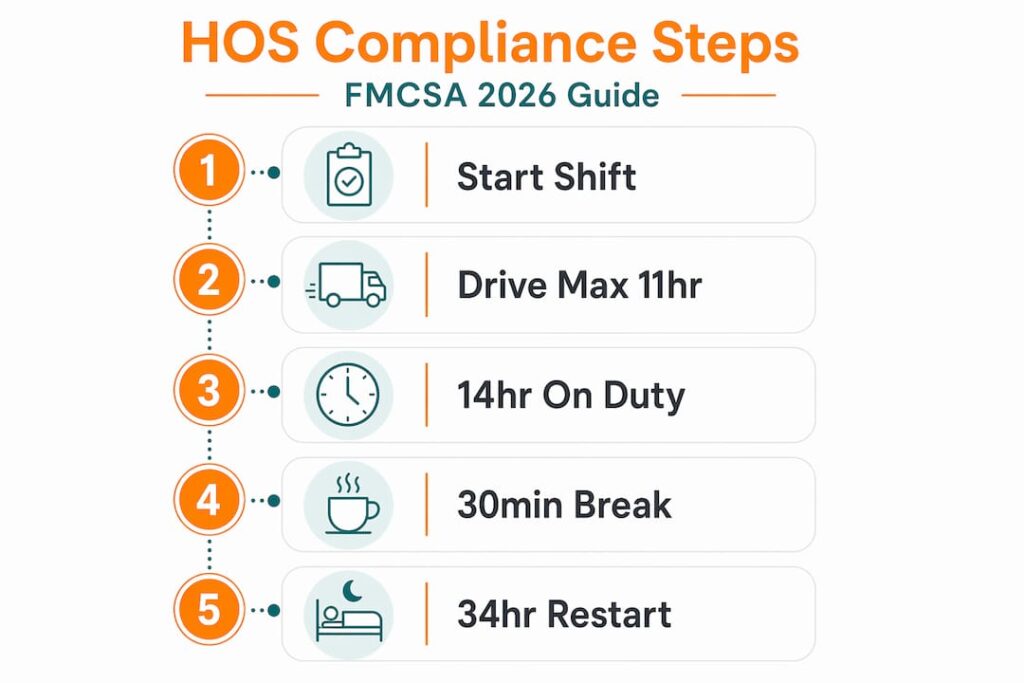
Property-carrying drivers may drive a maximum of 11 hours following 10 consecutive hours off duty. That driving must occur within a 14-hour on-duty window that begins the moment a driver goes on duty after that 10-hour rest period. The critical distinction here is that the 14-hour window does not pause for any reason. If a driver spends two hours at a shipper waiting to be loaded, those two hours count against the 14-hour clock regardless of whether they are logged as on-duty or off-duty.

This creates a scheduling reality that many dispatchers underestimate. A driver who goes on duty at 6:00 AM must complete all driving by 8:00 PM, no matter how much non-driving time occurred in between. Planning loads that require extended detention time at origin or destination without accounting for this fixed window is one of the most common sources of unintentional HOS violations.
The 30-minute break rule
After 8 cumulative hours of driving, a driver must take a break of at least 30 minutes before continuing. This rule has been in effect since 2020 and remains unchanged for 2026. What many drivers and dispatchers get wrong is the assumption that this break must be logged as off-duty time.
In fact, the break can be satisfied by on-duty not-driving time, which is a significant scheduling advantage for terminal operations. A driver completing paperwork, conducting a pre-trip inspection, or waiting at a dock while logged as on-duty not-driving can satisfy the 30-minute break requirement without losing productive time.
Pro Tip: When scheduling terminal stops, coordinate them to fall after the 8-hour driving threshold so drivers satisfy the break requirement during productive on-site tasks rather than adding idle off-duty time.
Weekly limits and the 34-hour restart
| Rule | Limit | Reset Mechanism |
|---|---|---|
| 11-hour driving limit | 11 hours per shift | 10 consecutive hours off duty |
| 14-hour on-duty window | 14 hours from first on-duty | 10 consecutive hours off duty |
| 60-hour weekly limit | 60 hours in 7 consecutive days | 34-hour restart |
| 70-hour weekly limit | 70 hours in 8 consecutive days | 34-hour restart |
| 30-minute break | Required after 8 hours driving | N/A |
Carriers operating 7-day schedules are subject to the 60-hour rule, while those operating every day of the week fall under the 70-hour rule. The 34-hour restart provision allows a driver to reset their weekly hours by taking at least 34 consecutive hours off duty. This provision is a genuine scheduling tool when used correctly, particularly for drivers approaching their weekly ceiling mid-week.
Sleeper berth provisions and HOS exemptions
The exceptions built into fmcsa driver regulations give carriers real operational flexibility, but they are also the source of some of the most costly compliance errors in the industry.
Sleeper berth split options
The sleeper berth provision allows drivers to split their required 10-hour off-duty period into two segments rather than taking it all at once. One segment must be at least 7 consecutive hours in the sleeper berth, and the other must be at least 2 consecutive hours spent either in the sleeper berth or off duty. Neither segment counts against the 14-hour on-duty window, which is the core benefit of the provision.
| Split Option | Segment A | Segment B | Window Impact |
|---|---|---|---|
| 7/3 split | 7 hours in sleeper berth | 3 hours off-duty or sleeper | Neither counts against 14-hr window |
| 8/2 split | 8 hours in sleeper berth | 2 hours off-duty or sleeper | Neither counts against 14-hr window |
The most damaging mistake drivers make with this provision is ELD logging. Logging sleeper berth time as off-duty invalidates the split entirely and forces the driver to take a full 10-hour off-duty period before resuming. This is not a minor clerical error. It can result in a driver being placed out of service at a roadside inspection if the logs do not reflect the correct duty status codes.
Pro Tip: Conduct periodic ELD audits specifically targeting sleeper berth duty status codes. A single mislogged segment can unwind an entire split and create a cascading violation across the day’s log.
Adverse driving conditions and short-haul exceptions
The adverse driving conditions exception allows a driver to extend the 11-hour driving limit by up to 2 hours when conditions encountered en route, such as snow, ice, or fog, were not foreseeable at the start of the trip. What this exception does not do is extend the 14-hour on-duty window. That distinction is widely misunderstood and frequently cited in compliance audits.
The adverse driving exception is misused in roughly 15% of audits, most often because carriers apply it without adequate documentation or use it to cover delays that were foreseeable. Clear, contemporaneous notes in the ELD or driver log explaining the specific conditions encountered are not optional. They are the difference between a defensible exception and a violation flag.
The short-haul exception is available to drivers operating within a 150-air-mile radius of their reporting location and returning to that location within 14 hours. Qualifying drivers are exempt from ELD requirements and the 30-minute break rule, but they must still comply with the 11-hour driving limit and weekly hour caps.
Applying HOS rules to real-world scheduling
HOS compliance is not just a regulatory checkbox. It directly shapes how carriers build driver schedules, assign loads, and manage fleet capacity across the week.
The 14-hour window demands that dispatchers treat every minute of on-duty time as a finite resource. Here is a practical framework for building compliant schedules:
- Map the full on-duty window before assigning loads. Account for pre-trip inspection time, expected detention at origin and destination, and any planned fuel or weigh station stops. These all consume the 14-hour clock.
- Build the 30-minute break into the load plan. Identify a natural stopping point after 8 hours of driving and align it with a shipper stop, fuel point, or terminal visit where on-duty not-driving time is available.
- Track cumulative weekly hours in real time. Drivers approaching the 60 or 70-hour ceiling mid-week need to know their remaining hours before accepting new assignments. Dispatchers who rely on end-of-day reports rather than live ELD data routinely create violations.
- Use the 34-hour restart strategically. If a driver will hit their weekly limit before completing a high-priority load, scheduling a 34-hour restart early in the week can preserve capacity for time-sensitive freight later.
- Document every exception at the time it occurs. Whether it is adverse driving conditions or a sleeper berth split, the documentation must be contemporaneous. Reconstructed notes created after an inspection rarely satisfy auditors.
Pro Tip: Integrate your ELD platform with dispatch software so that remaining hours are visible to both the driver and the dispatcher simultaneously. Reactive hour management is where most preventable violations originate.FMCSA is actively studying the relationship between current HOS rule inflexibility and driver fatigue, with parking availability also under review as of 2026. Carriers that build flexibility into their scheduling now, rather than running drivers to the edge of every limit, are better positioned regardless of how those rules evolve.
HOS violations, penalties, and enforcement
Understanding what triggers enforcement action is as important as understanding the rules themselves.
Common violations cited during roadside inspections and carrier audits include:
- Exceeding the 11-hour driving limit
- Operating beyond the 14-hour on-duty window
- Failing to take the required 30-minute break
- Exceeding the 60 or 70-hour weekly limit
- Incorrect ELD logging, including misclassified duty statuses
- Falsification of log records
FMCSA penalties for HOS violations range from $1,200 to $16,000 per violation. Falsification of records carries the highest fines and can trigger criminal referrals in egregious cases. Beyond the direct financial exposure, each violation generates CSA points that accumulate in the carrier’s safety profile and can trigger interventions, including compliance reviews and targeted roadside inspection campaigns.
A driver placed out of service for an HOS violation cannot legally resume driving until the required off-duty time has been satisfied. For a carrier managing time-sensitive freight, that is not just a compliance problem. It is an operational failure with downstream consequences for every load behind that driver.
Carriers also need to understand that drivers have formal protections against being pressured to violate HOS limits. Under 49 CFR 390.6, drivers can report coercion to FMCSA and are protected from adverse employment actions for doing so. FMCSA reinforced this in April 2026 guidance. Carriers that pressure drivers to run illegal hours face not only penalty exposure but also formal coercion complaints that become part of the carrier’s enforcement record.
The most effective defense against enforcement action is a culture of accurate, real-time ELD logging combined with dispatcher training that treats HOS limits as operational constraints, not suggestions to be managed around.
My take on HOS compliance after years in this industry
I’ve watched carriers treat HOS compliance as a documentation exercise rather than an operational discipline, and the pattern is remarkably consistent. The violations that cause the most damage are rarely the ones where someone knowingly pushed a driver over the limit. They are the ones where a dispatcher did not understand that the 14-hour window was already running, or where a driver logged sleeper berth time as off-duty out of habit and voided a split they legitimately took.
What I’ve learned is that the rules themselves are not the hard part. The hard part is building the organizational knowledge so that everyone touching a load understands the constraints before the truck moves, not after the inspection.
I’ve also seen the coercion dynamic play out in ways that carriers do not anticipate. When drivers feel pressure to accept loads that will push them over their limits, the best ones document it and report it. FMCSA’s coercion protections exist precisely because this pressure is real and widespread. Carriers that build a culture where drivers feel safe raising HOS concerns before departure avoid both the violation and the coercion complaint.
The FMCSA’s 2026 fatigue study is worth watching closely. The industry has long argued that rigid hour windows do not always align with actual fatigue patterns, and regulators are finally examining that question with data. My view is that carriers who have already built scheduling practices around driver well-being rather than maximum utilization will adapt to any rule changes with far less disruption.
Compliance is not the ceiling. It is the floor.
— Gwagsi
How Level5Fleet supports compliant freight execution

HOS compliance does not exist in isolation. It intersects directly with freight execution integrity, and the gaps in one area amplify risk in the other. When drivers are running under time pressure and loads are moving through exception-driven workflows, the conditions that produce both HOS violations and unauthorized freight movements tend to converge.
Level5Fleet was built to address exactly that intersection. By integrating identity verification, authorization protocols, and on-asset enforcement into a single trust infrastructure, Level5Fleet gives carriers the visibility and control they need to manage freight execution accurately, even when conditions on the ground are not going according to plan. Admiral Enforce provides physical enforcement on trailers and containers, while Admiral Resolve verifies pickup and change requests before freight moves. Together, these tools reduce the operational drift that compounds compliance exposure. Visit Level5Fleet to learn more or schedule a demonstration.
FAQ
What is HOS in trucking?
HOS stands for hours of service, the federal regulations set by FMCSA that govern how long commercial motor vehicle drivers may drive and work before taking mandatory rest. The rules apply to property-carrying and passenger-carrying drivers, with different limits for each category.
How many hours can a property-carrying driver work per day?
A property-carrying driver may drive up to 11 hours and remain on duty for up to 14 hours after 10 consecutive hours off duty. The 14-hour on-duty window is fixed and cannot be extended by taking breaks within it.
What triggers a 30-minute break requirement under FMCSA rules?
A driver must take a 30-minute break after accumulating 8 cumulative hours of driving. The break can be satisfied by off-duty time, sleeper berth time, or on-duty not-driving time, giving carriers flexibility in how they schedule it.
What are the penalties for FMCSA HOS violations?
FMCSA penalties for hours of service violations range from $1,200 to $16,000 per violation, with falsification of log records carrying the highest fines. Violations also generate CSA points that affect a carrier’s safety rating and inspection targeting.
Can a driver be forced to violate HOS rules by a carrier?
No. Under 49 CFR 390.6, drivers are protected from coercion to violate HOS limits and can report such pressure directly to FMCSA without fear of adverse employment action. FMCSA issued reinforcing guidance on this protection in April 2026.