
Educational Resources
>
The One Vulnerability Behind Cargo Theft — and Why Simple Infrastructure Beats Complex Fixes
The One Vulnerability Behind Cargo Theft — and Why Simple Infrastructure Beats Complex Fixes
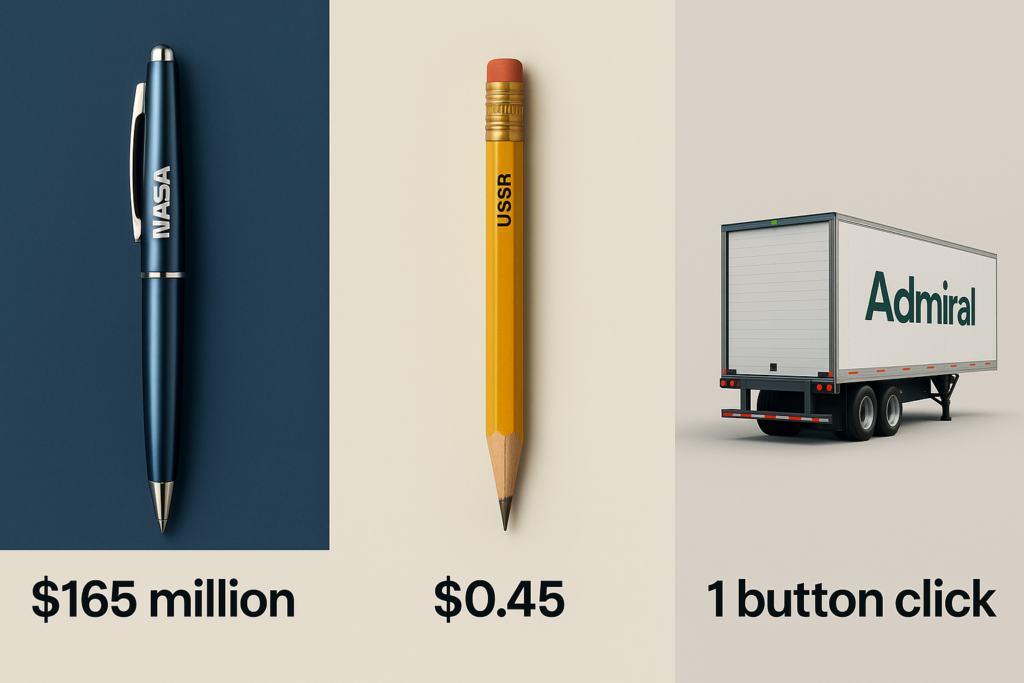
There’s a well-known engineering urban legend about the space race. Faced with the challenge of writing in zero gravity, one team spent years developing a pressurized pen. The other used a pencil.
The story isn’t really about cost or cleverness. It’s about recognizing when a problem that looks complex is actually constrained by a simple failure, and choosing to solve that instead.
Freight theft is a similarly complex problem. The surface area is enormous: fictitious pickups, impersonation, forged documents, substitutions, last-minute changes, collusion, break-ins, cyber attacks, GPS spoofing, straight trailer theft, etc. Each incident looks different. Each seems to demand its own countermeasure.
But if you peel away the noise: the prisoner’s dilemmas, the coordination failures, the escalation of monitoring — the same vulnerability appears again and again.
They exploit how difficult it is, in the middle of execution, to reliably tie a request to three things: who is making it, who they represent, and whether they are authorized to ask for that change right now. When any of those links are ambiguous, judgment fills the gap.
That gap is not created by negligence. It’s created by pressure. Schedules compress, exceptions stack, systems lag, and decisions have to be made before context can be reassembled. Trust is carried informally: through emails, forwarded PDFs, phone calls, and “this seems right.”
The instinctive response is to build a better pen: more precision, more sensing, more alerts, more review after the fact. These systems can work, but only by increasing the cost of coordination, ensuring that the same gap will open again under pressure.
The alternative is to build the pencil instead.
Once you recognize the vulnerability, the requirements become clear. Trust has to survive execution — not as policy or intent, but as something enforced by the asset itself at the moment it matters. Proof has to be scoped to a specific load, valid for a specific moment, and able to reach the point of action without leaking context. Authorization must be verifiable and physically enforceable by the equipment, without exposing who approved or how, so frontline teams can act without guessing and out-of-policy actions simply cannot proceed, even when things move fast.
That is the premise of this post. Not that freight is simple, but that its most expensive failures originate from a single structural weakness. Build infrastructure that holds at that seam, and much of the complexity collapses with it.
Stay Connected
Want more insights like this? Follow Level5Fleet for future articles, freight industry trends, and updates on building a smarter, more secure supply chain:
🔗 LinkedIn
🐦 X: @Level5fleet
📘 Facebook
📸 Instagram