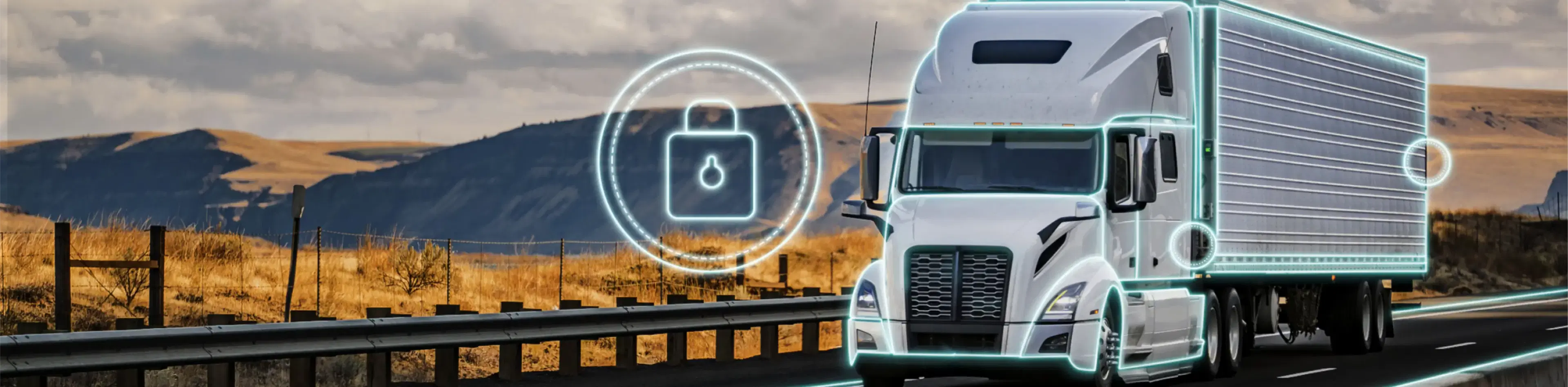
Why Automated Trailer Immobilization Scales — and Judgment Does Not
While strategic cargo theft is on the rise, straight theft still constitutes the majority of cases. It happens when trailers are left unattended: in drop yards, overflow lots, rest areas, or unsecured corners of busy operations. These moments aren’t rare edge cases; they’re a structural feature of how freight actually moves.
And they expose a simple truth: security that depends on supervision or judgment does not scale.
Why “just lock it” eventually breaks down
At small scale, manual controls work. A kingpin lock gets applied. A wheel boot goes on. Someone decides the trailer looks safe enough “just for a minute.”
At enterprise scale, those decisions multiply.
Every manual control requires someone to apply it, someone to decide when it’s necessary, someone to decide when it can be skipped, and someone to remove it again.
None of those decisions are unreasonable on their own. But under pressure—late appointments, limited space, drivers needing breaks—discretion becomes variability. And variability is exactly where theft lives.
This isn’t a failure of discipline. It’s the predictable outcome of asking humans to repeatedly make situational security calls in environments optimized for speed.
Why immobilization changes the equation
Automated immobilization removes discretion from the loop. When a trailer cannot move unless conditions are met, protection no longer depends on whether someone remembered, whether it “felt safe enough,” or whether supervision was available.
The control becomes binary. Either movement is allowed, or it isn’t. That property — consistency without supervision — is what makes automated immobilization the only approach that scales cleanly across fleets, yards, and geographies.
Why the parking brake is the right control surface
Choosing how to immobilize a trailer is not a philosophical decision. It’s an engineering one. The parking brake was selected because it already satisfies the hardest constraints of the problem:
- It exists on every trailer.
- It is designed to hold stationary loads safely.
- It is binary in state.
- It is already safety-rated and deeply understood.
- It requires no change in driver behavior.
Most importantly, it is designed to fail safely. Rather than introducing a new mechanical risk, parking-brake immobilization works with systems already trusted to keep equipment stationary under load.
Safety is not an afterthought
Any immobilization system worth deploying must answer one question before all others: can this ever activate in motion?
The answer here is no because of layered interlocks. Multiple independent conditions must be satisfied before immobilization is possible. Crossing them accidentally would require a chain of failures more severe than many everyday mechanical risks already accepted in freight operations.
In practice, this makes parking brake immobilization safer than many failures operators already plan around: brake leaks, air loss, or mechanical degradation.
The safety layers
Admiral Immobilizer, part of Admiral Enforce, is engineered with a triple-layered redundancy to make accidental activation virtually impossible. The layers are:
- Passive Layer: Electrically isolates the valve. If the switch is off, nothing happens.
- Logic Layer: Confirms the trailer isn’t moving and isn’t connected to the tractor before switching.
- Architecture Layer: Ensures the immobilizer can’t be remotely activated. You as an operator can only request it — the trailer decides whether it is safe to engage. There are no “engage now” overrides.
For additional margin, each layer itself contains redundant safety mechanisms. Let’s take a closer look at the logic layer to illustrate.
Motion matters more than location (and physics is honest)
As noted above, the logic layer verifies that no tractor is connected and that the trailer is stationary. Motion detection in turn is informed by two independent signals. If asked to pick signals, GPS would be one of the first choices. Vibrations would be the other.
Long before GPS existed, engineers learned that machines announce what they are doing through vibration alone. Rolling does not look like lifting. Coupling does not look like dragging. And being tampered with does not look like either, no matter how optimistic someone is about being gentle.
If your phone can tell the difference between sitting on a desk, riding in your pocket, or falling off a table, it’s already doing motion classification. Trailers are no different. Just louder.
The same MEMS sensors that quietly rotate screens and count steps can distinguish real movement from interference. These patterns are not subtle. Steel, rubber, and inertia are surprisingly expressive.
Which is useful, because physics doesn’t need cell service.
Even when GPS is degraded or unavailable, motion classification continues in the background, providing a second, independent layer of truth about what the asset is actually experiencing.
Why this matters operationally
The goal is not to build a smarter lock. It’s to remove the moments where security depends on someone making the right call under pressure.
When immobilization is embedded at the asset level:
- unattended trailers remain protected without supervision,
- exceptions stop being judgment calls,
- and “probably safe” stops being a security posture.
This is not about being more restrictive. It’s about being more consistent.
Where Admiral Enforce fits
Admiral Enforce was designed around this reality: enterprise security must survive execution without asking for attention.
Immobilization is one part of that system. It is part of the Admiral Trust Infrastructure. It ensures that protection doesn’t disappear when the yard is busy, the phone rings, or the schedule slips.
Closing thought
At scale, security choices are not about intent. They’re about incentives and physics. Controls that require judgment eventually vary. Controls embedded in equipment simply work.
If the driver is authorized to pull the load, the immobilizer disengages silently. The driver never even knows it was there.
There’s more nuance when it comes to live loads versus drop-and-hook scenarios. That’s where Admiral Execute enters the picture.
Stay Connected
Want more insights like this? Follow Level5Fleet for future articles, freight industry trends, and updates on building a smarter, more secure supply chain:
🔗 LinkedIn
🐦 X: @Level5fleet
📘 Facebook
📸 Instagram