
Stop Fictitious Pickups: Audit Trail Best Practices for Fleets

A strong audit trail for trailers and containers combines identity-verified digital handovers, documented seal controls, and enforced on-asset actions recorded in tamper-evident logs. Ideally every check-in carries a verified driver and vehicle identifier, every seal has a logged number with VVTT verification and timestamped photos, and every critical action has GPS and time-stamped evidence tied to an enforced, auditable event.
TL;DR:
- Verify identity at every handover, capturing driver ID, vehicle details, and a timestamped digital record to prevent fictitious pickups.
- Seal controls should include logging each seal with photos and VVTT verification, with immediate recording of any seal changes and associated event details.
- All critical actions and seal inspections should be recorded as tamper-evident events with synchronized timestamps, GPS data, user tokens, and photographic evidence.
- Routine audits should include scheduled reviews and random spot checks, with KPIs tracking discrepancies, photo documentation, incident response times, and compliance with standards like C-TPAT and TAPA.
- Start with a pilot on high-risk lanes, combined with enforced control measures and strong management support, so you can measure results before scaling.
Table of Contents
- Operational checklist: audit-trail best practices to implement now
- Technical controls and data-integrity rules for tamper-evident audit trails
- Audits, KPIs, and standards alignment (C-TPAT and TAPA)
- Implementation roadmap and change management (pilot to rollout)
- An operational perspective on enforcing audit trails
- How Admiral maps to these best practices
- FAQ
- Sources
Operational checklist: audit-trail best practices to implement now
A trustworthy audit trail is built from specific, repeatable actions, not a vague policy. Start with identity verification at every handover. We recommend capturing driver photo ID, the vehicle’s VIN or Motor Carrier number, and a timestamped digital record tied to that specific person and asset. Fragmented or informal check-ins are exactly where fictitious pickups succeed, since organized theft networks exploit cloned carrier trucks to pass as legitimate drivers, according to the 2025 Cargo Theft Report, and the FBI’s IC3 warns of criminals using compromised carrier accounts to impersonate legitimate businesses.
From there, the checklist expands into physical controls:
- Control seal inventory with assigned custody logs, and document every seal application with a placement photo plus a completed VVTT (view, verify, tug, twist) check.
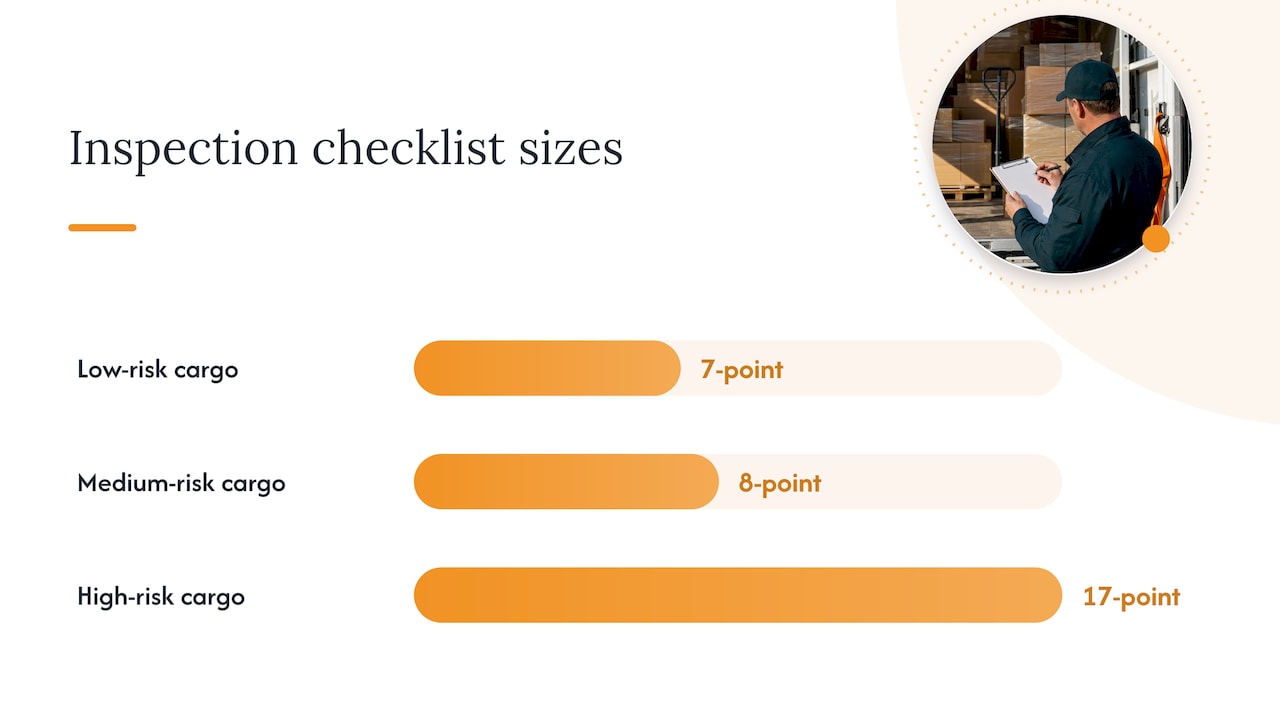
- Run pre-departure and at-stop inspections using a standardized checklist (C-TPAT highway carriers use a 17-point tractor-and-trailer inspection) and record results electronically rather than on paper.
- Log every seal change the moment it happens: who removed it, why, and the new seal number, with immediate notification to dispatch or the receiving party.
- Record chain-of-custody events for each handoff, including booking ID, handler identity, timestamp, a geofence snapshot, and photographic proof of the trailer’s condition.
- Establish an incident containment protocol: document the event, notify your partners, and investigate, adding live monitoring and notifying law enforcement and insurers without delay where warranted.
These steps line up with the C-TPAT highway carrier security criteria, which require written seal procedures, the VVTT seal verification process, and a 17-point tractor-and-trailer inspection, and recommend recording inspections on a checklist.
Pro Tip: Treat every seal change as an incident report, not a routine note. A one-line explanation written down at the time prevents hours of reconstruction later.
Technical controls and data-integrity rules for tamper-evident audit trails
An audit trail only holds up under scrutiny if the underlying records cannot be quietly altered. Every critical action should have a tamper-evident event record: synchronized timestamps, a user identity token, a GPS snapshot, and supporting photo or video evidence.
- Log seal IDs, placement photos, and VVTT verification steps as separate, discrete events rather than a single bundled note.
- Route all booking and handover communication through one secure channel instead of splitting it across texts, emails, and phone calls, since a single, centralised channel allows tighter monitoring, easier verification, and clearer audit trails.
- Apply write-once metadata and strict edit controls so any correction to a record shows who made it, when, and why.
- Set retention policies and role-based access so records survive long enough to support audits, insurance claims, and customs reviews.
- Feed automated enforcement events, such as immobilization or door-lock activation, directly into the audit log as verifiable evidence rather than a separate alarm feed.
Keeping load-booking communication in a single, centralised channel helps reduce exposure to identity fraud, according to the TT Club and BSI cargo theft report, which says attempts to move conversations to private phone numbers or personal email addresses may constitute a red flag. Integrating an immobilizer’s activation record into the same audit trail as the seal log and the identity check turns a reactive alarm into time-stamped proof of custody control. The TAPA Trucking Security Requirements (Hard Sided Truck) specify high-security cargo-door locking devices, ISO 17712 tamper-evident seals with a documented control procedure, engine immobilizers, and tracking and monitoring protocols.
Audits, KPIs, and standards alignment (C-TPAT and TAPA)
An audit trail needs its own audit. Schedule routine reviews of logs and seals, then supplement them with random, unannounced verifications so field teams cannot prepare in advance.
- Set a cadence that fits your risk: scheduled reviews plus periodic unannounced spot checks of seal inventory and handover logs. Where a C-TPAT member keeps a seal inventory, C-TPAT requires a seal audit with periodic inventory and reconciliation, and all audits must be documented.
- Track KPIs that matter operationally: seal discrepancy rate, percentage of handovers with photo documentation, average incident response time, and percentage of events carrying identity verification.
- Train auditors to check specific field evidence: seal placement photos, completed VVTT steps, and whether timestamps correlate with GPS location data.
- Document corrective actions and nonconformance logs so every gap has a paper trail, and compile evidence packages ready for customs or insurer review.
- Map internal records against C-TPAT and TAPA checklists directly, confirming that VVTT steps, seal standards, and inspection points appear exactly where those frameworks require them.
High-security seals used in these checks should meet ISO 17712, and C-TPAT requires written seal procedures to be reviewed at least once a year. Keeping this documentation also demonstrates that the seal and identity controls were followed, not just written down.
Implementation roadmap and change management (pilot to rollout)
Rolling out audit-trail enforcement works best as a staged process rather than a single policy memo.
- Phase 1, risk scoping: identify high-risk lanes, high-value commodities, and the specific handoff points where fictitious pickups and seal tampering are most likely.
- Phase 2, pilot: run identity-verified handovers and an enforced-control pilot, such as an Enforce Pilot with trailer immobilization, on one terminal or a small fleet segment before expanding further.
- Phase 3, SOP update and training: document the new handover steps, seal procedures, and escalation paths, then train dispatch and yard staff on exactly when and how to escalate a seal discrepancy or trigger an incident report.
- Phase 4, scale: measure the KPIs from the pilot, close any gaps the data reveals, and add automation such as immobilization or door locks where the evidence justifies it.
The Windsor Whisky Heist is a clear illustration of why perimeter-only security fails: a fence at a yard does nothing once thieves cut through it and drive a trailer away. On-asset enforcement, by contrast, ties the asset’s own movement and access to a verified identity, closing that gap instead of just monitoring it.
Pro Tip: Run the pilot on your highest-risk lane first. A single prevented incident there will justify the rollout faster than any spreadsheet.
An operational perspective on enforcing audit trails
Cost and process friction are the usual objections to tightening audit trails, and they are reasonable ones until a theft happens on a lane nobody flagged. Senior sponsorship matters here because dispatch and yard staff will not change a habit without someone above them backing the new steps. Logs alone do not stop theft. An audit trail only earns its name when it is tied to an enforced action, something that physically stops an unverified pickup rather than just recording that one occurred. Start with a measurable pilot, track the KPIs, and let the numbers make the case for wider rollout.
— Gwagsi
How Admiral maps to these best practices
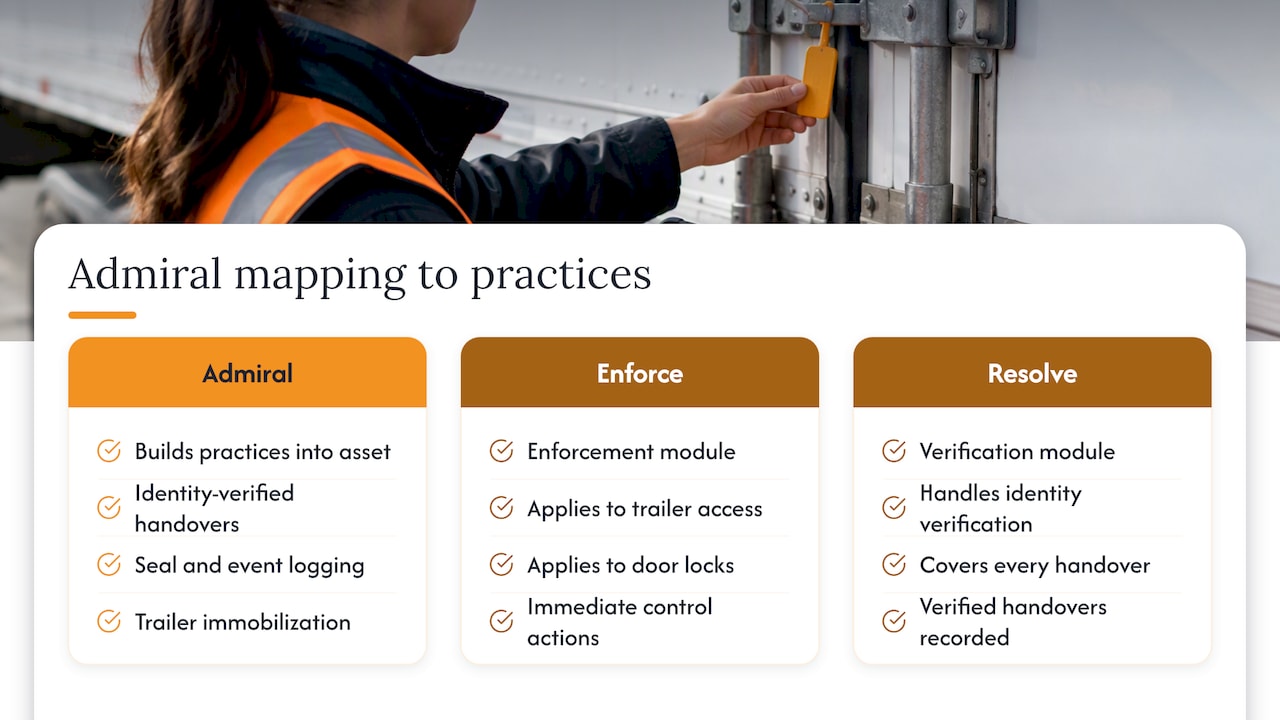
Admiral pairs identity verification with enforcement on the asset itself: trailer immobilization, cargo door locking, and virtual seals that only authorized personnel can break, so the record of what was authorized comes from the control rather than being reconstructed after the fact.
Admiral Enforce keeps doors locked and trailers immobilized unless movement is authorized, while Admiral Resolve verifies who is requesting a pickup, access, or change before it is authorized. If your current process depends on paper logs and manual seal checks, request an Enforce Pilot to see how it would run on your own lanes.
FAQ
What should an audit trail for trailers always include?
An audit trail should include identity-verified check-ins tied to a specific driver and vehicle, logged seal numbers with VVTT verification and photos, and time-stamped records of any enforced action like immobilization. These elements together, not logs alone, line up with the seal-control, inspection, and monitoring expectations in C-TPAT and TAPA.
What is VVTT seal verification?
VVTT stands for view, verify, tug, twist, a four-step process for confirming a high-security seal is properly affixed and shows no sign of tampering. C-TPAT requires carriers to follow the VVTT process, train drivers on it, and maintain written seal procedures.
Why are fictitious pickups a growing risk?
Fictitious pickups, where a thief poses as the legitimate carrier to collect freight, increased sharply in recent years as organized groups exploit weak identity checks and cloned carrier trucks. A Munich Re claims executive told the 2025 Cargo Theft Report that fictitious pickups rose 1,445.83% between Q1 2022 and Q1 2024. More recently, the FBI’s IC3 reports that confirmed cargo theft incidents in the U.S. and Canada rose 18% in 2025, with the average value per theft up 36% to $273,990.
How often should seal and log audits happen?
Seal and log audits should combine a scheduled review with random unannounced spot checks so field teams cannot prepare for them in advance. This mix catches both routine compliance gaps and the kind of deliberate tampering a predictable schedule would miss.
Does Admiral replace manual seal checks entirely?
Admiral pairs identity verification with physical access control on the asset itself, recording authorization decisions and enforcement attempts as part of that process rather than replacing seal checks outright. Seal application and VVTT verification remain part of the documented procedure, with Admiral’s enforced actions adding a verifiable layer on top.
Sources
- IC3 PSA 2026
- C-TPAT highway carrier security criteria (MSC Oct 2021)
- TAPA TSR 2023 standard requirements (appendix A)
- 2025 Cargo Theft Report (Roanoke Group)
- TT Club / BSI cargo-theft report 2025