Fleets: Enforced Remote Lock Control That Stops Fictitious Pickups
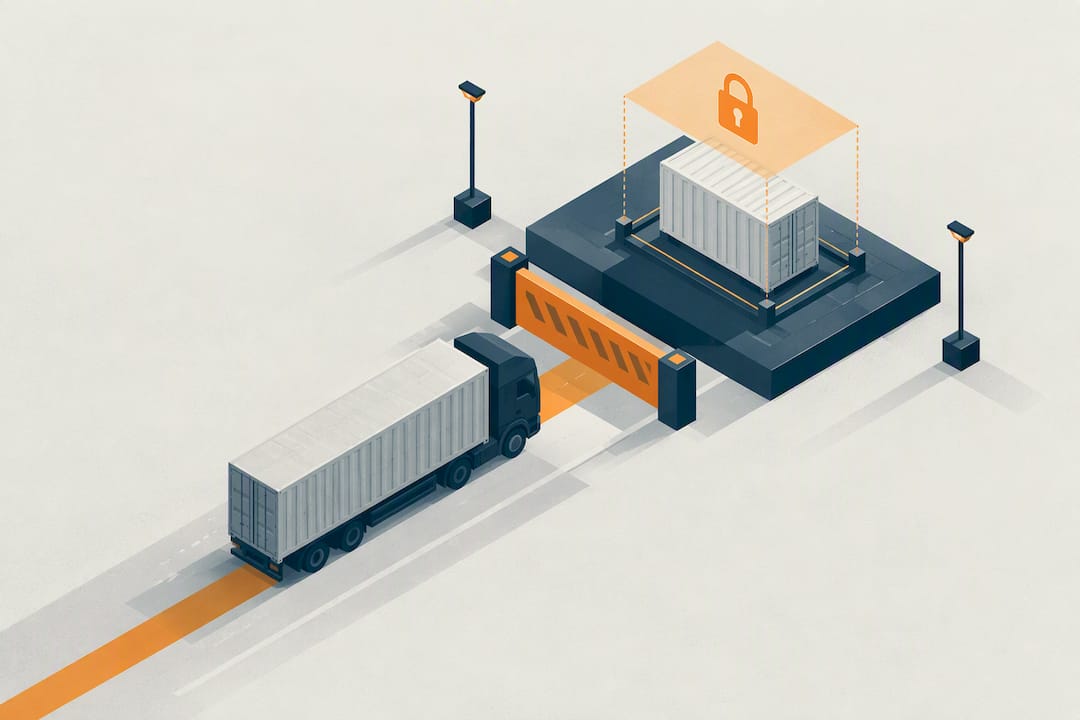
Remote lock control means asset-mounted door locks and immobilizers that only release when a person’s identity has been independently verified, not just when a code or app confirms a transaction. That enforcement layer is what stops fictitious pickups and credential-based fraud, among the fastest-growing theft methods in freight. Level5Fleet built its Admiral platform around this exact principle: verify identity, then enforce the physical release.
TL;DR:
- Remote lock control can help prevent theft by requiring independent identity verification before trailer release or movement.
- Systems should include multiple verification channels, seals aligned with ISO 17712 (mechanical) or ISO 18185 (electronic), and resilient communications to function in dead zones.
- Pilot programs targeting high-value lanes and hotspots are essential for testing and tuning system performance before full deployment.
- Integration with existing workflows and clear SOPs are crucial to prevent driver frustration and ensure effective adoption of enforced locking systems.
- Cost benefits are most evident for fleets with concentrated or high-value losses, where preventing even one incident may offset a meaningful share of hardware and platform expenses.
Table of Contents
- Why remote lock control matters for fleets today
- Core components of a remote lock control system
- Evaluation checklist: how to choose the right remote lock control for your operation
- Implementation steps and how to run a pilot
- Integration, workflows, and verification: tying identity to physical enforcement
- Standards, programs, and compliance to factor into procurement
- Return on investment (ROI) analysis and cost-benefit considerations
- Author perspective and operational caveats
- Level5Fleet Admiral: a direct option for enforced remote lock control
- Sources
- FAQ
Why remote lock control matters for fleets today
Cargo theft has moved from opportunistic break-ins to organized fraud. Thieves now impersonate carriers, forge paperwork and exploit load board credentials to walk away with full trailers, no bolt cutters required.
Cargo theft losses in the United States and Canada jumped 60% year over year to nearly $725 million in 2025, with the average value per incident rising 36% to $273,990 and confirmed incidents up 18%. That trend line explains why visibility tools alone are losing ground.
GPS trackers and passive seals report what happened after the trailer is gone. They cannot stop a driver from picking up a load using a compromised credential, and a theft like this is often not discovered until tracking devices reveal it, after the load has been diverted.
Enforced locking changes that math:
- A fictitious pickup is much harder to complete when release requires independent identity confirmation, not just a paper reference number.
- An immobilized trailer stays in place unless movement is authorized, even if a thief has walked past the gate.
- Every access attempt, successful or not, becomes a timestamped record rather than a mystery.
Core components of a remote lock control system
A working system is not one device. It is four layers working together: physical hardware, identity verification, communications, and record-keeping.
- Trailer door locks secure the cargo compartment itself and keep the doors locked against unauthorized access.
- Internal cargo locks add a lock mounted inside the trailer and hidden from outside view.
- Trailer immobilizers keep the trailer from moving until movement is authorized.
- Identity verification relies on secure pick-up numbers and confirming driver, truck and trailer identifiers at pick-up, which FBI guidance recommends, along with independent multi-channel verification of pickup requests, as the FBI’s IC3 advises.
- Electronic seals add tamper detection and digital identity to a physical seal, so a broken seal does not have to be discovered at delivery. As the EUIPO’s e-seal guidance notes, they can trigger alarms when tampered with and be monitored in real time.
- Resilient communications matter in dead zones and outages: the system should keep enforcing locally when connectivity drops, with a defined offline behavior rather than a silent failure.
- Audit trails log who requested release, when, and from where, creating a record that can support an insurance claim or a police report.
Pro Tip: Test your system’s offline behavior before you rely on it. A remote lock that fails open when it loses signal gives false confidence.
Evaluation checklist: how to choose the right remote lock control for your operation
Vendor claims are easy to make. Use a structured checklist during procurement so you compare systems on the details that actually determine whether theft gets stopped.
- Tamper resistance and standards alignment: check whether seals meet or reference ISO 17712 (mechanical high-security seals) or the ISO 18185 series (electronic seals for freight containers). These standards cover seals, not door locks or immobilizers, so also ask vendors how their locking hardware is tested.
- Depth of identity verification: confirm the system uses more than one independent channel, not just a single app confirmation that a stolen phone could satisfy.
- Integration and data ownership: ask whether the platform offers open APIs into your TMS or WMS, and who owns the telemetry data once it is generated.
- Failover policy: get a written answer on what happens during connectivity loss, including manual override procedures and how emergency releases get logged.
- Service and lifecycle support: review warranty terms, firmware update cadence, installation timelines and the training the vendor provides to operators and drivers.
Weigh these against your fleet’s actual loss patterns. A regional produce hauler and a long-haul electronics carrier will prioritize different rows on this list.
Implementation steps and how to run a pilot
Most fleets succeed by piloting narrowly before scaling. Start with the routes and yards where losses are concentrated, since ATRI’s 2025 survey found motor carriers report theft most often at their own terminals (24.3%) and logistics service providers most often at customer pick-up locations (50.5%).
A workable sequence looks like this:
- Scope a pilot around a handful of hotspot trailers or one high-value lane, with clear KPIs such as unauthorized release attempts and seal-break events.
- Install hardware and run comms testing, then connect the system to existing TMS or WMS workflows through vendor APIs.
- Update SOPs and train dispatchers and drivers on their new responsibilities before go-live.
- Monitor results over a defined review period, tuning alert thresholds and escalation paths based on what the pilot surfaces.
Overhaul recorded 2,576 cargo theft incidents in the United States in 2025, so it is worth comparing your pilot results against broader industry patterns rather than relying on anecdote. Timeline and cost depend heavily on fleet size and how much retrofitting existing trailers requires versus specifying new equipment.
Integration, workflows, and verification: tying identity to physical enforcement
The value of remote lock control comes from the chain connecting a digital approval to a physical action. A typical flow runs from shipper approval, to carrier verification, to a driver identity check at the gate, and only then to an unlock command reaching the asset.
- Immobilization can hold a trailer in place during staging or until movement is authorized, without anyone needing to physically intervene.
- Every step in that chain, including failed attempts, writes to an audit trail that can support insurance claims, law enforcement reports and internal investigations.
- Requiring more than one verified party to approve a release can make insider collusion harder, since a single falsified document or manipulated seal number is no longer enough to trigger a release.
- Build in safeguards against stranding a legitimate driver: a documented manual override, reachable dispatcher support and a clear emergency release procedure protect both cargo and people.
Standards, programs, and compliance to factor into procurement
Referencing recognized standards during procurement gives auditors and buyers a common baseline.
- ISO 17712 sets requirements for mechanical freight-container seals, including the high-security class; the ISO 18185 series separately covers electronic seals for freight containers. Neither is a standard for door locks or immobilizers.
- CBP’s 2026 C-TPAT alert on cargo theft recommends a layered security approach that includes hard locking devices and tracking technology, and calls for ISO 17712-compliant high-security seals on shipments that can be sealed.
- TAPA’s facility and truck security standards and ATRI’s 2025 research both stress securing terminals and facilities and vetting the people who have access, alongside physical and technology measures.
- Aligning your SOPs to these references gives auditors and buyers a shared language for what “secure” actually means.
Return on investment (ROI) analysis and cost-benefit considerations
The financial case for remote lock control starts with the size of the loss it prevents. With the average value per theft at $273,990, a single prevented loss could offset a meaningful share of a system’s annual cost, depending on pricing and fleet size.
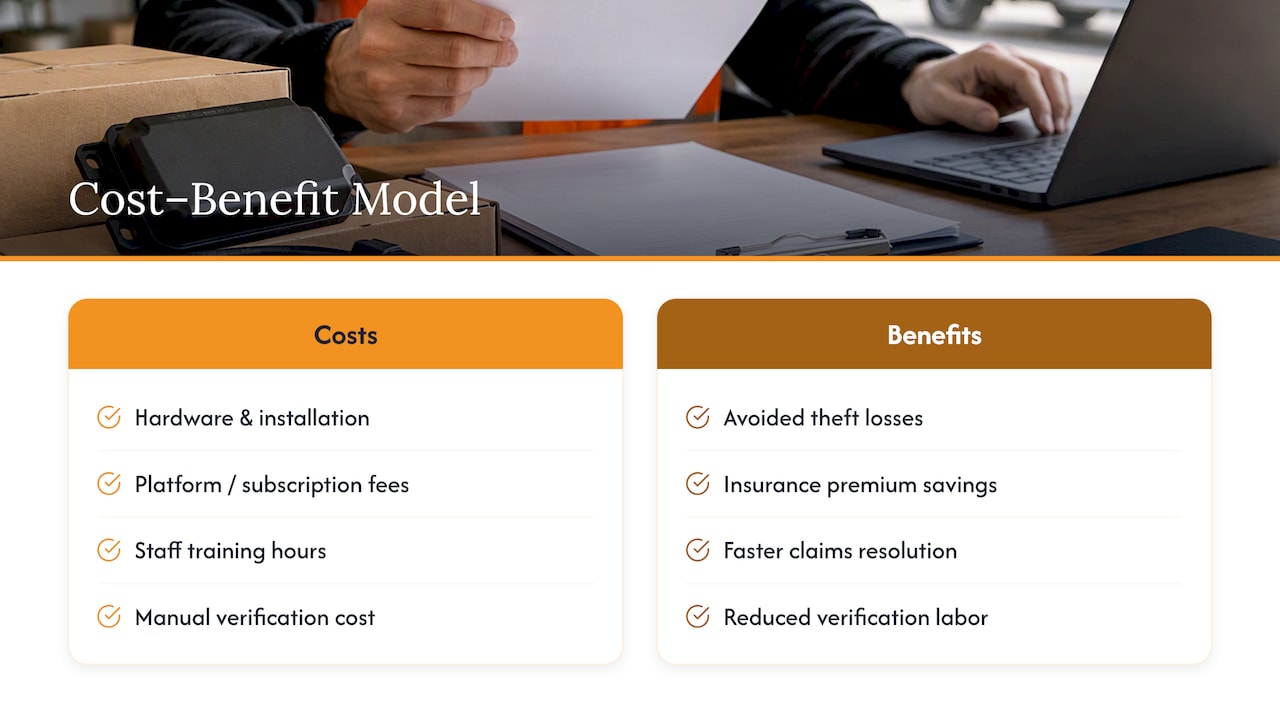
Building a cost-benefit picture means weighing four categories against each other: hardware and installation costs, subscription or platform fees, staff training time, and the ongoing cost of manual verification processes the system replaces. On the benefit side, count avoided theft losses, any premium or underwriting benefit your insurer will recognize for verified security controls (ask them), easier claims documentation thanks to audit trails, and fewer hours spent on manual pickup verification calls.
Fleets running high-value or frequently targeted lanes are likely to see the fastest payback, since each prevented incident avoids a large loss. Lower-risk lanes may still benefit from better audit readiness, even if the theft-prevention math takes longer to show up. Building a realistic ROI model means starting with your own loss history, not industry averages, since a fleet with concentrated losses on two lanes has a very different payback curve than one with dispersed, low-value pilferage.
The most overlooked cost-benefit factor is time. Manual identity checks, phone-tag verification calls and after-the-fact claims investigation all consume staff hours that enforced automation can reduce, a saving that rarely appears in a vendor’s pitch deck.
Author perspective and operational caveats
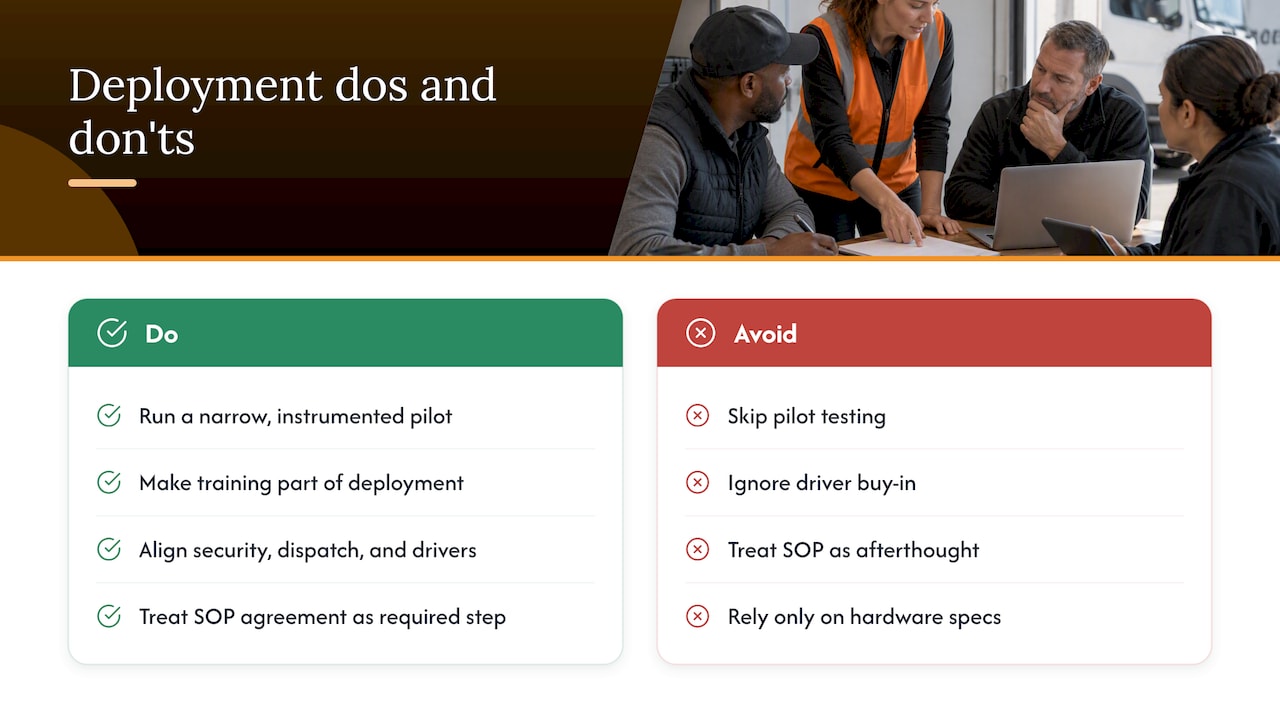
Deployments tend to go best with a narrow, well-instrumented pilot before any fleet-wide rollout. Skipping that step is a common way deployments stall, because SOP gaps and driver pushback surface faster in a small pilot than in a mass rollout.
Driver buy-in matters more than the hardware spec sheet. A lock that frustrates a legitimate driver at 2 a.m. gets bypassed or complained about until dispatch disables it. Treat training and cross-functional governance, security, dispatch and drivers agreeing on the SOP together, as part of the deployment, not an afterthought.
— Gwagsi
Level5Fleet Admiral: a direct option for enforced remote lock control
Admiral is Level5Fleet’s trailer security system. Admiral Enforce handles locking and immobilization on the asset itself, evaluating credentials presented by drivers, tractors or yard personnel against stored access policies. Admiral Resolve verifies who is making a pickup, access or change request before it is authorized.
- Door locks, an interior cargo lock and trailer immobilizers cover both access and movement.
- Admiral Resolve records each approval or denial as an audit trail and produces enforcement-ready records your team can reference in follow-up.
- Enforce can run standalone or integrate with Admiral Resolve for decision context.
If your fleet is ready to move enforcement onto the asset itself, request an Enforce Pilot to scope a deployment plan for your highest-risk lanes.
Sources
- IC3 Public Service Announcement (PSA) 2026-04-30
- C-TPAT alert: surge in cargo theft and security best practices (CBP, 2026)
- FBI — Cargo theft guidance
- EUIPO guide to electronic seals
- Overhaul — United States & Canada annual cargo theft report 2025
- ATRI — The Fight Against Cargo Theft (October 2025)
FAQ
What is remote lock control for trailers and containers?
Remote lock control combines asset-mounted door locks and trailer immobilizers with identity verification, so a release only happens after a driver’s identity is independently confirmed. This closes the gap between a digital approval and physical access to the cargo.
How does remote locking prevent fictitious pickups?
Fictitious pickups rely on a thief presenting valid-looking paperwork or a compromised load board credential to a driver or gate guard. When release requires independent, multi-channel identity confirmation rather than a single document check, it follows FBI/IC3 advice to independently verify shipment requests and pickups using secondary methods before releasing any load.
What is the difference between a trailer immobilizer and a trailer door lock?
A trailer door lock secures the cargo compartment itself, preventing access to the freight inside. A trailer immobilizer keeps the entire trailer from being moved unless movement is authorized, even if someone has already bypassed the door.
What standards apply to electronic seals and remote lock systems?
ISO 17712 covers mechanical freight-container seals, including the high-security class, while the ISO 18185 series addresses electronic seals for freight containers. These standards apply to seals rather than to door locks or immobilizers. CBP’s 2026 C-TPAT alert calls for ISO 17712-compliant high-security seals as part of a layered security approach.
How much does a remote lock control system cost to implement?
Cost depends on fleet size, the number of trailers requiring retrofitting, and which hardware modules a fleet selects. Level5Fleet does not publish set pricing for its Admiral product lines, so fleets should request a quote based on their specific fleet size and lanes.