
Platform Locks Stop Fake Pickups: Truck Parking Security for Fleets
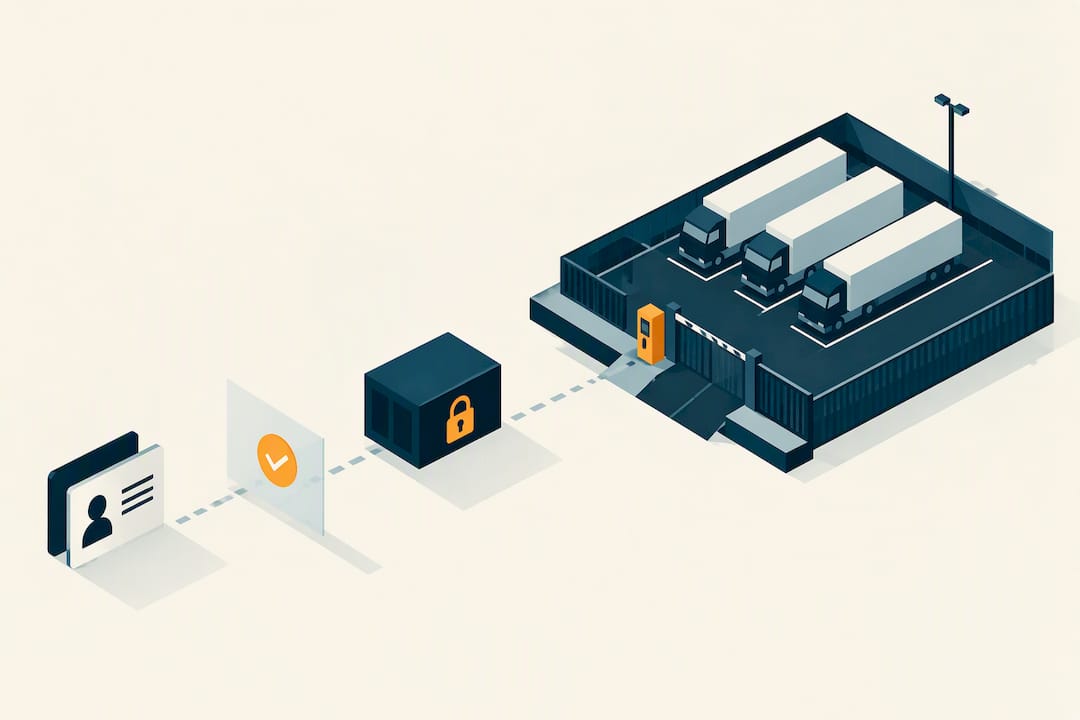
For parked trucks and trailers, the most effective security is prevention-first asset enforcement: verify who may move or open a trailer, and block movement until that authorization is confirmed. This approach ties identity checks directly to physical controls on the asset itself, rather than relying on GPS alerts that arrive after a theft is already underway. The rest of this guide covers the threats, the controls, how to run them daily, and how to measure whether they work.
TL;DR:
- Physical locks and verified identity checks on trailers prevent unauthorized movement, addressing gaps left by GPS tracking and documentation alone.
- Attack methods such as spoofed IDs, cloned carrier details, and forged paperwork are common, making layered asset enforcement essential.
- Real-time controls, including immobilization and lock audits, are more effective than post-incident alerts for stopping theft upfront.
- Consistent, documented verification processes and monitored communication channels significantly reduce fraud opportunities at pickup.
- Tracking KPIs like prevented unauthorized events and value-at-risk protected helps demonstrate controlled, effective theft prevention efforts.
Table of Contents
- Why criminals target parked trailers and how identity gaps enable theft
- Prevention-first controls: identity checks and physical locks on the asset
- Building a daily process that makes on-asset controls actually work
- Measuring whether your controls actually reduce losses
- Physical security at the parking facility still matters
- Choosing a parking location with security in mind
- Training drivers to spot and stop security breaches
- Responding to a theft attempt and working with law enforcement
- Where GPS tracking and geofencing fit into a modern security stack
- What years of covering freight security taught us about prevention
- How Admiral’s on-asset approach lines up with the controls in this guide
- Sources
- FAQ
Why criminals target parked trailers and how identity gaps enable theft
Parked trailers are stationary targets, which gives organized groups time to plan rather than improvise. Strategic theft, which exploits gaps in identity verification, has become a larger part of the picture. A Munich Re analysis found that strategic cargo theft and organised crime account for around 18% of all thefts in the United States, with criminals using fraudulent documentation and hacked FMCSA accounts to arrange fictitious pickups.
These schemes work because paperwork checks alone are easy to defeat. TT Club notes that much of the road cargo theft in the USA results from criminals posing as legitimate trucking companies using fraudulent websites, emails and documents. A 2024 report by FMC Commissioner Carl Bentzel describes industry advice for brokers to build a thoroughly vetted carrier network and to verify carrier paperwork such as operating authorities and insurance documents.
GPS-only defenses fall short for a related reason. Tracking tells you where a trailer went after it left, not whether the person taking it was authorized to. Munich Re’s 2025 report notes that criminals are already fighting back against GPS tracking with jammers and by hacking carrier accounts, which is one reason to bind identity authorization to a physical control on the trailer itself.
Common exploitation patterns include:
- Fictitious pickups using convincing but fake email domains or falsified documents.
- Cloned or stolen motor-carrier identifiers used to pass a basic paperwork check.
- Document forgery that mimics real bills of lading closely enough to fool a rushed handoff.
- Double-brokering, where a load is reassigned to an unvetted carrier without the shipper’s knowledge.
Around 18% of U.S. cargo theft in 2024 was strategic and organised rather than opportunistic, according to Munich Re, meaning identity verification failures drive a meaningful share of losses.
Prevention-first controls: identity checks and physical locks on the asset
Stopping theft before it happens means combining three layers: verifying identity, physically restricting movement, and controlling access to the cargo itself. Each layer covers a gap the others miss.
Asset-tied identity verification starts before the driver arrives. A pre-alert from the carrier can specify the driver’s name, the truck and trailer numbers, and an expected arrival window. TT Club suggests requiring carriers to provide tractor VINs, or at minimum the motor carrier number, tractor make and year, and trailer number, so cargo is released only to the expected driver. When the driver shows up, staff compare presented identification against that pre-alert record rather than trusting a badge or a company logo on a shirt. A two-factor check, such as matching a government-issued ID against a code or confirmation sent through a verified channel, adds a strong additional layer against impersonators. Critically, that approval should be recorded against the specific asset, so the release authorization and the trailer’s lock status are the same event, not two separate records that can drift apart.
Trailer immobilization adds a physical backstop. A brake lock that stays engaged until identity verification clears means a cloned or stolen truck cannot simply hitch up and drive off, even if it fools a visual inspection. This single control addresses the scenario that GPS tracking cannot: unauthorized movement happening in real time, not after the fact.
Internal cargo-door locks and virtual seals protect the contents even if someone gains access to the yard itself. A release event, meaning the moment a seal is broken or a door lock disengages, should generate a timestamped log entry tied to the person who triggered it.
Pro Tip: Treat identity verification and physical lock release as a single transaction. If they are logged separately, investigators lose the chain that proves who authorized what.
The strongest programs layer these controls rather than picking one:
- Identity verification confirms who is requesting access.
- Trailer immobilization prevents movement until that identity clears.
- Interior door locks and virtual seals protect cargo even after a trailer is released.
- GPS logs provide a movement history that supports investigations after the fact.
No single layer is absolute. A determined actor might defeat one check, but layering means a lock, a log, or a verification step catches what the others miss, which is why high-value freight increasingly relies on all four rather than any one alone.
Building a daily process that makes on-asset controls actually work
Controls only work if the people running them follow a consistent process. Here is a workflow that keeps verification and enforcement reliable without slowing down legitimate pickups:
- Collect pre-alert details (driver name, truck and trailer numbers, arrival window) from the carrier ahead of pickup.
- Store that pre-alert in a system both the yard staff and the carrier can reference, not in a personal text thread or email inbox.
- At arrival, compare the driver’s government-issued ID against the pre-alert record before touching the trailer’s locking mechanism.
- Release the immobilizer and any door locks only after that match is confirmed, and log the release with a timestamp and the verifier’s identity.
- Route any mismatch or unusual request to a named supervisor for manual review rather than allowing a front-line employee to override the lock alone.
Centralizing communications matters as much as the steps themselves. Keep every broker and carrier exchange in one monitored channel. TT Club‘s red-flag list from 2024 theft claims includes free-mail email accounts, no landline, no website, spot-hire contracts and double brokering, and it recommends a robust manual procedure to check inbound email addresses and question changes to agreed plans.
Vetting rules reduce how often a bad actor reaches the yard at all. TT Club’s April 2025 supply chain security bulletin suggests a rules-based approach, such as requiring that a carrier has been in business for at least one year and that its business information on the FMCSA website has not changed in the last six months. Rules like these can be built into a gate before a load is even offered.
Pro Tip: Give drivers a one-page script for what to expect at pickup: which ID to present, how the immobilizer release works, and who to call if the process stalls. Confusion at the gate is where fraud slips through.
Watch for red flags: requests to skip the pre-alert, contact information that changes between calls, or pickup timing that does not match the scheduled window. Any one of these is reason to consider a hold rather than a judgment call from whoever happens to be at the gate that day. TT Club also recommends hard stops when original carrier information has been changed by even one character.
Measuring whether your controls actually reduce losses
Decision-makers need numbers that tell them whether prevention is working, not just whether alerts are firing. Consider tracking a few KPIs such as:
- Attempted unauthorized access events prevented, tracked as a raw count per month.
- Value-at-risk prevented, meaning the dollar value of loads protected from confirmed unauthorized access attempts.
- Mean time to verify, the average minutes between a driver’s arrival and a confirmed identity match.
- False-release rate, how often the system releases a lock without a valid verification match.
Audit trails turn these numbers into something usable beyond a dashboard. A record showing who requested access, when identity was checked, and how the release was authorized gives investigators and insurers a chain of custody they can act on.
Losses hit $304 million in Q2 2026 despite a drop in reported theft counts, according to Verisk’s CargoNet analysis, which is one reason to track value-at-risk prevented alongside raw incident counts. A pilot that shows fewer high-value losses may be working even if the total number of attempted incidents looks unchanged.
Physical security at the parking facility still matters
On-asset controls do not replace basic physical security at the lot itself, they work alongside it. Lighting that covers the full perimeter, not just the entrance, reduces the cover that opportunistic thieves rely on after dark. Fencing with controlled, single-point entry limits how many ways a vehicle can enter or leave without passing a checkpoint.
Surveillance cameras covering trailer rows, gate lanes, and loading areas serve two purposes: they discourage casual theft attempts and they provide footage that corroborates or contradicts what an access log shows. When a camera timestamp lines up with an identity verification record, investigators get a far stronger case than either piece of evidence alone.
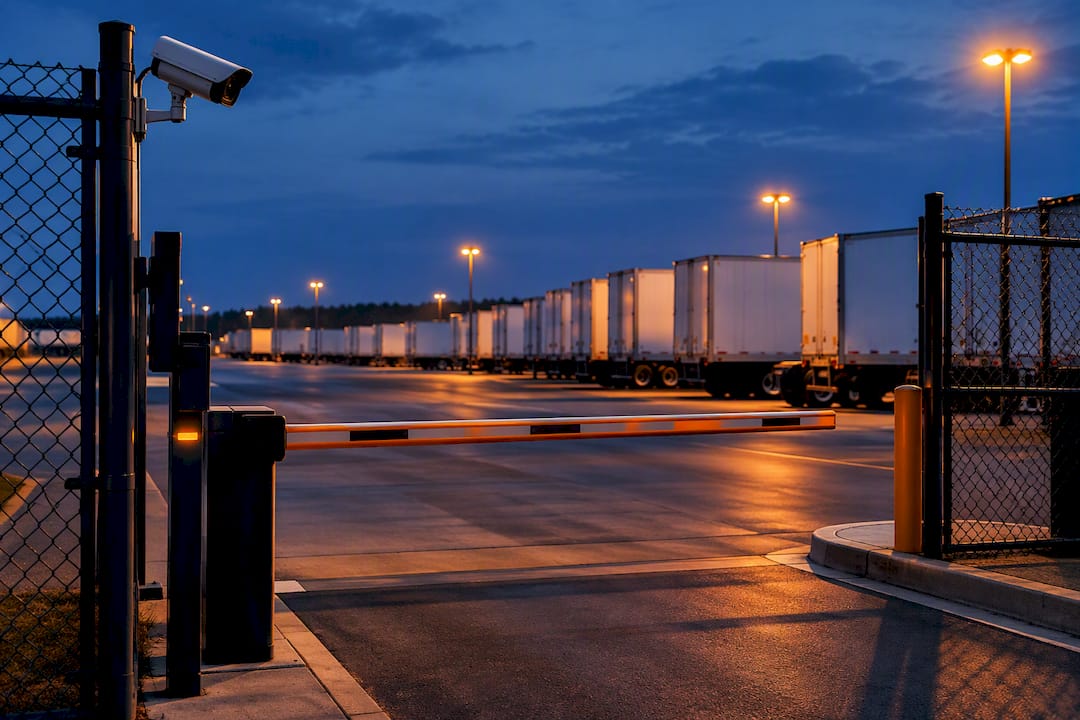
None of this replaces asset-level enforcement. A well-lit, fenced lot with cameras can still lose a trailer to a fictitious pickup if the person driving away presented convincing but fraudulent paperwork. Physical site security reduces opportunistic and pilferage-style theft, the kind involving someone cutting a fence or breaking a seal under cover of darkness. Strategic theft, the kind built on impersonation and forged documents, walks through the front gate looking legitimate, which is exactly why identity verification and physical locks on the trailer itself need to sit on top of good lot security rather than instead of it.
Choosing a parking location with security in mind
Where a trailer sits overnight affects how exposed it is, regardless of what controls are on the trailer itself. ATRI’s research on cargo theft, as reported by Transport Topics, found that motor carriers see more theft at their own terminals (24.3%) than at any other location type, while logistics service providers see about half of their thefts (50.5%) at customer pick-up locations, where strategic theft is their leading problem.
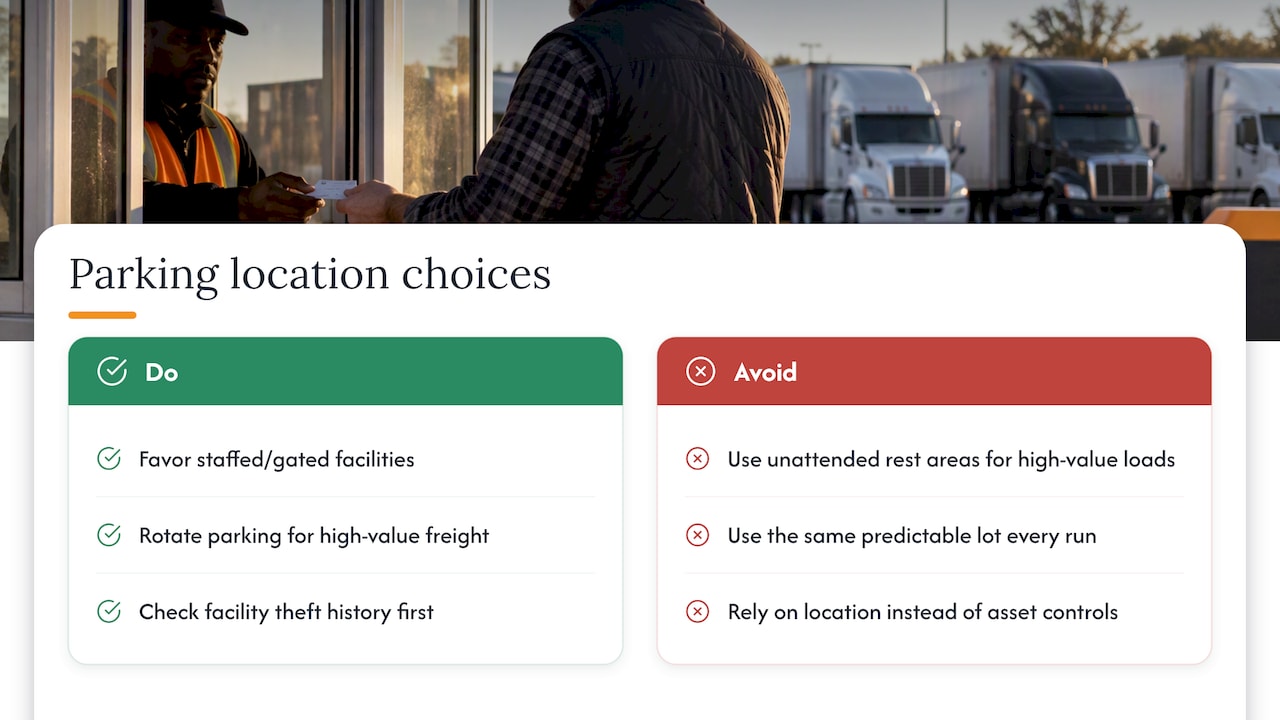
A few practical guidelines follow from that pattern. Favor staffed or gated facilities over unattended rest areas for high-value loads, since a monitored entry point at least creates friction for anyone trying to access a trailer without reason. Consider rotating parking locations for the highest-value freight rather than using the same predictable lot on every run, since predictable routines make planning easier for criminals. Check whether a facility has had recent theft activity before assigning it as a regular stop, since theft can concentrate in particular areas.
None of these choices substitute for asset-level controls. A well-chosen lot lowers the odds of a random break-in, but it does nothing to stop a criminal who shows up with a plausible cover story and legitimate-looking paperwork. Location selection and on-asset enforcement solve different problems, and a full security posture needs both.
Training drivers to spot and stop security breaches
Drivers are often the last line of defense at a handoff, which makes their training as important as any lock or camera. A driver who knows what a legitimate pickup request looks like is far harder to trick than one who has never been told what to check.
Basic protocols should cover a few consistent habits: confirming pickup or delivery details against the pre-alert before handing over any paperwork, verifying that the person requesting access matches the name and company on file, and refusing to release a trailer based on a verbal assurance alone. Drivers should also know that a legitimate dispatcher or broker should not ask them to bypass a verification step to save time, since urgency can be a pressure tactic in fraud attempts.
Training works best when it is specific rather than generic. A one-page reference card showing exactly what a valid ID check looks like, what the immobilizer release process involves, and who to call when something feels off gives drivers a concrete standard to follow instead of a vague instruction to “stay alert.” Refresher training after any regional theft pattern change, such as a new type of impersonation being reported in an area, keeps the guidance current rather than static.
Responding to a theft attempt and working with law enforcement
When a theft attempt is detected, whether through a failed verification, a triggered immobilizer alarm, or a driver noticing something wrong, speed matters. A clear internal escalation path, where the driver or yard staff know exactly who to call and what information to have ready, shortens the gap between detection and response.
That information should include the trailer and load details, the time and location of the incident, and any identifying details about the person or vehicle involved, such as a license plate or a description. Audit trail data from an identity verification event, including timestamps and the specific record that failed to match, gives law enforcement a starting point that a verbal account alone cannot provide.
Coordination with law enforcement works best when it is planned before an incident, not improvised during one. Knowing which local agency covers a given facility, having a standing contact for reporting theft in areas where a fleet regularly parks, and keeping documentation ready to hand over quickly all shorten the time between a theft and a police report being filed. Prompt reporting can help with recovery, and insurance claims depend on a clear, time-stamped account of what happened.
Where GPS tracking and geofencing fit into a modern security stack
GPS tracking and geofencing remain useful tools, they just are not sufficient on their own. A geofence alert that fires when a trailer leaves an expected area tells a fleet operator that something unusual happened, but by the time that alert arrives, the trailer may already be gone.
The technology has also become a target itself. Munich Re’s 2025 report notes that criminals are already fighting back against GPS tracking with jammers and by hacking carrier accounts. That does not make GPS useless, it means treating it as one input among several rather than a standalone defense.
Where GPS and geofencing add real value is in combination with on-asset enforcement. A movement log that shows exactly when a trailer left, cross-referenced against an identity verification timestamp, gives investigators a far clearer picture than either data point alone. Geofencing around a yard can also flag unexpected movement, adding a redundant layer rather than the only layer. The technology’s role has shifted from “the way we catch theft” to “the way we confirm what our access controls already prevented or flagged.”
What years of covering freight security taught us about prevention
The industry conversation used to center on recovery: find the truck, find the load, hope it is still intact. That framing has shifted, and for good reason. Recovery happens after the loss, while prevention stops it from happening at all. The strategic theft trends showing up in recent industry data make that shift more urgent, not less.
When evaluating a platform meant to prevent theft, ask a direct question: does it enforce anything, or does it only alert? An alert after unauthorized movement has already started is a notification, not a control. A platform that ties verified identity to a physical lock on the trailer is doing something categorically different, and that distinction is worth pressing on in any vendor conversation.
— Gwagsi
How Admiral’s on-asset approach lines up with the controls in this guide
Every control covered here, identity verification tied to the handoff, immobilization until authorization clears, interior door locks and virtual seals, and an audit trail that ties it all together, describes what a cargo theft prevention platform like Admiral is designed to do. Such platforms combine identity verification with enforced physical actions on trailers and containers, so a release only happens once the person requesting it is confirmed against the asset’s own authorization record.
For a fleet operator, carrier, or broker evaluating options, a useful checklist for a vendor meeting looks like this:
- Does the platform lock or unlock the trailer itself, or only send an alert after movement starts?
- Is the identity check recorded against the specific asset and pickup event, or stored separately from the release action?
- Does the audit trail include enough detail (who, when, how) to support an insurance claim or law enforcement report?
- Can the system be piloted on a small set of high-value lanes before a full rollout?
Admiral’s product lines cover this ground directly. Admiral Enforce embeds authorization rules on trailers and containers so they stay immobilized and doors stay locked until movement is authorized, and Admiral Execute carries approved changes such as appointment updates, early arrivals or carrier swaps into execution across companies. The trailer immobilizer hardware controls the trailer’s spring brakes so the trailer stays immobile until an authorized driver is verified. Teams can start with Admiral Resolve, which is free to use within fair usage limits and verifies pickup, access and change requests, then request an Enforce Pilot to add physical enforcement on trailers or containers, or review the full Tractor-Trailer Security Products line to find the right fit for their yards.
Sources
- Cargo theft tactics and trends report 2025 | Munich Re Specialty
- TT Club loss prevention guidance on cargo theft
- Cargo theft losses more than double to $304 million in Q2 | Verisk
- 2024 Bentzel cargo theft report (FMC)
- TT Club — Supply Chain Security Bulletin (April 2025)
- Transport Topics — ATRI cargo theft research
- ATRI — The Fight Against Cargo Theft (October 2025)
FAQ
What is the most effective way to secure parked trucks and trailers?
The most effective approach combines identity verification with physical enforcement on the asset itself, meaning a trailer stays locked until the person requesting access is confirmed against a pre-alert record. GPS tracking alone only reports movement after it happens, while on-asset controls prevent unauthorized movement before it starts.
How do fictitious pickups happen and how can they be prevented?
Fictitious pickups happen when a criminal impersonates a legitimate carrier using cloned identifiers or forged paperwork to convince staff to release a load. Preventing them requires comparing presented identification against a pre-alert record collected before the driver arrives, which addresses the impersonation and fraudulent-pickup tactics Munich Re’s 2025 analysis documents as part of the rise in strategic theft.
What KPIs should fleets track to measure theft prevention?
Fleets should track attempted unauthorized access events prevented, value-at-risk prevented, mean time to verify, and the false-release rate. Value-at-risk prevented is worth tracking alongside incident counts, since Verisk’s Q2 2026 data shows losses can climb even as incident counts fall.
Does trailer immobilization work if a truck’s identity is cloned?
Yes, because immobilization enforces the brake lock independently of whatever identity a truck or driver presents. Even if a criminal successfully impersonates a legitimate carrier on paper, the trailer will not release until the identity verification step clears against the recorded authorization.
What does Admiral by Level5Fleet actually enforce on a trailer?
Admiral combines identity verification with enforced physical actions on trailers and containers, including immobilization and interior cargo-door locks, so movement only happens once a verified match is confirmed. Details on specific enforcement features are available through Admiral Enforce and the trailer immobilizer product pages.