Broker Impersonation: The $273K Seafood Load a Fake Broker Redirected

Broker impersonation is when someone poses as the legitimate freight broker on a shipment, usually by phone, text or email, to give the real driver or carrier a fake instruction such as a new delivery address or a mid-route transfer. The truck, driver, carrier and load are all real. Only the instruction is fake. That is why carrier vetting and pickup checks don’t catch it, and why the control that works is verifying every change on a channel the impersonator doesn’t control.
TL;DR
- Broker impersonation attacks a load after it has been tendered: a legitimate driver gets an instruction that appears to come from the broker, and it doesn’t.
- On October 3, 2026, police say a driver hauling about 29,000 pounds of frozen seafood worth more than $273,000 was told, through calls and texts from someone falsely claiming to be with the freight broker, to divert part of the load to North Arlington, New Jersey, for a transfer.
- Two people began moving pallets into a 26-foot box truck. Partway through, the transaction was questioned, police responded, and the entire load was recovered at the scene.
- The fix that would have prevented it is a process, not a gadget: confirm any mid-route change with the broker on a number you already have. Tracking and alerts could only have flagged the unplanned stop earlier.
- An 18-year-old is charged and a juvenile was taken into custody. Nobody has been convicted, the charged man is presumed innocent, and police have not identified who made the calls.
Table of contents
- What is broker impersonation?
- The case: a redirect that didn’t finish in North Arlington
- Case timeline
- The numbers
- Verification vs tracking vs on-asset enforcement: what each would have done
- Warning signs of broker impersonation
- How to prevent broker impersonation: a 7-step checklist
- An analyst’s perspective: the instruction is the attack surface
- How Admiral maps to this case
- FAQ
- Sources
- Recommended
What is broker impersonation?
Broker impersonation, also called freight broker impersonation or a fake broker scam, is a form of cargo fraud in which someone pretends to represent the real broker on a load in order to misdirect it. Sometimes the impersonator books loads under a broker’s name. In the version this case shows, which Verisk CargoNet calls shipment misdirection, the load is already assigned to a legitimate carrier and moving. The impersonator contacts the driver or dispatcher with a change: a new address, a different consignee, or a “transfer” to another truck.
It is worth separating from its neighbors, because each one needs different controls:
- Double brokering re-tenders a load to a carrier without the shipper’s or original broker’s authority. The carrier is often real, but the chain of authority behind it is not. We covered a case built on a hacked inbox in our double brokering case file.
- Carrier impersonation and fictitious pickups put the wrong truck at the dock under a real carrier’s identity. Vetting and pickup checks are aimed at that, as in the carrier impersonation ring we covered earlier.
- Insider diversion is the assigned driver taking the load off-route deliberately, as in our freight diversion case.
Broker impersonation is different from all three. The carrier passed vetting, the right driver picked up the right load, and the driver isn’t doing anything wrong. The weak point is the moment an instruction changes and nobody checks where it came from.
CargoNet flagged this gap in its Q3 2025 analysis, noting that “most anti-fraud tools focus on the shipment tender phase,” and that some groups research shipments already assigned to legitimate carriers and then “impersonate company representatives to misdirect drivers” [7]. The FBI’s April 2026 public service announcement on cyber-enabled cargo theft describes the same end state: loads “redirected from their intended destination and stolen for resale” [10].
The case: a redirect that didn’t finish in North Arlington
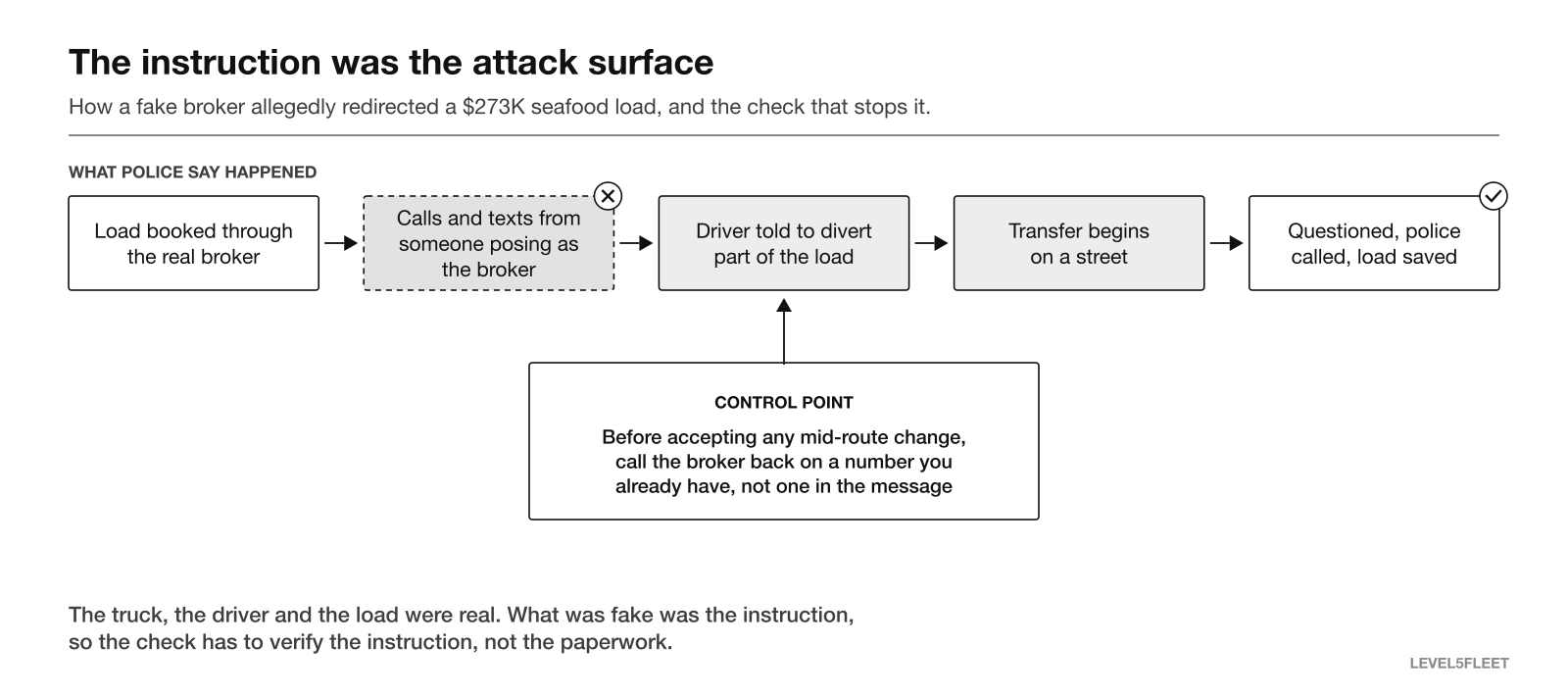
The truck was real. The driver was real. The 29,000 pounds of frozen seafood, mostly shrimp plus salmon, conch meat and branzino, were real. In the police account, the truck, the driver and the load were all real. What was fake was the instruction.

Here is what police say happened. Before arriving in North Arlington on October 3, 2026, the driver received “a series of telephone calls and text messages from an individual falsely representing himself as being associated with the freight broker responsible for the shipment” [1]. The instruction was to divert a portion of the load to North Arlington, a borough in Bergen County, New Jersey, where it would supposedly be transferred to another truck.
The driver went to the designated location on Porete Avenue. Two people arrived in a 26-foot box truck and began moving pallets of frozen seafood out of the refrigerated trailer. Police identified them as Jonathan Pollaguari, 18, of the Bronx, and a juvenile [1].
Then the transaction stopped looking right. In the police department’s words: “As the transfer continued, the legitimacy of the transaction was questioned” [1]. Officers responded to a report of suspicious activity, found the transfer underway, secured the scene and stopped it “before the cargo could be removed from the area” [1]. Police haven’t said who first raised the doubt or who made the call. The entire shipment was recovered, and both people were taken into custody without incident [1][3].
A subsequent investigation found that the person directing the transfer “was not affiliated with the legitimate freight broker and had allegedly impersonated a representative of the company in an effort to fraudulently obtain the shipment” [1]. That person has not been publicly identified, and no source reports them as charged [3].
Pollaguari is charged with second-degree theft by deception, second-degree false representation, second-degree conspiracy, and first-degree employing a juvenile in the commission of a crime [1][2][3]. He has not been convicted and is presumed innocent. Police have not said he was the person making the calls; their release separates the two people at the truck from “the individual directing the transfer” [1].
NAPD’s public information officer, Capt. David Hudak, credited his officers with “stopping this theft before more than $273,000 worth of merchandise could be stolen” [1].
It’s also worth saying plainly: nobody has accused the driver of anything. FreightWaves summed it up in its subhead, saying a legitimate driver followed fraudulent instructions [3]. That isn’t a lapse. Following the broker’s instructions is the job. The trouble is that the job runs on instructions nobody authenticates.
Much of what matters is still unknown. FreightWaves reports that investigators have not disclosed how the suspects obtained the shipment information, who coordinated the fraudulent communications, or what first raised suspicion. The broker, carrier and shipper have not been named, and the investigation remains active [3].
Case timeline
| Date | Event | Source |
|---|---|---|
| Before arrival (date not stated) | The driver receives a series of calls and texts from someone falsely claiming to be associated with the shipment’s freight broker, instructing a partial diversion to North Arlington for a transfer | NAPD release via The Observer; FreightWaves [1][3] |
| Oct 3, 2026 | The driver arrives on Porete Avenue; two people arrive in a 26-foot box truck and begin transferring pallets | NAPD release [1] |
| Oct 3, 2026 | The transaction’s legitimacy is questioned mid-transfer; officers respond to a report of suspicious activity and stop the transfer | NAPD release [1] |
| Oct 3, 2026 | The full load, valued at more than $273,000, is recovered; two people are taken into custody without incident | NAPD release; SeafoodSource [1][2] |
| Oct 3–6, 2026 | Jonathan Pollaguari, 18, is charged with four criminal counts | NAPD release; Daily Voice [1][4] |
| Oct 6–9, 2026 | The Observer and Daily Voice publish the NAPD account (Oct 6); CDLLife (Oct 7), SeafoodSource (Oct 8) and FreightWaves (Oct 9) follow | [1][2][3][4][5] |
| As of Nov 4, 2026 | No conviction or court outcome has been reported and the caller is unidentified; the investigation was last reported as active | FreightWaves [3]; Level5Fleet search, Nov 4, 2026 |
The numbers
| Figure | What it measures |
|---|---|
| $273,000+ | Estimated value of the shipment |
| ~29,000 lb | Weight of the frozen seafood (roughly 14.5 tons) |
| 26 ft | Length of the box truck used for the transfer |
| 2 | People taken into custody |
| 1 | Person charged (an adult); a juvenile was also taken into custody |
| 0 | Pallets lost: the whole load was recovered at the scene |
One figure stands out against the national data. Verisk CargoNet put the average value per cargo theft in the U.S. and Canada at $273,990 in 2025, up 36% on 2024, as estimated losses rose about 60% to nearly $725 million and confirmed theft incidents rose 18% [6]. The FBI’s Internet Crime Complaint Center cited the same figures in its April 2026 PSA [10]. This load was worth almost exactly the 2025 average. It just never left the street.
The 2026 trend points the same way. CargoNet recorded 677 supply chain theft incidents in Q2 2026, down 26% year over year, while estimated losses more than doubled to $304.6 million from $135.7 million [9]. It said physical thefts and some non-delivery schemes fell, while “compromise-based schemes such as business email fraud and shipment misdirection continued at steady levels.” Seafood theft rose by 11 events year over year even as food and beverage theft fell overall [9].
The geography fits as well. CargoNet counted 59 cargo theft incidents in New Jersey in Q1 2026, up from 27 a year earlier (+119%), and called New Jersey, along with California, a primary operating environment for organized crime networks, pointing to sustained activity by groups with a nexus in the New York City metropolitan area [8]. CargoNet doesn’t connect any of this to the North Arlington case, and neither do we. The national numbers describe the climate, not this crime.
Verification vs tracking vs on-asset enforcement: what each would have done
This case separates verifying an instruction from seeing where the load went. Here is each control applied to what police say happened.
| Control | What it does against a fake broker instruction | Effect in this case |
|---|---|---|
| Carrier vetting / broker vetting at tender | Confirms the companies on the load are legitimate. They were. | None. The carrier, driver and real broker all passed. |
| Pickup verification at the shipper | Confirms the right truck collects the right load. It did. | None. The attack came after pickup. |
| Out-of-band confirmation of the change | The driver or carrier calls the broker back on a known number before accepting a mid-route change. | Would have prevented it. The real broker would have said there was no transfer. |
| Broker- or shipper-side tracking with an unplanned-stop alert | Flags a reefer stopping at an unscheduled street address, if someone watches and acts. | Would have shortened it, possibly alerting the real broker before pallets moved. No tracking or alert is reported in this case. |
| Tracking alone, without verification | Shows where the truck is. | Can’t stop a legitimate driver from following a convincing instruction. |
The honest limit: this load was saved anyway, by someone questioning the transfer and police arriving. So “shortened” here means earlier and less dependent on luck. It doesn’t mean tracking would have saved a load that was, in fact, saved.
Warning signs of broker impersonation
The signs are mostly about the instruction, not the people. That’s deliberate: the driver did nothing wrong here, and the point of a warning list is to make the check routine, not to cast suspicion on whoever follows instructions.
- A mid-route change of destination or consignee, especially a “partial drop” or a transfer to another truck that wasn’t on the rate confirmation.
- A change that arrives by call or text from a number you haven’t used for this broker before. The FBI notes threat actors often use VoIP or short-lived phone numbers [10].
- A transfer location that isn’t a dock, warehouse or customer facility. Legitimate cross-docks happen at facilities, not curbside.
- Urgency, or pressure to skip the usual paperwork or dispatcher. A real change survives a five-minute callback.
- Familiar names used as proof. The FBI warns that “familiar names or email addresses alone do not confirm authenticity” [10]. CargoNet reports that impersonators increasingly use correct shipment details to establish credibility [7].
- A receiving party that can’t produce documents matching the load, or a vehicle that doesn’t fit the freight, such as a straight truck for a reefer load.
How to prevent broker impersonation: a 7-step checklist
- Make “no verbal-only changes” a written rule. Why: if a destination change by phone or text is never accepted on its own, the impersonator’s main tool stops working.
- Call back on a known number before acting on any change. Use the number on the rate confirmation or in your TMS, not the one in the message. Why: this is the one control that would have prevented this case outright, and the FBI recommends independently verifying requests through secondary methods [10].
- Route every change through dispatch, not straight to the driver. Why: drivers on the road shouldn’t be the last line of identity checking. Dispatch has the contacts and the time.
- Agree a change protocol with each broker at booking. Name who can authorize changes, and how. Why: when both sides know the only legitimate path, anything outside it stands out.
- Treat partial drops and truck-to-truck transfers as high-risk by default. Why: splitting a load at an unplanned location is exactly the pattern here, and it’s rarely how legitimate freight moves.
- Watch for unplanned stops on high-value loads and name who responds. Why: if verification fails, an unscheduled stop with doors opening is the next signal. An alert nobody owns is just a log entry.
- Document everything and report fast. Keep the numbers, messages and times, and call police first if a load is at risk. Why: the FBI asks victims to report to local police and IC3, and good records help investigators trace the person behind the calls [10].
Pro Tip: Run a tabletop test. Have someone on your team text a driver or dispatcher a fake “change of plan” from an unfamiliar number, with their manager’s agreement, and see whether the callback rule holds. If it doesn’t, you’ve found the gap before someone else does.
An analyst’s perspective: the instruction is the attack surface
Reading the North Arlington release next to CargoNet’s recent quarterly reports, what strikes me is how little this scheme needed. It didn’t need a fake carrier, a forged bill of lading or a cut lock. Every credential check in the chain did its job and passed. The bar it had to clear was a phone call and a text from someone claiming to be the broker. That isn’t a comment on anyone in this case. It’s a comment on how freight confirms instructions, which is mostly that it doesn’t.
The industry has spent years hardening the tender: vetting carriers, checking authorities, verifying pickups. CargoNet’s own data suggests that work is paying off, with fewer non-delivery schemes in Q2 2026. But CargoNet also says misdirection held steady, and that groups are deliberately working the phase after tender, when the load is already with a legitimate carrier [7][9]. If that’s right, the next gap isn’t who gets the load. It’s who gets to change where the load goes.
I’d also push back on the reflex to make this a driver-training problem. The driver did what drivers are supposed to do: follow the broker. Asking each driver to be a fraud investigator on the shoulder of a highway puts the control in the worst possible place. Verification belongs in the process, before the instruction reaches the cab, with a known number, a named approver and a record of who said yes.
Visibility still matters. The real broker should be able to see a reefer stop on an unplanned street and ask why. But this case was saved because someone questioned the transfer and police were called. That worked. It also isn’t a system.
— Gwagsi Glenn, Growth Analyst, Level5Fleet
How Admiral maps to this case
Could plausibly have prevented: verifying the change before anyone acts on it. Admiral Resolve is built for the moment a pickup, access or change request arrives and someone has to decide whether to act on it. It shows whether the request came from the real person, whether they act for the right company, and whether they’re allowed to make that change for that load. Resolve’s own page lists carriers confirming requests “before acting on access, routing, or handoff changes” [11]. This is the out-of-band check from the checklist, made routine and recorded. The honest limits: requests reach Resolve by email (verify@) or through the Admiral Console, so a call or text straight to a driver is checked only if the carrier’s rule routes it there first, and it only works if no change is accepted until it’s verified. The callback on a known number is what would have stopped this redirect; Resolve makes that check routine and recorded. A text that goes straight to a driver and is acted on never reaches Resolve. Resolve is free to use within fair usage limits.
Location-conditioned door access (not assessed in our case analysis). With Admiral Enforce, the trailer door lock can stay locked in transit and unlock automatically at the authorized consignee, and the Admiral Hub can authorize access based on location, time, user and operating plan [12][13]. On a load set up this way, an unplanned street address wouldn’t open the doors unless the change had been approved. When Resolve is connected, approved decisions propagate to the asset [11]. That depends on every legitimate stop being in the plan, on who can approve exceptions, and on whether the driver holds an unrestricted unlock.
Could shorten detection, if someone is watching: the event record. The Hub uses GPS and motion sensing to know where the asset is and what it’s doing, and reports physical events and asset state back to Admiral when it has a connection [13]. The lock records lock state, door position, and who performed each seal action, with location and time [12]. A door opening at an address that isn’t in the plan is on record as it happens, not something reconstructed later. It isn’t an alert: a person still has to look at it and act. Admiral’s pages describe GPS location and movement data, not route-deviation alerts, so an alert on an unplanned stop depends on how your tracking is set up and who is assigned to respond.
What Admiral was not: nothing from Level5Fleet was involved in this case, and no tracking or alert is reported to have played a part. The load was saved after someone questioned the transfer and North Arlington police responded.
If your answer to “who can change where my load goes?” is “anyone with a phone,” start with Admiral Resolve at no cost, or request an Enforce Pilot to make approved changes the only ones a trailer will honor. See the Admiral overview for how the pieces fit.
FAQ
What is broker impersonation in trucking?
Broker impersonation is when someone pretends to be the legitimate freight broker on a load to misdirect it, usually by calling, texting or emailing the driver or carrier with a fake change such as a new address or a transfer. The carrier and driver are real; only the instruction is fake.
How is broker impersonation different from double brokering?
Double brokering re-tenders a load to a carrier without proper authority, so the chain of authority is fake from the start. Broker impersonation targets a load already assigned to a legitimate carrier and attacks it mid-route with a false instruction. Vetting helps against the first. Only verifying the change stops the second. For a related pattern built on fake identities, see our guide to chameleon carriers.
How do you verify a delivery change from a freight broker?
Call the broker back on a number you already have, from the rate confirmation or your own records, never the number in the message. Confirm the change with a named contact who is authorized to make it, and record who approved it and when. The FBI recommends multi-channel verification for exactly this reason [10].
What happened in the North Arlington seafood case?
On October 3, 2026, police say a driver was told, by someone falsely claiming to be with the freight broker, to divert part of a 29,000-pound frozen seafood load to North Arlington, New Jersey. A transfer into a box truck was stopped mid-way and the whole load, worth more than $273,000, was recovered [1]. An 18-year-old is charged and presumed innocent, a juvenile was taken into custody, and the caller hasn’t been identified.
Is the driver responsible in a broker impersonation scam?
In this case, no. Nobody has accused the driver of anything, and FreightWaves describes them as a legitimate driver who followed fraudulent instructions [3]. Drivers are expected to follow broker instructions, which is why verification should happen in dispatch before an instruction reaches the cab.
Sources
- The Observer (Kevin A. Canessa Jr.), reproducing the North Arlington Police Department release, “NAPD arrest ‘fishy’ suspect who attempted quarter-million-dollar plus theft,” October 6, 2026. https://www.theobserver.com/2026/10/06/napd-arrest-fishy-suspect-who-attempted-quarter-million-dollar-plus-theft/
- SeafoodSource (Nathan Strout), “New Jersey police stop teen attempting to steal USD 273,000 worth of frozen seafood,” October 8, 2026. https://www.seafoodsource.com/news/new-jersey-police-stop-teen-attempting-to-steal-usd-273-000-worth-of-frozen-seafood
- FreightWaves (Phil Brink), “Fake freight broker redirects $273K seafood shipment in New Jersey cargo theft attempt,” October 9, 2026. https://www.freightwaves.com/news/fake-freight-broker-redirects-273k-seafood-shipment-in-new-jersey-cargo-theft-attempt
- Daily Voice, “29,000-Pound Frozen Seafood Heist Intercepted Mid-Transfer In North Arlington: Police,” October 2026. https://dailyvoice.com/article/29000-pound-frozen-seafood-heist-intercepted-mid-transfer-in-bergen-county-police/
- CDLLife, “Trucker received calls and texts from fake freight broker in attempt to steal $273K worth of seafood,” October 7, 2026. https://cdllife.com/2026/trucker-received-calls-and-texts-from-fake-freight-broker-in-attempt-to-steal-273k-worth-of-seafood/
- Verisk CargoNet, “Cargo Theft Losses Surge to Estimated $725 Million in 2025,” January 22, 2026. https://www.verisk.com/company/newsroom/cargo-theft-losses-surge-to-estimated-$725-million-in-2025-verisk-cargonet-analysis-reveals/
- Verisk CargoNet, “Cargo Theft Holds Steady in Q3, Organized Crime Drives Surge in High-Value Cargo Theft Across U.S. and Canada,” October 31, 2025. https://www.verisk.com/company/newsroom/cargo-theft-holds-steady-in-q3organized-crime-drives-surge-in-high-value-cargo-theft-across-u.s.-and-canada/
- Verisk CargoNet, “Incident Volume Falls as Organized Crime Reshapes Cargo Theft Landscape Through Impersonation and Targeted Commodity Selection,” April 24, 2026. https://www.verisk.com/company/newsroom/incident-volume-falls-as-organized-crime-reshapes-cargo-theft-landscape-through-impersonation-and-targeted-commodity-selection/
- Verisk CargoNet, “Cargo Theft Losses More Than Double to $304 Million in Q2 Despite a Drop in Thefts,” August 6, 2026. https://www.verisk.com/company/newsroom/cargo-theft-losses-more-than-double-to-$304-million-in-q2-despite-a-drop-in-thefts-driven-by-high-value-metals-and-technology-heists/
- FBI Internet Crime Complaint Center, “Cyber-Enabled Strategic Cargo Theft Surging,” Public Service Announcement I-043026-PSA, April 30, 2026. https://www.ic3.gov/PSA/2026/PSA260430
- Level5Fleet, Admiral Resolve. https://level5fleet.com/products/resolve
- Level5Fleet, Trailer Door Lock. https://level5fleet.com/explore-products/trailer-door-lock
- Level5Fleet, Admiral Hub. https://level5fleet.com/explore-products/admiral-hub