
MC Number Fraud: The $22K Trucking Company Behind a $2M Theft Verdict

MC number fraud is the use of a real motor carrier’s operating authority, its USDOT and MC numbers, history and reputation, by someone who intends to steal the freight it is hired to haul. The authority is genuine, so every check that asks “is this a real, authorized carrier?” passes. The control that still works is not a better registration lookup. It is knowing, during the trip, whether the load is actually heading where it is supposed to go.
TL;DR
- MC number fraud doesn’t need a fake company. In the case below, prosecutors showed that a group bought established trucking companies and used their real credentials to win real loads.
- According to trial evidence, one Texas carrier was bought for about $22,000 in March 2024. Later that month, a load of televisions was picked up in Fontana, California, under that carrier’s name. It never reached Florida.
- The thefts ran from March 2024 to June 2025 across at least 11 Southern California cities and Grand Prairie, Texas, with an estimated loss of at least $2 million.
- Authority and registration checks could not have caught it, because the carriers were real. Load tracking with a delivery geofence would most likely have shortened detection, not prevented the booking.
- Status: on Sept 29, 2026, a federal jury in Los Angeles found Arshpreet Singh and Vikramjeet Singh guilty of conspiracy to commit theft from interstate shipments; Arshpreet Singh was also found guilty of wire-fraud conspiracy, and Vikramjeet Singh was acquitted on that count. Sentencing is set for Jan 20, 2027. No cargo recovery has been reported.
Table of contents
- What is MC number fraud?
- The case: two bought carriers and a load that never reached Florida
- Case timeline
- The numbers
- Authority checks vs in-transit visibility: what each verifies
- Warning signs of MC number fraud
- How to prevent MC number fraud: a 7-step checklist
- A perspective: real paperwork, wrong question
- How Admiral maps to this case
- FAQ
- Sources
- Recommended
What is MC number fraud?
MC number fraud covers any scheme in which a carrier’s operating authority is used by someone other than its legitimate operator, or for a purpose its registration was never meant to cover. Freight-fraud coverage uses the phrase for several patterns: fake MC numbers, stolen logins to a real carrier’s account, and the one this article is about, buying or “renting” an established authority to borrow its history.
It is often confused with a chameleon carrier, which sheds a bad record by reopening under a new identity. Purchased-authority fraud does the opposite: it acquires a good record. Nobody forges a carrier profile. The company on the paperwork is the company that shows up.
Regulators have noticed. On March 13, 2026, the Federal Motor Carrier Safety Administration (FMCSA) issued a bulletin headed “DO NOT Sell, Purchase, or Lease a USDOT Number or Operating Authority (MC Number) online or elsewhere from an unknown person or outside of a legitimate corporate transaction.” The agency wrote that a USDOT number “belongs to the same legal person forever,” and said it will move to inactivate numbers and revoke related registrations when it finds them being traded outside a legitimate transaction [6][7][8].
That carve-out matters. Companies are bought and sold legitimately, and authority can move with them. The fraud lives in the intent, which no registry records.
The case: two bought carriers and a load that never reached Florida
According to evidence presented at a seven-day federal trial in Los Angeles, the scheme ran from March 2024 to June 2025. Prosecutors with the U.S. Attorney’s Office for the Central District of California said the conspirators “purchased or fraudulently used real trucking companies to bid on authentic shipping contracts” [1].

The rest, in the office’s words: “After winning the bids, the defendants and others took possession of the cargo but stole it rather than deliver it to the correct destination” [1].
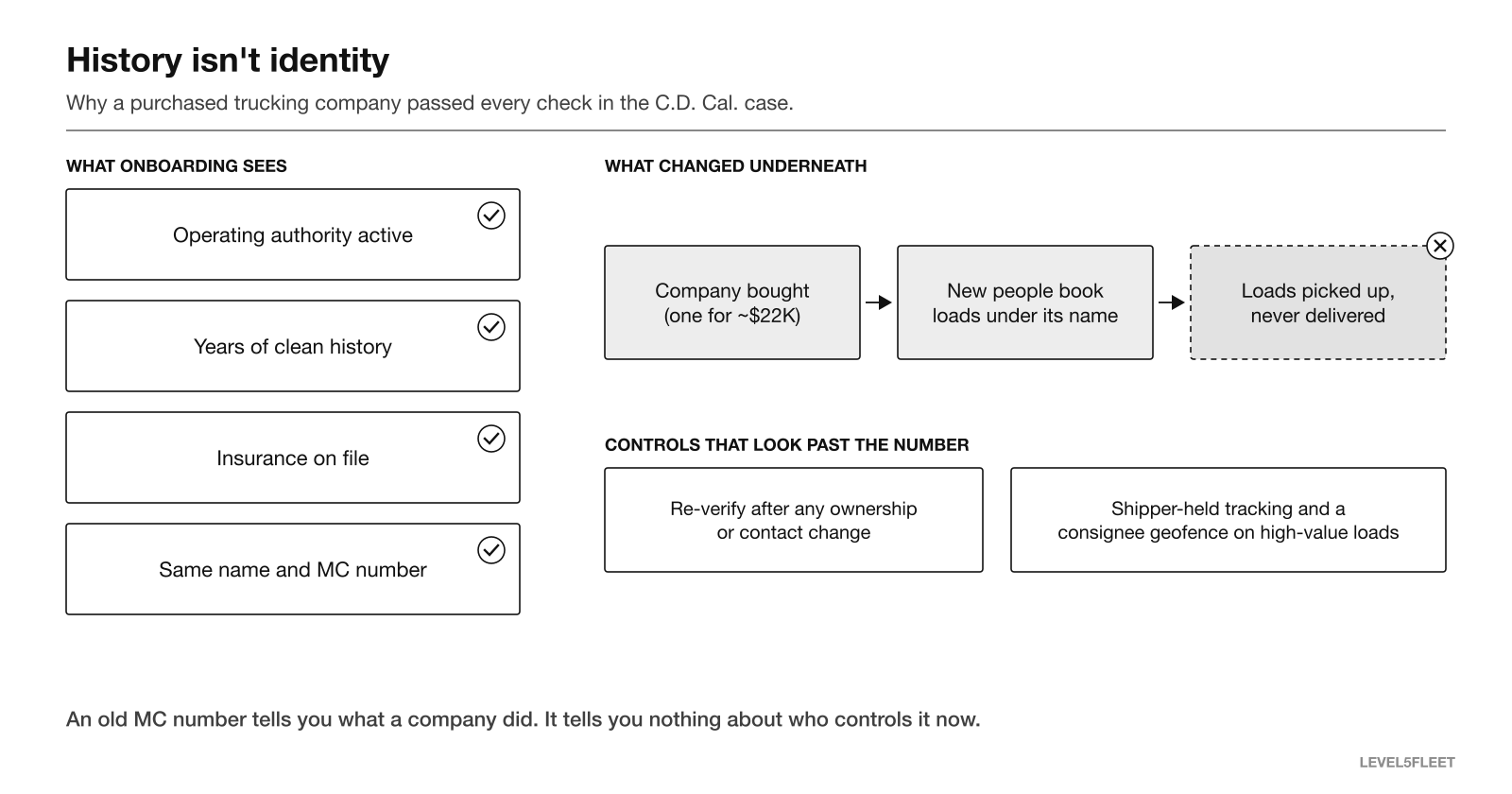
The clearest example came out at trial. In March 2024, the evidence showed, Arshpreet Singh met the owner of an established Texas-based carrier and bought the company for about $22,000. Later that month, a co-conspirator picked up a load of televisions in Fontana, California, on behalf of that carrier. The televisions were supposed to go to Florida. They never arrived [1][2].
In May 2024, co-conspirators bought a second carrier and used it to take laptops, televisions, solar panels and other goods. Loads were booked through major freight brokers, picked up from warehouses and not delivered to the destinations on the transport agreements [1][2]. (We are not naming either purchased carrier: the person who sold the first one isn’t accused of anything, and naming small carriers implicates drivers and sellers who did nothing wrong.)
The stolen freight was mostly televisions, laptops and appliances, plus vacuums, LED lights, shoes and tires. The thefts occurred in Fontana, Vernon, Santa Fe Springs, Perris, City of Industry, Long Beach, Compton, Commerce, Pico Rivera, Chino and Moreno Valley, as well as Grand Prairie, Texas. Prosecutors estimate the loss at no less than $2 million [1].
Transport Topics reports that the case emerged in October 2025, when the San Bernardino County Sheriff’s Department arrested 12 people, and that a federal grand jury indicted five, including both trial defendants [3]. The status of the other people arrested and indicted has not been reported in the sources we reviewed. They are presumed innocent, and we don’t name them.
On Sept 29, 2026, the jury returned a split verdict, and the split matters:
- Arshpreet Singh, 28, of Sacramento, was found guilty of conspiracy to commit theft from interstate or foreign shipments and of conspiracy to commit wire fraud.
- Vikramjeet Singh, 31, of Fontana, was found guilty of conspiracy to commit theft from interstate or foreign shipments. He was acquitted of conspiracy to commit wire fraud [1].
U.S. District Judge Anne Hwang set sentencing for Jan 20, 2027. The statutory maximums are 20 years for Arshpreet Singh and five years for Vikramjeet Singh. Those are legal ceilings, not predictions of the sentences the court will impose [1][2]. No source we reviewed reports that any of the stolen cargo was recovered.
The investigation involved the FBI’s Inland Violent Crime Suppression Task Force, IRS Criminal Investigation, the Fontana and Fort Worth police departments, and the San Bernardino, Riverside and Los Angeles County sheriff’s departments [1].
FreightWaves summed up why the case matters: it shows “how established carrier identities can provide access to legitimate shipping contracts and high-value loads” [2]. It is a theme we’ve seen before, in an alleged Amazon Relay scheme involving real, registered carriers, but here a jury has ruled.
Case timeline
| Date | Event | Source |
|---|---|---|
| March 2024 | According to trial evidence, Arshpreet Singh buys an established Texas carrier for about $22,000 | DOJ, FreightWaves [1][2] |
| March 2024 | A co-conspirator picks up televisions in Fontana, CA, under that carrier’s name; they never reach Florida | DOJ, FreightWaves [1][2] |
| May 2024 | Co-conspirators buy a second carrier and use it to take laptops, TVs, solar panels and more, booked through brokers | DOJ, FreightWaves [1][2] |
| Mar 2024 – Jun 2025 | Conspiracy period per the trial evidence; thefts across 11 Southern California cities and Grand Prairie, TX | DOJ [1] |
| October 2025 | San Bernardino County Sheriff’s Department arrests 12 people, according to Transport Topics | Transport Topics [3] |
| 2025 | A federal grand jury indicts five, including both trial defendants, according to Transport Topics | Transport Topics [3] |
| Mar 13, 2026 | (Industry context) FMCSA bulletin warns against selling, buying or leasing USDOT or MC numbers outside a legitimate corporate transaction | FMCSA, Land Line, FreightWaves [6][7][8] |
| Sept 29, 2026 | After a seven-day trial, jury finds both men guilty of theft-from-interstate-shipment conspiracy; Arshpreet Singh also guilty of wire-fraud conspiracy; Vikramjeet Singh acquitted on that count | DOJ [1] |
| Jan 20, 2027 | Sentencing scheduled before Judge Anne Hwang | DOJ [1] |
| As of Nov 4, 2026 | Awaiting sentencing; no post-trial rulings or cargo recovery reported in public sources | DOJ, FreightWaves [1][2] |
The numbers
| Figure | What it measures |
|---|---|
| ~$22,000 | Price paid for one established carrier, per trial evidence |
| ≥ $2 million | Estimated loss across the conspiracy |
| 16 months | Conspiracy period, March 2024 to June 2025 |
| 11 + 1 | Southern California cities named by prosecutors, plus Grand Prairie, Texas |
| 2 | Carriers the evidence shows were purchased |
| 7 days | Length of the trial |
| 2 / 1 | Defendants convicted of theft conspiracy / of wire-fraud conspiracy |
The ratio is the uncomfortable part. It isn’t a price guide. It measures how much weight the industry puts on an authority number, and how little that number says about who holds it today.
The national data shows the same pattern from the other side. Verisk CargoNet estimates that 2025 cargo theft losses in the U.S. and Canada reached nearly $725 million, up 60% from 2024, while confirmed incidents rose 18% and the average value per theft rose 36% to $273,990 [11]. The FBI’s Internet Crime Complaint Center used the same figures in an April 30, 2026 public service announcement [5].
In the second quarter of 2026, CargoNet recorded 677 incidents, down 26% year over year, while estimated losses more than doubled to $304.6 million [4]. CargoNet said the decline was driven partly by fewer “non-delivery schemes in which malicious actors acquired existing, reputable motor carriers, booked shipments under those companies’ established operating authorities and reputations, and picked up freight with no intent to deliver it,” a drop it said was especially visible in California and Texas [4]. That is this case’s pattern. CargoNet doesn’t attribute the decline to any prosecution, and neither do we. Email-compromise and misdirection schemes held steady, so a quieter quarter for one tactic is not a quieter threat.
Authority checks vs in-transit visibility: what each verifies
The scheme separates two questions that freight security usually treats as one: is this a real carrier? and is my load going where it should? As in an impersonation ring where carrier vetting passed, the first answer was yes. Here is each control applied to what prosecutors showed at trial.
| Control | What it verifies | Effect in this case |
|---|---|---|
| MC/USDOT authority lookup | The authority exists and is active | None. The authority was real. |
| Authority age and safety history | The company has a track record | None, arguably negative. A long, clean history is exactly what was bought. |
| Insurance and paperwork verification | Documents are valid | None. The paperwork was genuine. |
| Identity check at pickup | The driver represents the carrier on the load | None. They did represent it. The carrier had changed hands. |
| Ownership-change monitoring (vetting) | Whether the carrier recently changed hands, or changed contacts, banking or equipment, before high-value loads | Could plausibly have flagged it before tender. It is a carrier-vetting function, not fleet visibility. |
| Shipper- or broker-held load tracking with a delivery geofence | Where the freight actually is, and whether it is approaching the consignee | Would most likely have shortened detection, from a missed delivery to hours after pickup. It would not have stopped the booking. |
| After-the-fact investigation | Reconstructs what happened | Built the case that led to the verdict, after the freight was gone. |
One honest limit applies to the tracking row. The sources say nothing about whether these particular loads were tracked, or how investigators eventually traced them. The row describes a general principle, not a claim that any specific load would have been caught.
Warning signs of MC number fraud
None of these proves fraud on its own. Each is a reason to slow down before tendering a high-value load.
- A recent ownership change on an established authority, especially one followed quickly by interest in high-value freight.
- New contact details on an old company: changed phone numbers, email domains or dispatch contacts that don’t match the carrier’s history.
- Changed remittance or factoring details shortly before or after a new booking.
- Lanes and commodities that don’t fit the carrier’s past, for example a carrier with no history in consumer electronics suddenly bidding on TV or laptop loads.
- Equipment or drivers that don’t match what the carrier previously ran.
- A load that isn’t heading toward the consignee after pickup, or tracking that stops sharing location.
- Hesitation over in-transit visibility on a load where it was agreed in advance.
The first five are vetting signals. The last two are execution signals, the only ones that still fire when the paperwork is perfect.
How to prevent MC number fraud: a 7-step checklist
- Treat authority age as history, not identity. Why: an old MC number tells you what a company did. It tells you nothing about who controls it now.
- Check for recent ownership and control changes before high-value tenders. Why: the purchased-authority pattern depends on a change of hands that most onboarding never re-examines.
- Re-verify after any change, not just at onboarding. Why: a carrier you approved last year is not automatically the same carrier this month. Changes to contacts, banking or equipment should trigger a fresh review.
- Require location visibility on high-value loads, held by you. Why: tracking the carrier controls tells you what the carrier chooses to share. Visibility the shipper or broker holds still works when the carrier is the problem.
- Geofence the consignee and set an expected-arrival window. Why: every load in this case failed the same way: it never arrived. “It isn’t heading there” is a signal you can have hours after pickup. “It never got there” arrives days later.
- Name a responder and an escalation path for off-plan loads. Why: an alert with no owner is a log entry. The value of earlier detection comes from someone acting on it.
- Document every party, and report fast. Why: the FBI recommends keeping thorough records of all parties, including photos of drivers, licenses, vehicles and plates, and DOT and MC numbers, because that documentation aids investigations [5]. Early reports give law enforcement a chance before the freight is resold.
Pro Tip: Pull your last 12 months of high-value tenders and count how many went to carriers whose ownership or contacts changed in the 90 days before the load. If you can’t answer the question, that is the gap.
A perspective: real paperwork, wrong question
Most carrier vetting answers a question the industry inherited from a time when fraud meant fakes: does this company exist, and is it allowed to operate? Fake companies fail that test, which is why it became the standard. This case shows what happens when a real company passes it. The check was never asking who was holding the authority.
The $22,000 figure is the irony worth sitting with, and it is aimed at the system, not at anyone in the case. The industry has spent years teaching itself to trust authority age as a proxy for safety. Older authority, cleaner history, lower risk. That heuristic made an established authority valuable, and anything valuable that can change hands will eventually change hands for the wrong reasons. FMCSA’s March 2026 bulletin effectively concedes the point: the agency felt it had to tell the industry, in capital letters, not to sell, purchase or lease a USDOT or MC number, because a USDOT number “may not be sold, transferred, rented, or leased” [6][7].
The answer isn’t to distrust old carriers or make legitimate acquisitions harder. Most ownership changes are ordinary business. The better move is to stop asking a registration check to answer an execution question. Vetting decides who gets the load. Only in-transit visibility tells you what happened to it. CargoNet shows the tactic cooling in California and Texas [4], but a tactic that cools in one state can resurface wherever the checks look the same.
The verdict deserves a note of its own. A jury heard seven days of evidence and drew its line count by count, convicting on one charge and acquitting on another. Many cargo-theft stories stop at an arrest. This one produced a court record that is unusually clear about the mechanism.
— Gwagsi Glenn, Growth Analyst, Level5Fleet
How Admiral maps to this case
Would not have prevented it. Nothing in Admiral checks who owns a motor carrier or watches for ownership changes. That is carrier vetting, and it is a different product category. We are not claiming Admiral would have stopped any load in this case from being booked or picked up.
Would not have helped: identity verification. Admiral Resolve, which is free to use within fair usage limits, verifies that a pickup, access or change request comes from the real person and that they are acting for the correct carrier. In this scheme the requester was acting for the carrier on the paperwork, because that carrier had been bought. Resolve confirms identity and authorization; it cannot judge intent. This is the same limit as every other check in the table above.
Could support shorter detection, where Admiral is on the asset. Admiral provides GPS-based location and movement data, and the Admiral Hub reports physical events and asset state, so there is a record of where an equipped trailer went and what happened to it. That is the kind of location data the “shortened detection” row in the table above depends on: data showing a load moving away from its consignee rather than toward it. Two limits apply. Admiral only sees assets it is installed on, and the sources don’t say whose trailers these loads moved in. And Admiral is built around on-asset enforcement, not geofence alerting; consignee geofences and expected-arrival alerts belong in your visibility and TMS stack, with a person who acts on them.
Where enforcement fits. Admiral Enforce keeps doors locked and trailers immobilized unless policy conditions such as location, time and state are met. That addresses unauthorized access to an equipped asset. It doesn’t change whether an authorized carrier wins a load, which is the failure this case turned on.
The question this case leaves for anyone tendering high-value freight: when a load leaves the dock, who besides the carrier knows where it is? See how Admiral works, or request an Enforce Pilot on your highest-value lane.
FAQ
Can you legally buy an MC number?
Not as a standalone item. FMCSA’s March 2026 bulletin says a USDOT number belongs to the same legal person permanently and may not be sold, rented or leased, and that the agency will move to inactivate numbers and revoke registrations traded outside a legitimate corporate transaction such as a genuine acquisition [6][7][8].
What is non-delivery fraud in trucking?
Non-delivery fraud is when a carrier takes possession of a load under a real booking and never delivers it. Verisk CargoNet uses the term for schemes in which criminals acquire reputable carriers, book loads under their established authority and pick up freight with no intent to deliver [4].
Does checking a carrier’s MC number prevent cargo theft?
It prevents some of it. An authority check catches fake and inactive carriers, but it cannot catch a real, active carrier being used to steal, as in this case. That needs ownership-change vetting before the load and location visibility during it.
What were the two men convicted of?
Both were found guilty of conspiracy to commit theft from interstate or foreign shipments. Arshpreet Singh was also found guilty of conspiracy to commit wire fraud; Vikramjeet Singh was acquitted of that charge. Sentencing is set for Jan 20, 2027 [1].
Is cargo theft a federal crime?
It can be. Under 18 U.S.C. § 659, stealing goods that are part of an interstate or foreign shipment, including obtaining them “by fraud or deception,” is a federal offense punishable by up to 10 years in prison, or up to 3 years if the value is under $1,000 [9].
Sources
- U.S. Attorney’s Office, Central District of California, “Two […] Found Guilty of Participating in Cargo Theft Scheme in Which Freight Was Stolen from Shippers,” Press Release 26-181, Sept 29, 2026. Read the press release on justice.gov
- FreightWaves (Phil Brink), “LA jury convicts 2 in $2M nationwide cargo theft ring using purchased trucking companies,” Sept 30, 2026. https://www.freightwaves.com/news/la-jury-convicts-2-in-2m-nationwide-cargo-theft-ring-using-purchased-trucking-companies
- Transport Topics (Noël Fletcher), “Jury convicts 2 in […] cargo theft case,” Oct 7, 2026. https://www.ttnews.com/articles/jury-convicts-2-cargo-theft
- Verisk CargoNet, “Cargo Theft Losses More Than Double to $304 Million in Q2 Despite a Drop in Thefts, Driven by High-Value Metals and Technology Heists,” Aug 6, 2026. https://www.verisk.com/company/newsroom/cargo-theft-losses-more-than-double-to-$304-million-in-q2-despite-a-drop-in-thefts-driven-by-high-value-metals-and-technology-heists/
- FBI Internet Crime Complaint Center, Public Service Announcement, April 30, 2026. https://www.ic3.gov/PSA/2026/PSA260430
- Federal Motor Carrier Safety Administration, “Do Not Sell, Purchase, or Lease a USDOT or MC Number,” March 2026. https://www.fmcsa.dot.gov/newsroom/do-not-sell-purchase-or-lease-usdot-or-mc-number
- Land Line, “FMCSA warns against selling USDOT/MC numbers,” March 16, 2026. https://landline.media/fmcsa-warns-against-selling-usdot-mc-numbers/
- FreightWaves (Adam Wingfield), “FMCSA just issued a bulletin warning carriers not to buy or sell DOT numbers,” March 13, 2026. https://www.freightwaves.com/news/fmcsa-just-issued-a-bulletin-warning-carriers-not-to-buy-or-sell-dot-numbers-here-is-why-that-warning-exists-and-what-it-means
- 18 U.S. Code § 659 (Legal Information Institute, Cornell Law School). https://www.law.cornell.edu/uscode/text/18/659
- FreightWaves, “Catch Me If You Can: the underground market for MC numbers regulators are trying to stop,” March 16, 2026. https://www.freightwaves.com/news/catch-me-if-you-can-the-underground-market-for-mc-numbers-regulators-are-trying-to-stop
- Verisk CargoNet, “Cargo Theft Losses Surge to Estimated $725 Million in 2025,” January 2026. https://www.cargonet.com/news-and-events/cargonet-in-the-media/2025-theft-trends/