Route Deviation Alerts: The $250K Copper Load That Drove Past Its Stop

A route deviation alert is an automatic notification that a tracked truck or trailer has left its planned route, sent while the load is still moving so a person can act. It doesn’t stop a theft; it shortens the time until someone knows. In the copper case below, no alert appears in the record, the load drove past its destination, and the failure that let it go began at pickup, where no alert reaches.
TL;DR
- Route deviation alerts and destination geofences shorten detection; they don’t prevent theft.
- On October 7, 2026, a Lancaster County, Nebraska, deputy stopped a truck on I-80 near Lincoln because its trailer was leaning. Inside were nearly 44,000 pounds of copper wire worth about $250,000, bound for a recycler in Carter Lake, Iowa, which the truck had already passed.
- The load was with a different carrier from the one the shipper booked, and the trailer doors had no seal or lock. The shipper says it was its fourth metal load lost in 2026 “in the same fashion.”
- A geofence or deviation alert would most likely have flagged the missed delivery while the truck was moving. Only a pickup check against the booked carrier, with the required lock and seal enforced, could plausibly have prevented it.
- The driver, 22, is charged, not convicted, and is presumed innocent. As of November 4, 2026, no plea, trial or other outcome had been reported, and KOLN reported a next court date of November 12.
Table of contents
- What are route deviation alerts?
- The case: the copper load that kept going
- Case timeline
- The numbers
- Route alerts vs pickup enforcement: what each would have done
- Warning signs a load has gone off plan
- How to catch a load that misses its destination: a 7-step checklist
- A perspective on the gap between pickup and delivery
- How Admiral maps to this case
- FAQ
- Sources
- Recommended
What are route deviation alerts?
Route deviation alerts compare a vehicle’s live GPS position with the route it was expected to follow, and notify someone when the two stop matching. Tive’s version, for example, builds the expected route from the origin and destination, uses buffer zones to filter out brief stops and detours, and alerts by email, SMS or webhook [9]. The U.S. DOT’s ITS reference architecture describes the same idea: the vehicle, freight equipment and driver are checked against the planned assignment, and “any unauthorized or unexpected route changes” register a route deviation alert at the fleet’s management center, which can notify public safety agencies when appropriate [10].
A close relative is the destination geofence, a virtual boundary around the consignee’s site. A deviation alert asks “is this load where it should be?” A geofence asks “did it get delivered?” A load that drives straight past its consignee should trip both.
Neither decides who gets the freight in the first place. Both start working after the load is moving, and by then the wrong truck may be the one being tracked.
The case: the copper load that kept going
A load with a destination should stop there. This one didn’t. And as far as the public record shows, nothing anywhere noticed until a deputy looked at the trailer.

According to court records reported by KOLN and FreightWaves, 11 pallets of copper wire were picked up at Imperial Metal Group in Chicago for delivery to Lakeside Auto Recyclers in Carter Lake, Iowa [1][2]. (KOLN’s text says Illinois; Carter Lake is in Iowa, as FreightWaves reports.)
On Wednesday, October 7, 2026, at around 2 p.m., a Lancaster County Sheriff’s Office deputy saw a westbound Freightliner on Interstate 80 near Lincoln, Nebraska, with its enclosed trailer leaning heavily to the passenger side, and pulled it over [1][2]. FreightWaves and CDLLife say the department’s Criminal Interdiction Unit made the stop; CDLLife, citing the sheriff’s office, adds that the shifted load had put the truck onto the shoulder [2][3].
According to court records, the driver couldn’t provide the vehicle’s registration or a bill of lading, and the ID he handed over did not appear to be his. He was taken into custody [1][2]. In the trailer, deputies found the 11 pallets of copper wire, nearly 44,000 pounds of it, with no tie-downs holding the pallets in place, which is why the load had shifted. The cargo doors had no seal and no lock [1][2]. More IDs carrying different names were found in the truck [1][2].
A bill of lading found in the truck listed the Chicago pickup and the Carter Lake destination. Deputies called the recycler, which confirmed the load had not arrived and was off route. They called the shipper, which said the copper was stolen because it was not in the possession of the correct carrier [1][2]. The truck displayed a different carrier from the one the affidavit says should have delivered the shipment, according to FreightWaves, which also reports that the trailer lacked the load lock and seal the shipper required [2]. Neither carrier is charged or named here: how the load moved from one to the other isn’t explained in any source, and the affidavit doesn’t describe a fictitious pickup or identify a broker [2].
By the time the deputy saw it near Lincoln, the truck was already west of Carter Lake. It had passed its destination and kept going [2]. The affidavit doesn’t say why [2].
Then the detail that turns one load into a pattern. A spokesperson for the shipper told investigators this was the fourth metal load the company had lost in 2026, all of them “in the same fashion” [1][2]. According to FreightWaves, citing the sheriff’s briefing, the four losses together exceeded $1 million, and Freight Wire quotes the sheriff’s office making the same point [2][4]. Records do not establish whether the same people were involved in all four [2]. Four times is not a comment on the company. It’s a measure of how long the same gap can stay open.
Court records show prosecutors charged the driver, Raman Pal, 22, of Tracy, California, with criminal impersonation and with theft by unlawful taking of more than $5,000 [1][2]. KOLN reports bond was set at 10% of $500,000 and the next court date as November 12, 2026 [1]. (The sheriff’s office’s initial arrest announcement, as reported by CDLLife, listed different arrest charges: theft by receiving over $5,000 and possession of burglary tools [3].) He has not been convicted and is presumed innocent.
The copper was recovered at the stop; FreightWaves reports the truck and trailer were placed on a criminal hold, and investigators are still working out how the load changed hands [2].
Case timeline
| Date | Event | Source |
|---|---|---|
| Earlier in 2026 | The shipper says it loses three metal loads “in the same fashion” as this one (the shipper’s account) | KOLN, FreightWaves [1][2] |
| On or before Oct 7, 2026 | 11 pallets of copper wire are picked up at Imperial Metal Group, Chicago, for Lakeside Auto Recyclers, Carter Lake, Iowa, per the bill of lading in court records | KOLN, FreightWaves [1][2] |
| Oct 7, around 2 p.m. | A Lancaster County deputy sees a westbound truck on I-80 near Lincoln with its trailer leaning heavily, and stops it | KOLN, FreightWaves, CDLLife [1][2][3] |
| Oct 7 | The driver can’t produce registration or a bill of lading and is taken into custody; a search finds 11 pallets of copper wire, no seal or lock, no tie-downs | KOLN, FreightWaves [1][2] |
| Oct 7 | The recycler confirms the load hasn’t arrived and is off route; the shipper confirms it’s stolen because it isn’t with the correct carrier | KOLN, FreightWaves [1][2] |
| Oct 7 to 8 | The driver is charged with criminal impersonation and theft by unlawful taking over $5,000; bond 10% of $500,000 | KOLN, FreightWaves [1][2] |
| Nov 12, 2026 | Next court date, as reported by KOLN | KOLN [1] |
| As of Nov 4, 2026 | Pending; no conviction | — |
The numbers
| Figure | What it measures |
|---|---|
| ~$250,000 | Value of the load, by the shipper’s figure |
| Nearly 44,000 lb | Weight of the copper wire |
| 11 | Pallets, none tied down |
| 0 | Seals or locks on the cargo doors |
| 4th | This load’s place among the shipper’s 2026 metal losses, by its own account |
| >$1 million | Combined value of the four losses, per FreightWaves citing the sheriff’s briefing |
| 0 | Alerts of any kind that appear in the public record |
National data says this is where cargo theft is heading. Verisk CargoNet estimates that U.S. and Canadian cargo theft losses reached nearly $725 million in 2025, up 60% from 2024, with confirmed cargo theft incidents up 18% and the average value per theft up 36% to $273,990 [5]. The FBI’s Internet Crime Complaint Center repeated those figures in an April 2026 public service announcement [8]. CargoNet says metals theft rose 77% in 2025, “driven by ongoing demand for copper products” [5]. In the third quarter of 2025 alone, copper theft events grew from 10 to 47 year over year [7].
The trend continued into 2026. CargoNet recorded 677 incidents in the second quarter of 2026, down 26% from a year earlier, yet estimated losses more than doubled to $304.6 million from $135.7 million [6]. Metal theft rose from 54 incidents to 80, and copper remained the most frequently targeted metal [6]. Fewer thefts, bigger losses, more metal.
Route alerts vs pickup enforcement: what each would have done
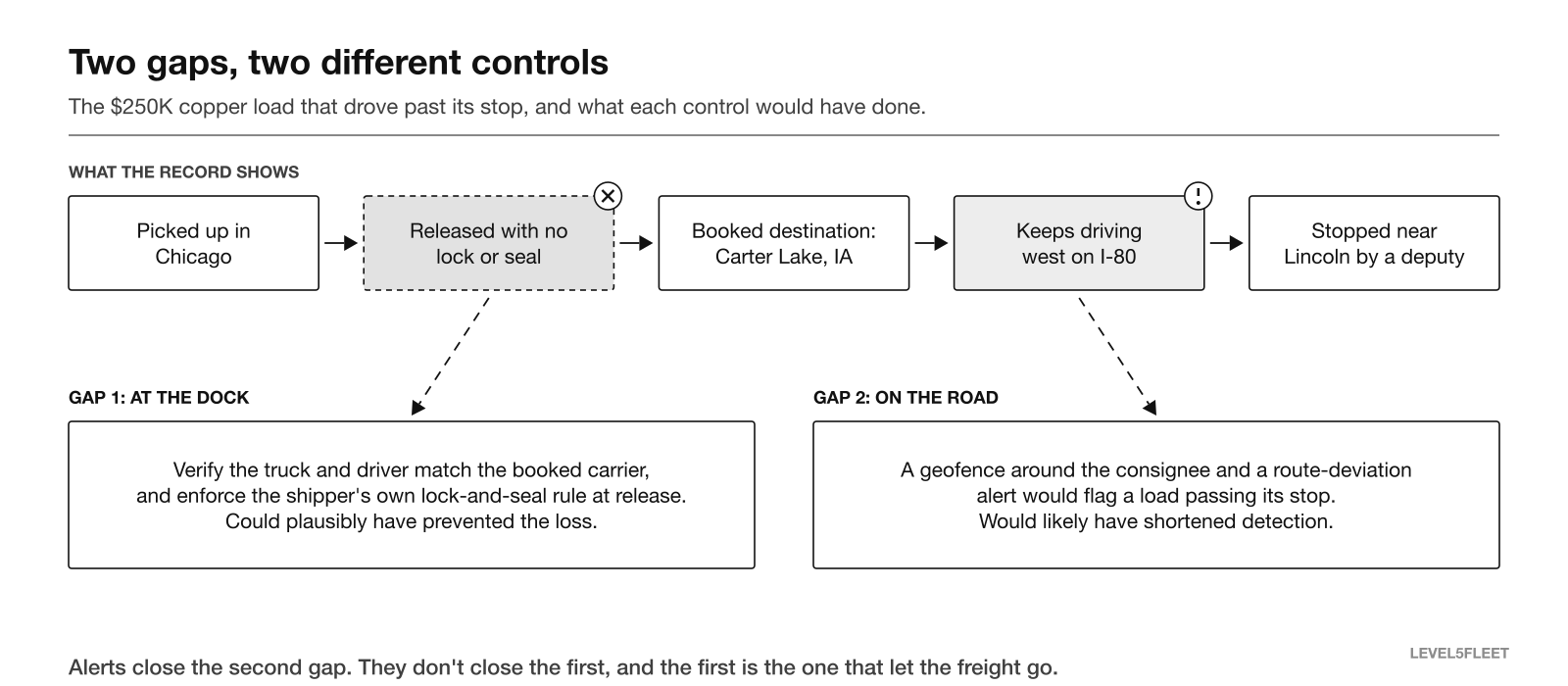
This case splits neatly into two failures: the load ended up with a carrier other than the one booked, without the lock and seal the shipper required, and then nobody knew where it was. Different controls address each one.
| Control | What it does | Effect in this case |
|---|---|---|
| Pickup-time check that the truck and driver match the booked carrier | Confirms the equipment and person at the dock are the ones the shipper hired, before release | Could plausibly have prevented it. The load was with the wrong carrier. How it got there is unknown, so this is the check that failed, not a proven fix. |
| Enforcing the shipper’s own lock-and-seal requirement at release | Makes “no seal, no lock, no release” a hard rule rather than a step | Could plausibly have prevented it, as part of the same release check. FreightWaves reports the required lock and seal were missing. |
| Destination geofence (“arrived / did not arrive”) | Flags a load that never enters, or never dwells at, the consignee’s site | Would likely have shortened detection. The truck passed Carter Lake; a geofence would flag that while it was still moving. |
| Real-time route deviation alert | Flags a load that leaves its expected corridor | Would likely have shortened detection, flagging the westbound run beyond the destination, if someone was watching and acted. |
| Waiting for the consignee to report a no-show | The default when no one is tracking | What actually stood in for detection, along with the deputy. The recycler confirmed the miss when deputies called; nothing in the record shows anyone flagging it earlier. |
| Any tracking, after the wrong carrier has the load | Shows where the load is | Would not have stopped the wrong carrier from driving away with it. |
Alerts would have changed when someone noticed. Only a release check could have changed whether the load left. And because the record shows no tracking at all, this is a “would have”, not a “should have caught”.
Warning signs a load has gone off plan
Most are visible long before a deputy sees a tilted trailer, if someone is looking.
- The truck or driver at the dock doesn’t match the booking. A different carrier name or USDOT number on the tractor, a different driver, or paperwork that doesn’t line up with the load tender.
- A load is released without the seal or lock your own procedures require. In this case, FreightWaves reports, the trailer lacked the load lock and seal the shipper required.
- No arrival confirmation by the expected delivery window. A consignee that hasn’t confirmed receipt is a signal, not a scheduling detail.
- A tracked load passes its consignee without stopping, or its last position is beyond the destination.
- Repeat losses on the same lane or commodity “in the same fashion.” A pattern means the gap is in the process.
How to catch a load that misses its destination: a 7-step checklist
- Verify the truck and driver against the booked carrier at the dock, every time. Why: here, the shipper confirmed the theft because the load wasn’t with the correct carrier, a fact checkable at pickup.
- Make the seal-and-lock rule a release condition, not a reminder. Why: a requirement that can be skipped is a preference. Record the seal number and confirm it at delivery.
- Put a geofence around every high-value consignee. Why: “did it arrive?” is the simplest question in freight, and here, the record shows it answered when a deputy phoned the recycler.
- Set route deviation alerts with a named responder and a response window. Why: an alert nobody owns is a log entry. Decide in advance who calls the carrier, the consignee and the police.
- Define the expected delivery window and escalate a no-show the same day. Why: every unaccounted hour is more distance between you and the freight.
- Require shipper-side visibility for metals and other high-value lanes. Why: if the only load tracking belongs to the carrier, and the carrier is the problem, you are not tracking anything.
- Treat a second loss “in the same fashion” as a process failure and change the control. Why: CargoNet’s data shows metals and copper are a sustained target [5][6], so the same gap will be tested again.
Pro Tip: For your three highest-value lanes, ask: if a load drove past the consignee right now, how long until we’d know? If the answer is “when the consignee calls,” start there.
For the identity side of step 1, see our posts on chameleon carriers and a carrier vetting failure. Nothing in the record says a carrier’s identity was impersonated here (the reporting doesn’t explain what the criminal impersonation charge rests on); the match is worth checking either way.
A perspective on the gap between pickup and delivery
What stands out to me isn’t the copper or the dollar figure. It’s that a load of nearly 44,000 pounds drove through its own destination, and the first thing in the record to register a problem was the angle of a trailer. That’s less a story about one truck than about how much of freight still assumes that a load that left will arrive.
There are two separate gaps here, and I think the industry often treats them as one. The first is at the dock: the load left without the lock and seal the shipper required, and it ended up with a carrier other than the one booked, by a route no source explains. Tracking doesn’t touch that. The second is on the road: once the load left, nothing in the record suggests anyone could see where it was. Route deviation alerts and destination geofences close the second gap, which is a good reason to have them. They don’t close the first, and the first is the one that let the freight go.
The part that worries me most is the pattern: four losses in one year, by the shipper’s account, the same way. That isn’t a judgment on any company. It’s a sign that a release check, as it’s commonly run, can fail repeatedly without anything flagging that it failed. A seal that isn’t there should stop the load, not just be missing.
So I’d measure both gaps separately: how often a load leaves without a verified match to the booking, and how long it would take to know a load had missed its destination. Here, the answer to the second was “until a deputy noticed.”
— Gwagsi Glenn, Growth Analyst, Level5Fleet
How Admiral maps to this case
Could plausibly have prevented, narrowly: the release check. The control that would have prevented this theft is verification at pickup plus an enforced lock and seal: a verification and process claim, not a tracking one. Admiral Resolve covers part of the verification half: it checks the request, not the truck at the dock. When a pickup, access or change request arrives, it shows who the request came from, whether they’re acting for the correct carrier, and whether they’re allowed to make that request for that load, and it records the decision. Resolve is free within fair usage limits. No source explains how this load reached the carrier on the road, so we can’t say which request Resolve would have screened, only that it addresses the mismatch the shipper identified. The truck at the dock is the Admiral Fob‘s job: before an Admiral-equipped trailer releases, its Hub checks the tractor’s Fob against an authorized list that only the trailer’s owner sets, and a mismatch keeps the trailer locked and immobilized. On a trailer equipped with Admiral Enforce, the lock-and-seal half becomes something the trailer enforces: the interior lock carries a virtual seal unique to each load, breakable only by an authorized person the shipper designates, and the door lock can stay locked in transit and unlock automatically at the authorized consignee. That requires an Admiral-equipped trailer, and the record doesn’t say whose trailer this was. A locked door also doesn’t, by itself, stop a trailer from being driven away.
Would not have shortened it on its own: location records. On an Admiral-equipped trailer, Admiral provides GPS-based location and movement data, but it describes itself as prevention-first, “not geofencing or late alerts”, so the geofence and deviation alert that would have flagged this load belong to your tracking stack.
Would not have helped: the IDs. The irregular IDs found in the truck are a matter for law enforcement, and no product addresses them.
If a high-value load can leave your dock without a verified match to the booking, start with Resolve at no cost or request an Enforce Pilot. The Admiral overview shows how the pieces fit.
FAQ
What is a route deviation alert?
A route deviation alert is a notification from a tracking or telematics system that a vehicle has left its expected route or corridor. Systems such as Tive’s build the expected route from the origin and destination, filter out brief stops and detours, and alert by email, SMS or webhook [9]. It speeds up detection; someone still has to act.
Do route deviation alerts prevent cargo theft?
No. They shorten detection, but only start working once the load is moving. In the Nebraska case, an alert would most likely have flagged the truck passing its destination, not stopped the wrong carrier from leaving with it.
Why is copper a target for cargo thieves?
Because it’s valuable and in demand. Verisk CargoNet says metals theft rose 77% in 2025, driven by demand for copper products, and that copper remained the most frequently targeted metal in the second quarter of 2026 [5][6].
Is cargo theft a federal crime?
It can be. Under 18 U.S.C. § 659, stealing goods that are part of an interstate or foreign shipment from a truck or trailer is a federal offense punishable by up to 10 years in prison, or up to 3 years if the value is under $1,000 [11]. The Nebraska case was charged under state law.
Sources
- KOLN / 10/11 NOW, “Man arrested after traveling through Nebraska with $250,000 in stolen copper, police say,” October 8, 2026 (updated October 9). https://www.1011now.com/2026/10/08/man-arrested-after-traveling-through-nebraska-with-250000-stolen-copper-police-say/
- FreightWaves (Phil Brink), “Nebraska deputies recover $250K stolen copper load 50 miles past Iowa destination,” October 14, 2026. https://www.freightwaves.com/news/nebraska-deputies-recover-250k-stolen-copper-load-50-miles-past-iowa-destination
- CDLLife, “Truck driver arrested for hauling $250K in stolen copper wire, Nebraska sheriff says,” October 9, 2026. https://cdllife.com/2026/truck-driver-arrested-for-hauling-250k-in-stolen-copper-wire-nebraska-sheriff-says/
- Freight Wire, “Trucker, 22, Says He Didn’t Know What Was in His Trailer — $250K in Stolen Copper Was Headed to an Iowa Recycler,” October 10, 2026. https://freightwire.news/content/2341806
- Verisk CargoNet, “Cargo Theft Losses Surge to Estimated $725 Million in 2025, Verisk CargoNet Analysis Reveals,” January 2026. https://www.verisk.com/company/newsroom/cargo-theft-losses-surge-to-estimated-$725-million-in-2025-verisk-cargonet-analysis-reveals/
- Verisk CargoNet, “Cargo Theft Losses More Than Double to $304 Million in Q2 Despite a Drop in Thefts, Driven by High-Value Metals and Technology Heists,” August 2026. https://www.verisk.com/company/newsroom/cargo-theft-losses-more-than-double-to-$304-million-in-q2-despite-a-drop-in-thefts-driven-by-high-value-metals-and-technology-heists/
- Verisk CargoNet, “Cargo Theft Holds Steady in Q3, Organized Crime Drives Surge in High-Value Cargo Theft Across U.S. and Canada” (Q3 2025). https://www.verisk.com/company/newsroom/cargo-theft-holds-steady-in-q3organized-crime-drives-surge-in-high-value-cargo-theft-across-u.s.-and-canada/
- FBI Internet Crime Complaint Center, “Cyber-Enabled Strategic Cargo Theft Surging,” Public Service Announcement, April 30, 2026. https://www.ic3.gov/PSA/2026/PSA260430
- Tive, “Smart Route Deviation Alerts” (product documentation). https://support.tive.com/smart-route-deviation-alerts
- U.S. DOT ARC-IT (National ITS Reference Architecture), “CF15: Fleet and Freight Security.” https://www.arc-it.net/html/servicepackages/sp178.html
- 18 U.S. Code § 659 (Legal Information Institute, Cornell Law School). https://www.law.cornell.edu/uscode/text/18/659