Stolen Copper Wire: A $586K Cargo Theft Recovered in 8 Hours

Copper cargo theft is the theft of copper wire, cable, cathode and other copper products while they move through the supply chain, and a growing share of it happens through deception rather than force: the load is handed over to someone using a legitimate carrier’s identity. That makes the pickup the weakest point and location the last line of defense. In the case below, the pickup check failed, and live location is the reason the copper came back.
TL;DR
- Metal cargo theft is rising: Verisk CargoNet says metal thefts rose from 54 to 80 incidents year over year in Q2 2026, with copper the most frequently targeted metal, and TT Club’s 2025 claims data ranks copper as its single most commonly stolen cargo.
- In September 2026, police say a load of industrial copper wire worth about $586,000 was picked up in DeKalb, Illinois, under a legitimate carrier’s identity and taken to a rented warehouse in Prestonsburg, Kentucky, instead of Rock Hill, South Carolina.
- CargoNet and the trailer’s GPS showed the load at the warehouse. Police arrived while copper was coming off the truck, and all six pallets were recovered within about eight hours of the theft being reported.
- Tracking didn’t stop the theft. It stopped the getaway. Only verification at the pickup could plausibly have kept the load from being released.
- Two California men have been charged in Kentucky. Neither has been convicted, both are presumed innocent, and the investigation is ongoing.
Table of contents
- What is copper cargo theft?
- The case: a copper load picked up under a borrowed identity
- Case timeline
- The numbers
- Pickup verification vs tracking: what each would have done
- Warning signs of a fictitious pickup
- How to prevent copper cargo theft: a 7-step checklist
- An analyst’s perspective: the check that failed and the one that worked
- How Admiral maps to this case
- FAQ
- Sources
- Recommended
What is copper cargo theft?
Copper cargo theft is the theft of copper products, such as wire spools, cable, cathode and rod, from trucks, trailers, containers, yards and warehouses while the freight is in transit or in storage. Most stolen copper wire in the news is stripped from buildings or utility lines. Cargo theft is a different problem: it takes full, packaged shipments.
Copper is attractive because it’s valuable and has an established resale market, which CargoNet says is exactly what organized groups now select for [6]. The same commodity-selection pattern showed up in our tungsten load case. The numbers show it:
- Verisk CargoNet reported that metal theft rose 77% in 2025, “driven by ongoing demand for copper products” [7].
- In Q2 2026, CargoNet recorded 80 metal thefts, up from 54 a year earlier, even though total incidents fell 26%. Copper remained the most frequently targeted metal [6].
- TT Club, a transport and logistics insurer, says its own 2025 claims data identifies copper as the single most commonly stolen cargo, with copper claims rising from 2 in 2016 to 37 in 2025 [10].
TT Club adds that deception-based theft is an increasing proportion of losses, which makes copper theft “an identity, process, and authentication risk” as well as a physical one [10].
The deception at the center of this case is the fictitious pickup: someone poses as the carrier that was booked, presents matching paperwork, and the shipper releases the load. CargoNet counted 158 fictitious pickups in Q2 2026, barely down from 165 a year earlier, while incidents classified as theft fell from 488 to 378 [6]. If you’ve read our explainer on chameleon carriers, the pattern will be familiar: the identity is real, and the person using it isn’t.
The case: a copper load picked up under a borrowed identity
The shipment was six pallets of industrial copper wire, collected at a shipper in DeKalb, Illinois, in September 2026 and bound for Rock Hill, South Carolina [1][5].
According to investigators, the people who collected it used a legitimate motor carrier’s identity and published contact information to be assigned the load [1][4][5]. The truck that arrived carried paperwork branded as that carrier. Police say the truck’s real identity was covered with magnetic decals [2][3]. The carrier whose identity was used hasn’t been named in any report, and it’s a victim here, not a suspect.
Here’s what a pickup check is usually made of: a name on the door that matches the booking, and a bill of lading that matches the load. Police say in this case the name on the door was a magnet. That’s not a comment on anyone’s cleverness. It’s a description of how little the check asks for.
Instead of reaching South Carolina, it went to a warehouse on Riverside Drive in Prestonsburg, in eastern Kentucky, which police described as far from the intended route [2][3][4].
Then the tracking caught up with it. Verisk CargoNet, a cargo theft prevention and recovery network, alerted law enforcement that the load was showing at the Prestonsburg warehouse, and Kentucky State Police asked the Prestonsburg Police Department to check [2][3][4]. “This load went off course and was last pinged at the location,” Prestonsburg Police Chief Ross Shurtleff told WYMT [2]. According to FreightWaves, the GPS data came from Schneider National, which also owned the equipment involved [1]. The sources don’t say what first triggered CargoNet’s alert: a deviation alert, a stolen-trailer report, or a call from the shipper or carrier.
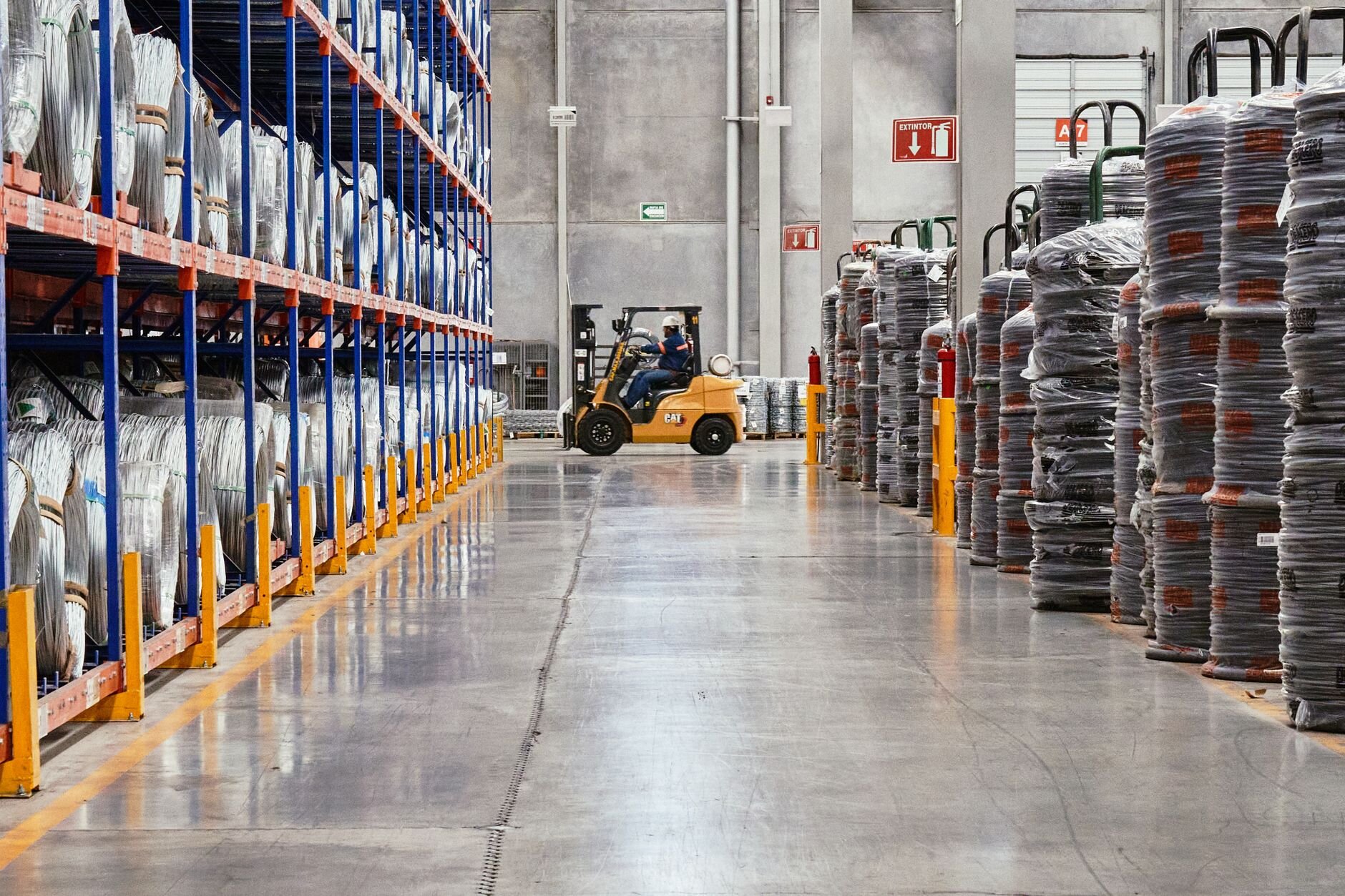
When officers returned, a tractor-trailer was backed into the loading dock and a forklift was unloading copper spools [2][3][4][5]. The forklift operator ran and was found on the riverbank with the help of a police K-9. The driver was detained at the scene [2][4]. Detectives believe the warehouse was meant as a “transfer station”, where the copper would be reloaded onto another truck and moved out of Kentucky [4]. That’s police belief, not established fact. But if it’s right, the load was found at the last point where it was still in one place.
All six pallets were recovered within about eight hours of the theft being reported [1][5].
There’s a second victim who’s easy to overlook. The warehouse owner says he had recently leased the space to what appeared to be a legitimate party. Police say that identity was stolen too [2]. Chief Shurtleff described the owner as someone “who did his due diligence” [2]. If police are right, the copper moved under a borrowed carrier name to a building rented under a borrowed tenant name: two sets of paperwork that looked clean, and neither, police say, belonged to the people using it.
A Verisk CargoNet spokesperson, Mary Keller, put it plainly: “The transportation was arranged under false pretenses by fraudulent individuals” [5].
The charges. Two California men were arrested in Prestonsburg [2][3][4]:
- Christopher Michael Delgado, 24, of Alhambra, is charged with receiving stolen property over $10,000 and with fleeing or evading police on foot [3][4][5].
- Haykaz Gasparyan, 43, of Tujunga, the driver, is charged in connection with the case. Police say he was driving under fraudulent documentation [3][4][5]. He told police he had been hired to pick up the load and take it to California [3][11].
Both were held on $250,000 cash bond [2][3][5], and as of September 22 both remained in the Floyd County Detention Center [5]. FreightWaves also reports that the stolen chassis and container were found in Chillicothe, Ohio, where the Ohio State Highway Patrol stopped the associated tractor and took one more person into custody [1]. We aren’t naming that person.
Neither of the men charged in Kentucky has been convicted of anything, and both are presumed innocent. Police are investigating possible links to other thefts, and the investigation is continuing in several states [1][2][4]. Cook County Sheriff’s Police opened the originating case in Illinois; Commander Michael Ware told FreightWaves that “real-time intelligence-sharing between law enforcement and the freight industry is essential” [1].
Case timeline
| Date | Event | Source |
|---|---|---|
| Sept 10, 2026 | ENR, citing an online report from the Cook County Sheriff’s Organized Retail Crime Unit, says a trailer was stolen in Oak Forest, Illinois | ENR [5] |
| Sept 10–11 | Police say six pallets of copper wire are picked up in DeKalb, Illinois, bound for Rock Hill, South Carolina, under a legitimate carrier’s identity | FreightWaves, ENR [1][5] |
| Sept 11 | According to FreightWaves, a CargoNet analyst alerts Cook County Sheriff’s Police, who enter the trailer as stolen | FreightWaves [1] |
| Sept 11 | CargoNet alerts law enforcement that the load is showing at a Prestonsburg, Kentucky, warehouse; Kentucky State Police ask Prestonsburg police to check | WYMT, Mountain Top Media, WSAZ [2][3][4] |
| Sept 11 | Officers find copper being unloaded at the dock; two men are arrested | WYMT, WSAZ, Mountain Top Media [2][3][4] |
| Sept 11 | All six pallets recovered, within about eight hours of the report | FreightWaves, ENR [1][5] |
| Sept 11 | FreightWaves reports the chassis and container found in Chillicothe, Ohio, and one more person taken into custody | FreightWaves [1] |
| Sept 22 | Both Kentucky defendants still held at the Floyd County Detention Center | ENR [5] |
| As of Nov 4, 2026 | No plea, trial or conviction reported; investigation ongoing | Search of public reporting |
Reports differ on whether the load was taken on September 10 or 11.
The numbers
| Figure | What it measures |
|---|---|
| ~$586,000 | Value of the copper, according to police [1][3] |
| 6 | Pallets of copper wire, all recovered [1][5] |
| ~8 hours | From the theft being reported to the recovery [1][5] |
| 2 | Men charged in Kentucky [2][3][4] |
| $250,000 | Cash bond for each [2][3][5] |
| 1 | Further person taken into custody in Ohio, according to FreightWaves [1] |
Some outlets round the value to “nearly $600,000” or “half a million” [2][4][5].
For context, Verisk CargoNet estimates cargo theft losses in the U.S. and Canada at nearly $725 million in 2025, up 60% from 2024. Confirmed cargo theft incidents rose 18%, and the average value per theft rose 36% to $273,990 [7][9]. In Q2 2026, incidents fell 26% to 677, but estimated losses more than doubled to $304.6 million, a rise CargoNet attributed to “high-value metals and technology heists” [6].
Fewer thefts, heavier ones. A single load of copper wire in this case was worth more than twice the 2025 average theft.
Pickup verification vs tracking: what each would have done
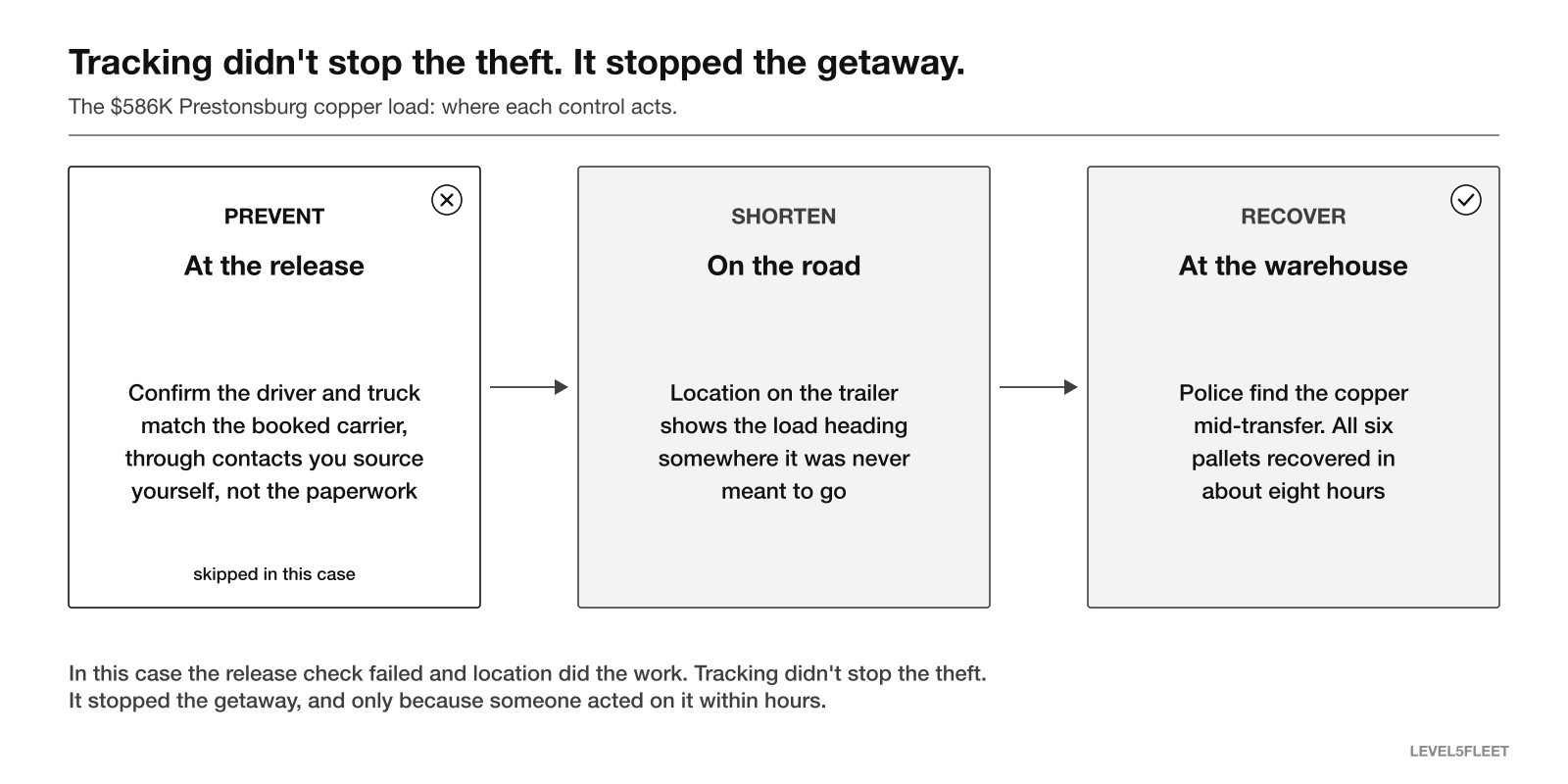
Two questions are easy to blur here: could the theft have been prevented, and could it be reversed? Here’s each control applied to what police say happened.
| Control | What it does against a fictitious pickup | Effect in this case |
|---|---|---|
| Matching the paperwork and door name to the booking | Confirms the documents look right. They did. | None. This is the check that was passed. |
| Pickup-time carrier and driver verification, using contacts you already hold rather than the carrier’s published details | Confirms that the driver and truck at the dock belong to the carrier you booked | Would likely have prevented the release. The decals and documents were the only identity presented. |
| Real-time location on the trailer or load | Shows where the freight is once it leaves | Did not prevent the pickup. Aided the recovery. It’s the reason police found the load mid-transfer instead of after it had been split up and moved on. |
| Route-deviation or geofence alert on the planned lane | Flags a South Carolina load heading into eastern Kentucky, potentially before anyone reports a theft | Would likely have shortened detection. The sources don’t say whether such an alert fired here, so we don’t claim one did. |
| Checks on the warehouse tenant | A matter for the property owner, not the shipper or carrier | Outside fleet visibility. The owner, police say, did his due diligence. |
| Protection of the carrier’s registered identity | A matter of registration and identity security | Outside fleet visibility. |
The honest summary: the pickup check failed, and visibility rescued the load afterward. Without the location data, the trail would most likely have ended at the dock.
Warning signs of a fictitious pickup
- The truck or driver doesn’t match what was booked. Different equipment, a different driver name, or markings that look temporary or freshly applied.
- Booking contacts that only lead back to published details. If every phone number and email came from a public listing or from the booking itself, you’ve verified nothing independently.
- Recent changes to a carrier’s contact or insurance details. The FBI warns that criminals impersonating carriers change the legitimate carrier’s contact information with the FMCSA [9].
- Look-alike email domains and short-lived phone numbers, both on the FBI’s list of indicators [9].
- A high-value metals load with nothing extra required. If copper gets the same release process as mixed dry freight, the process is set by the lowest-value load you ship.
- A load that stops somewhere with no reason to be there. Unplanned dwell at a facility that isn’t on the lane, especially early in the trip.
How to prevent copper cargo theft: a 7-step checklist
- Classify copper as high-value freight. Why: TT Club warns that controls adequate for routine cargo may be insufficient for copper [10]. Treat copper loads like the targets they are.
- Verify the carrier through a channel you already hold. Why: in this case the carrier’s own published contact details were allegedly part of the deception [1][5]. The FBI recommends independently verifying shipment requests and pickups by secondary methods before releasing any load [9].
- Match driver, truck and trailer to the booking at the dock, and record it. Why: the FBI recommends documenting drivers, licenses, vehicles, plates, and DOT and MC numbers. That record also helps investigators if a load is lost anyway [9].
- Put live location on the load or trailer, not only the tractor. Why: in a fictitious pickup, the tractor isn’t yours. What police followed here was the load itself, which “was last pinged at the location” [2].
- Define the lane and alert on deviation, with a named responder. Why: a load bound for South Carolina has no reason to be in eastern Kentucky. An alert matters only if someone owns it and acts on it.
- Know who you’ll call before you need them. Why: this recovery depended on fast hand-offs between CargoNet, Illinois, Kentucky and local police [1][2][3]. Report a missing load to police immediately, and file with the FBI’s IC3 if the scheme was cyber-enabled [9].
- Assume the destination may be borrowed too. Why: the warehouse here was reportedly rented under a stolen identity [2][4]. Any unexpected address change or unfamiliar consignee facility on a high-value load deserves a call through a known contact.
Pro Tip: Pick a recent high-value load and ask how long it would take you to learn it was off course. If the honest answer is “when the consignee calls”, your detection runs on someone else’s schedule.
For a wider set of controls, see our cargo theft prevention guide.
An analyst’s perspective: the check that failed and the one that worked
This is a tracking success story. The more useful reading, though, is that two different controls were tested on the same day and gave opposite results.
The first was the pickup. Everything presented at the dock matched. Carrier vetting is largely built around companies, registrations and authority, and those checks confirm that a carrier exists. They don’t confirm that the carrier is the one standing at the dock. CargoNet’s own vice president of operations said in its Q1 2026 analysis that the industry “needs to think beyond tender-phase controls,” with identity verification “throughout the lifecycle of a shipment, from booking to delivery” [8]. This case shows why.
The second control was location. It worked because the data existed, someone was watching it, and several agencies moved fast enough to act on it. Take away any one of those and the copper is likely gone. That’s a lot of conditions for a good outcome to rest on.
The data points the same way. CargoNet’s Q2 numbers show fictitious pickups holding steady while other theft falls, and metals rising while the overall count drops [6]. TT Club’s warning against treating copper as a standard commodity [10] reads like a description of this dock.
My read is that operations should stop treating verification and visibility as alternatives. Visibility made this a recovery story. Verification at the moment of release is the only thing in this case that could have made it a non-story. A shipper of high-value metal needs both, and needs to know which one it’s relying on for which outcome.
— Gwagsi Glenn, Growth Analyst, Level5Fleet
How Admiral maps to this case
First: Level5Fleet and Admiral weren’t involved in this case. The tracking that found the copper was the trailer’s own GPS, which FreightWaves attributes to Schneider National, plus Verisk CargoNet [1]. What follows maps Admiral’s capabilities against what police say happened. It isn’t a claim about this load.
Where Admiral addresses the failure point: verification of the pickup request. The failure point was the release. Someone allegedly acting under a real carrier’s identity was assigned the load and collected it [1][5]. Admiral Resolve is designed for that moment: it verifies who is making a pickup, access or change request, whether they are acting for the carrier they claim to represent, and whether they’re authorized for that specific load, and it records the decision. It works without hardware, and teams can use it at no cost within fair usage limits. It could only have caught this request if the request went through it before release, so it’s a process commitment, not a guarantee. The truck side of that check is the Admiral Fob: on an Admiral-equipped trailer, the Hub checks the tractor’s Fob against an authorized list that only the trailer’s owner sets before it will release, and a mismatch keeps the trailer locked and immobilized. Neither is described here as preventing this case, because the reporting doesn’t show how the request was made or whose equipment was involved.
Aids recovery, not prevention: location on the asset. Admiral provides GPS-based location and movement data from the trailer itself, and the Admiral Hub reports physical events and asset state when connected. That’s the same category of control that worked here: it helps find a load that’s already gone, and it doesn’t stop a fraudulent pickup on its own. Route-deviation alerting belongs to your telematics or monitoring stack, and Admiral doesn’t claim to replace it.
Would not have helped: the warehouse lease under a stolen identity, and the theft of the carrier’s identity itself. Both sit outside fleet visibility. We also make no claim that the Admiral Fob, Immobilizer or Lock would have changed this case; the reporting says too little about how the equipment was taken to support one.
If you release high-value metal loads to carriers, start with Admiral Resolve at no cost to verify pickup requests before freight moves. If you control the trailers, Admiral Enforce adds on-asset enforcement, and you can request an Enforce Pilot on your highest-value lane.
FAQ
What is a fictitious pickup?
A fictitious pickup is a cargo theft in which someone poses as the booked carrier, presents matching paperwork and collects the load. CargoNet recorded 158 of them in Q2 2026 [6]. In the Prestonsburg case, police say a copper load was collected under a legitimate carrier’s identity, with magnetic decals covering the truck’s real identity [1][2][3].
Why do cargo thieves target copper?
Copper is valuable and has an established resale market [6]. CargoNet says 2025 metal theft rose 77%, driven by demand for copper products [7], and TT Club’s 2025 claims data ranks copper as the single most commonly stolen cargo [10].
Can GPS tracking prevent cargo theft?
Not on its own. Tracking shows where a load is after it leaves; it doesn’t decide who it’s released to. In this case GPS didn’t stop the pickup, but it let police find the copper mid-transfer and recover all six pallets within about eight hours [1][5].
Is cargo theft a federal crime?
It can be. Under 18 U.S.C. § 659, stealing or obtaining by fraud or deception goods that are part of an interstate shipment, from a truck, trailer, warehouse or similar location, is a federal offense punishable by up to 10 years in prison, or up to 3 years if the value is under $1,000 [12]. The charges reported in the Prestonsburg case were filed in Kentucky, and both men are presumed innocent.
What should you do if a load goes missing?
Report it to police immediately and share every identifier you recorded at pickup: driver, truck, trailer, plates and DOT and MC numbers. If the scheme involved spoofed emails or compromised accounts, the FBI also asks victims to file with IC3 [9].
Sources
- FreightWaves, “Police recovered $586K stolen copper load within 8 hours after suspected carrier impersonation,” September 14, 2026. https://www.freightwaves.com/news/police-recovered-586k-stolen-copper-load-within-8-hours-after-suspected-carrier-impersonation
- WYMT, “POLICE: K9 helps in cargo theft arrest, agencies recover $500k in stolen copper,” September 15, 2026. https://www.wymt.com/2026/09/15/k9-helps-cargo-theft-arrest-agencies-recover-500k-stolen-copper/
- Mountain Top Media, “KSP, P’burg Police recover over half a million dollars’ worth of stolen copper,” September 15, 2026. https://mountain-topmedia.com/ksp-pburg-police-recover-over-half-a-million-dollars-worth-of-stolen-copper/
- WSAZ, “Law enforcement recover nearly $600,000 in stolen copper in interstate theft ring,” September 16, 2026. https://www.wsaz.com/2026/09/16/law-enforcement-recover-nearly-600000-stolen-copper-interstate-theft-ring/
- Engineering News-Record, “Copper Wire Valued at $600K Stolen in Interstate Theft,” September 22, 2026. https://www.enr.com/articles/63683-copper-wire-valued-at-600k-stolen-in-interstate-theft
- Verisk CargoNet, “Cargo Theft Losses More Than Double to $304 Million in Q2 Despite a Drop in Thefts, Driven by High-Value Metals and Technology Heists,” August 6, 2026. https://www.verisk.com/company/newsroom/cargo-theft-losses-more-than-double-to-$304-million-in-q2-despite-a-drop-in-thefts-driven-by-high-value-metals-and-technology-heists/
- Verisk CargoNet, “Cargo Theft Losses Surge to Estimated $725 Million in 2025, Verisk CargoNet Analysis Reveals,” January 22, 2026. https://www.verisk.com/company/newsroom/cargo-theft-losses-surge-to-estimated-$725-million-in-2025-verisk-cargonet-analysis-reveals/
- Verisk CargoNet, “Incident Volume Falls as Organized Crime Reshapes Cargo Theft Landscape Through Impersonation and Targeted Commodity Selection,” April 24, 2026. https://www.verisk.com/company/newsroom/incident-volume-falls-as-organized-crime-reshapes-cargo-theft-landscape-through-impersonation-and-targeted-commodity-selection/
- FBI Internet Crime Complaint Center, “Cyber-Enabled Strategic Cargo Theft Surging,” Public Service Announcement I-043026-PSA, April 30, 2026. https://www.ic3.gov/PSA/2026/PSA260430
- TT Club (Mike Yarwood), “TT Talk – Copper theft risk rising across global supply chains,” June 2, 2026. https://www.ttclub.com/news-and-resources/news/article/tt-talk-copper-theft-risk-rising-across-global-supply-chains/
- Floyd County Times, “Police: California men caught with $586K of stolen copper in Prestonsburg,” September 14, 2026. https://www.floydct.com/news/police-california-men-caught-with-586k-of-stolen-copper-in-prestonsburg/article_5f867cb3-4321-48ec-b3e0-9d4cf9252828.html
- 18 U.S. Code § 659 (Legal Information Institute, Cornell Law School). https://www.law.cornell.edu/uscode/text/18/659