
Educational Resources
>
Chameleon Carriers: How to Spot Reincarnated and Fake Carrier Identities Before Pickup
Chameleon Carriers: How to Spot Reincarnated and Fake Carrier Identities Before Pickup
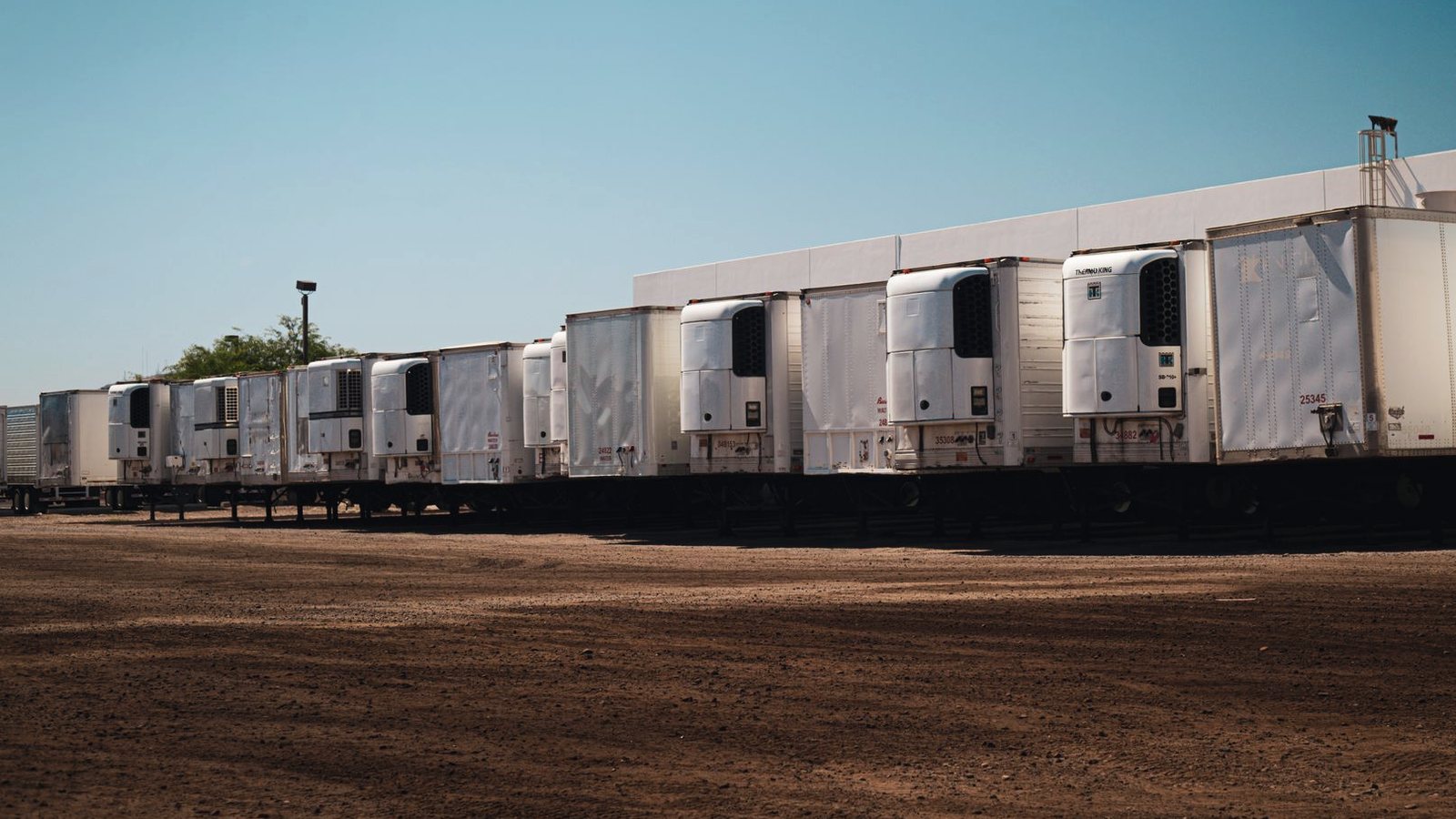
Chameleon carriers are trucking companies that shut down one identity and come back under another to escape their FMCSA safety record, an out-of-service order, or unpaid penalties. Federal rules let FMCSA shut these “reincarnated” carriers down and merge their records. The same identity trick also fuels cargo theft: a carrier name or number on the paperwork doesn’t tell you who is at your dock.
TL;DR
- A chameleon carrier is a motor carrier that re-registers under a new identity to avoid an FMCSA order, a penalty, or a bad compliance history, and 49 CFR 386.73 lets FMCSA put it out of service.
- In GAO’s 2012 analysis, 18% of new applicants with chameleon attributes had been involved in severe crashes, compared with 6% of applicants without them.
- FMCSA’s Motus registration system, launched in May 2026, now requires identity proofing for new registrants, but MC numbers are still in use and their elimination has been deferred.
- The same identity games enable cargo theft, from hijacked carrier accounts to fake or borrowed carrier identities used for fictitious pickups.
- A clean SAFER snapshot proves a registration exists; it does not prove the person requesting your load works for that carrier, so verify the request as well as the company.
Table of contents
- What is a chameleon carrier?
- How FMCSA defines and polices reincarnated carriers
- Regulatory timeline: chameleon carriers and registration fraud
- Why chameleon carriers matter: the safety evidence
- From safety evasion to cargo theft
- How to spot a chameleon carrier: red flags and where to check
- What carrier verification actually proves
- A carrier vetting checklist that closes the gap
- An operational perspective
- Where Admiral fits, and where it doesn’t
- FAQ
- Sources
What is a chameleon carrier?
A chameleon carrier is a motor carrier that registers under a new name or number to hide its earlier identity, usually to avoid an FMCSA out-of-service order, a civil penalty, an enforcement action, or a poor safety history. FMCSA’s regulations call these “reincarnated” carriers. The old company’s owners, trucks, drivers, and customers often carry on under the new name.
Two related problems share the label, and it helps to keep them apart:
- Reincarnation (the regulatory meaning). The same operator comes back under a new USDOT number or company name to shed its record.
- Identity misuse (the cargo-theft meaning). Someone uses a stolen, hijacked, purchased, or invented carrier identity to get freight released to them.
Both work because they exploit the same weakness: a registration record is trusted as proof of who you are dealing with.
How FMCSA defines and polices reincarnated carriers
FMCSA’s authority sits in 49 CFR 386.73, adopted in April 2012. It lets the agency issue an out-of-service order and a record consolidation order when a carrier, broker, freight forwarder, or intermodal equipment provider operates “under a new identity or as an affiliated entity” to avoid an FMCSA order, a statutory or regulatory requirement, a civil penalty, an enforcement action, or “a negative compliance history.”
The test is “substantial continuity,” meaning “one is merely a continuation of the other.” FMCSA may weigh common ownership, officers, and management; shared addresses, phone numbers, or email addresses; the same vehicles, drivers, facilities, or insurance; continuity of customers; and the old company’s safety history. A January 2014 Patterns of Safety Violations rule went further, authorizing full revocation of operating authority.
FMCSA guidance also says a carrier’s “principal place of business” must be an actual place of business, not a post office box center, a mail-drop service, or a consultant’s office. FMCSA’s fraud alert on the sale of registration numbers adds that a USDOT number “belongs to the same legal person forever.” The agency says it will inactivate a number “upon discovery that the number is being used by anyone other than the assigned legal person.”
Regulatory timeline: chameleon carriers and registration fraud
| Date | Event | Source |
|---|---|---|
| Mar 2012 | GAO-12-364 finds FMCSA vets only bus and household-goods applicants for chameleon traits, missing freight carriers (98% of 2010 applicants) | GAO |
| Apr 26, 2012 | Reincarnated-carrier rule published (77 FR 24870), codified at 49 CFR 386.73 | eCFR |
| Jun 2013 | FMCSA reports to Congress on a prototype risk-based applicant screening tool | FMCSA report to Congress |
| Jan 2014 | Patterns of Safety Violations rule announced, adding revocation of authority | FMCSA newsroom |
| Feb 2016 | FMCSA expands chameleon vetting to all new applicant motor carriers, including freight | GAO recommendation status |
| Apr 2025 | FMCSA partners with IDEMIA for identity verification of new applicants | Federal Register, 91 FR 23144 |
| Sep 2025 | FMCSA partners with CLEAR for business verification | Federal Register, 91 FR 23144 |
| Mar 2026 | FMCSA bulletin: do not sell, buy, or lease USDOT or MC numbers | FMCSA newsroom |
| Apr 29, 2026 | FMCSA defers eliminating MC numbers to later Motus releases | Federal Register, 91 FR 23144 |
| May 19, 2026 | FMCSA launches Motus with identity verification using government ID and facial scans | FMCSA newsroom |
Why chameleon carriers matter: the safety evidence
The most-cited evidence is GAO-12-364 (March 2012). GAO counted carriers whose registration data matched a previously registered carrier that had a motive to hide, such as a history of safety violations or a bankruptcy. The number of new applicants with these chameleon attributes rose from 759 in 2005 to 1,136 in 2010, and 1,082 of the 2010 group were freight carriers.
GAO found that 18% of applicants with chameleon attributes were involved in severe crashes, compared with 6% of new applicants without them. That is three times the rate. The figure is now more than a decade old, and GAO measured chameleon attributes, not legally proven reincarnation, so treat it as a risk signal and not a current prevalence estimate.
GAO also said FMCSA “does not determine the total number of chameleon carriers,” which would require investigating tens of thousands of new applicants a year. Industry estimates of the share of carriers that are chameleons circulate online; we could not trace any to a primary source, so we’ve left them out.
From safety evasion to cargo theft
The regulatory definition is about safety. For shippers and brokers, the bigger daily risk is that reincarnated, recycled, and borrowed carrier identities make fictitious pickups possible. FMCSA’s April 2026 Federal Register notice reported “a significant increase in the occurrence of presumed fraudulent activity … resulting in cargo and monetary theft.” Its examples included identity theft, hijacked carrier accounts, the sale of carrier numbers, and “fraudulent or fake initial registrations.”

Three patterns stand out:
- Hijacked identities. The FBI’s IC3 warned in April 2026 that criminals use compromised carrier accounts, change the carrier’s FMCSA contact details and insurance information, and accept real shipments under its authority. The real carrier may not realize it until brokers call about missing loads booked under its authority. IC3 put 2025 U.S. and Canada cargo-theft losses at nearly $725 million, up about 60%, with the average theft up 36% to $273,990.
- Acquired identities. Verisk CargoNet’s Q2 2026 analysis described non-delivery schemes in which “malicious actors acquired existing, reputable motor carriers,” booked shipments under their established authority, and picked up freight “with no intent to deliver it.” Those schemes declined that quarter, but fictitious pickups barely moved (165 to 158 events) while estimated losses more than doubled to $304.6 million.
- Borrowed or invented identities. Two cases we’re covering:
- In Manhattan, eight defendants have been indicted. Prosecutors allege the crew displayed a legitimately registered carrier’s real name, MC number, and DOT number on a leased tractor-trailer to collect loads, causing $4.49 million in losses (also reported as nearly $5 million). The case is pre-trial, and the defendants are presumed innocent. (Case post coming soon: the NYC carrier impersonation ring.)
- In Chicago, Aivaras Zigmantas pleaded guilty to wire fraud and was sentenced in May 2026 to five years in federal prison. Using at least 11 aliases, he had posed as an agent of both real and fictitious carriers and brokers, and $10.1 million in freight was stolen. (Case post coming soon: the Chicago fake carrier with 11 aliases.)
In a borrowed-identity scheme like the one alleged in Manhattan, a registration lookup returns a real, active carrier, because the identity is real. The question it can’t answer is whether this driver, this truck, for this load was authorized by that carrier.
How to spot a chameleon carrier: red flags and where to check
No single signal proves a carrier is a chameleon or an impostor. Look for clusters, and treat each as a reason to verify independently.
| Signal | What to check | Where to check it |
|---|---|---|
| Brand-new authority on a high-value load | When authority was granted versus the experience the carrier claims | FMCSA Licensing & Insurance record (linked from SAFER, now in Motus) |
| Recent registration update on an older authority | MCS-150 form date versus authority age. Ask what changed, especially phone, email, or ownership | SAFER Company Snapshot |
| Address is a mail drop or matches many other carriers | Whether the principal place of business is a real operating location | SAFER snapshot address; FMCSA principal-place-of-business guidance |
| Contact details don’t match the registration | The phone or email you were given versus FMCSA records; call the number on file | SAFER snapshot; independent callback |
| Lookalike or free-mail email domain | Misspellings, extra words, a different top-level domain, or a free provider | The sender address itself; IC3’s red-flag list |
| Insurance recently changed or doesn’t match the certificate | Insurer on file versus the certificate you received | FMCSA insurance filings; call the listed insurer |
| Officers, trucks, or phone shared with an out-of-service carrier | Overlaps with carriers that have OOS orders or poor histories | SAFER/SMS records; your own carrier files |
| USDOT or authority status not active | USDOT status, operating authority status, and out-of-service date | SAFER Company Snapshot |
| Driver, truck, or plate at pickup doesn’t match the assignment | Driver ID, tractor, trailer, and plate versus what dispatch confirmed | The carrier’s dispatch, on an independently sourced number |
Behavioral warning signs at the dock and in the inbox:
- A broker or carrier contacts you about a load booked “in your name” that you never authorized. IC3 lists this as a sign of a compromised account.
- The carrier pushes to move communication to a personal phone, a messaging app, or a new email address mid-load.
- A last-minute change of driver, truck, pickup time, or delivery address arrives without confirmation from the contracted carrier’s known contact.
- Contacts use VoIP or short-term phone numbers, sometimes overseas, which IC3 also flags.
What carrier verification actually proves
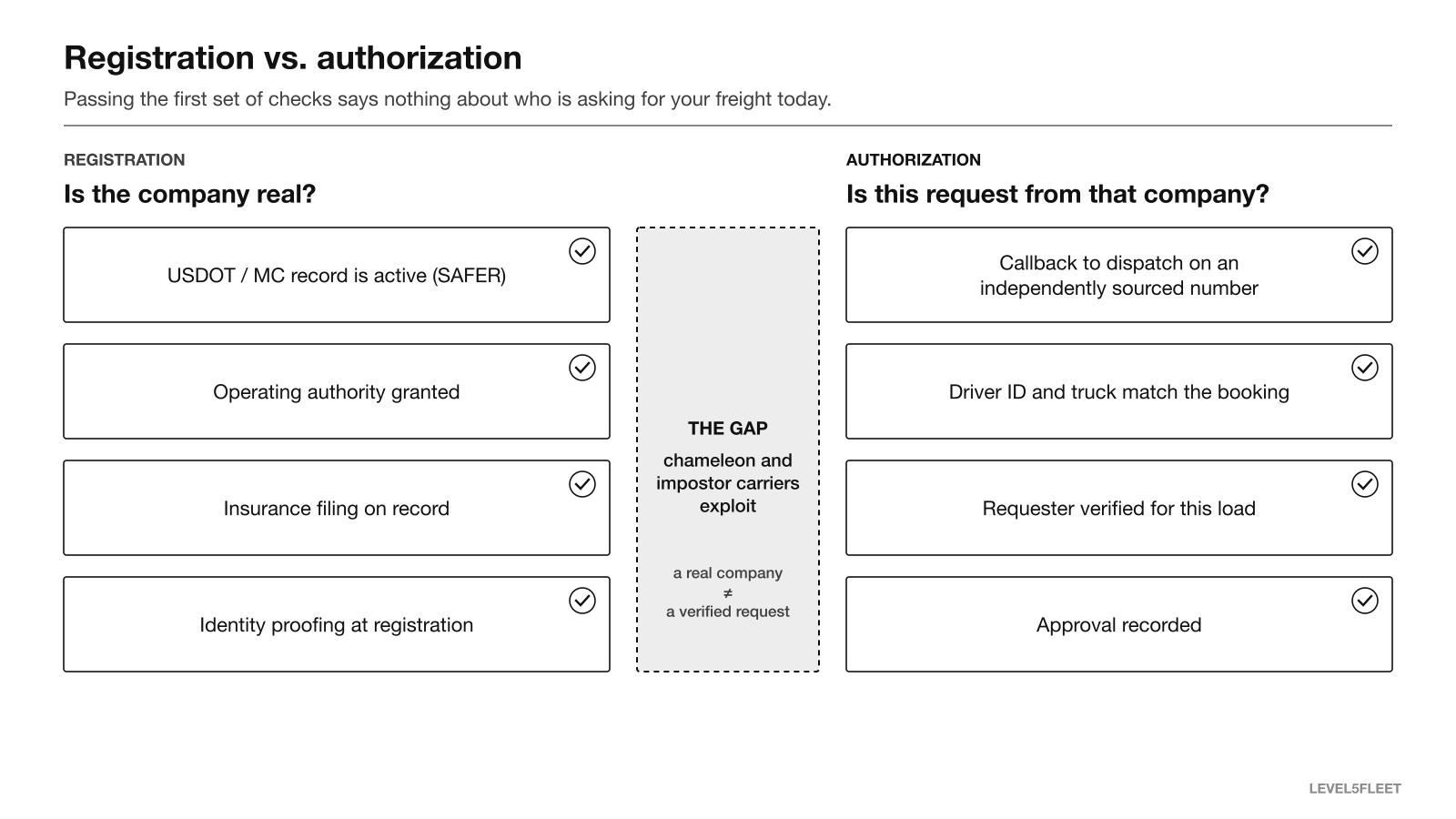
Most carrier vetting answers “is this company real?” Fictitious pickups succeed on a different question: “is this request coming from that company?”
| Vetting check | What it proves | What it does not prove |
|---|---|---|
| Active USDOT number and operating authority on SAFER | A registered entity exists and is authorized for interstate for-hire work | That the caller, emailer, or driver belongs to that entity |
| Insurance filing on record | Coverage was filed with FMCSA | That the certificate you received is genuine, or that coverage wasn’t recently swapped |
| Identity verification at registration (Motus) | The registrant passed ID proofing when registering or first accessing the system | Who is using the account or the carrier’s name today |
| Clean safety record and no OOS order | No recorded enforcement against this USDOT number | That the operator isn’t a reincarnation of a carrier with a bad record |
| MC/DOT number painted on the truck | Someone applied those numbers | Anything, on its own. Real numbers can be copied |
| Callback to a number from FMCSA records or your own files | The real carrier confirms the load and assignment | Nothing more, but it’s the step that catches impersonation |
FMCSA’s new identity checks are a real improvement at the front door: the agency says Motus will verify all new applicants and the roughly 800,000 existing registrants when they first access it. But a verified carrier can still be impersonated, sold, or hijacked later, so verification has to happen again when freight is released.
Pro Tip: Keep a verified contact record for every carrier you use: the dispatch phone and email confirmed at onboarding. Call that number before releasing a load, never the one on today’s rate confirmation or in the driver’s hand.
A carrier vetting checklist that closes the gap
- Check SAFER and the FMCSA authority and insurance record for every new carrier. Why: it filters out inactive, out-of-service, and unauthorized entities.
- Compare authority age, MCS-150 date, address, and contact details with what the carrier tells you. Why: IC3 reports criminals altering contact and insurance details on hijacked accounts, and Verisk reports schemes built on acquired carriers.
- Look for overlaps with carriers you’ve already rejected or that carry out-of-service orders. Why: shared officers, addresses, phones, and equipment are the same factors FMCSA weighs under 386.73.
- Confirm insurance directly with the agent listed in the filing. Why: a forwarded certificate is easy to forge, and IC3 says criminals change insurance details on compromised accounts.
- Verify every pickup request through a second, independent channel. Why: this is IC3’s core recommendation, and it’s the only check here that catches impersonation of a real carrier.
- Match driver ID, tractor, trailer, and plate at the dock against what the carrier’s dispatch confirmed. Why: identity theft succeeds at release, not at onboarding.
- Record who approved the release and how they verified it. Why: IC3 advises documenting driver, vehicle, DOT/MC, and communication details, which speeds investigations and claims.
An operational perspective
The chameleon problem shows how freight confuses registration with authorization. FMCSA decides who may operate, and identity proofing and business verification make it much better at that. But no federal database can tell a shipping clerk at 4:45 p.m. whether the driver in front of them was sent by the carrier on the rate confirmation.
That decision belongs to whoever releases the freight, and it usually rests on a phone call and a printed number. I think the industry should treat each release like a payment: verify the requester, confirm they’re authorized for this specific transaction, and keep a record. Carrier vetting is still necessary; it just answers a different question. The safest operations don’t chase perfect vetting. They add a second, independent check at handover, so a borrowed identity is stopped at the gate instead of leaving with the load.
— Gwagsi Glenn, Growth Analyst, Level5Fleet
Where Admiral fits, and where it doesn’t
Admiral doesn’t vet carrier safety records, detect reincarnation under 49 CFR 386.73, or replace FMCSA data checks; for the classic safety chameleon, use SAFER, FMCSA enforcement, and your onboarding review. Admiral applies at the execution moment that identity misuse exploits:
- Admiral Resolve (free to use, within fair-usage limits) verifies who is making a pickup, access, or change request. It shows whether that person is acting for the correct carrier, shipper, or partner, and whether the request is allowed for that specific load right now. Then it records the decision. In a borrowed-identity scheme like the one alleged in Manhattan, that is the check that would have prevented release, because a valid MC or DOT number alone doesn’t pass it: the named party confirms or declines the request itself. Our Admiral platform brochure calls this the one unverified link, where every other check returns yes while the person acting for the company was never verified. In a fake-carrier case like Chicago, verifying the requester before freight is released targets the same failure point, though vetting at booking is still your job.
- Admiral Enforce puts authorization rules on the trailer or container itself, keeping doors locked and trailers immobilized unless approved conditions are met. It matters most where the asset is the control point, such as drop or pre-loaded trailers in yards. In a live pickup at the dock, a trailer lock doesn’t decide who gets the load; the verified authorization does.
If your release decisions still depend on a phone number someone gave you, start with Admiral Resolve at no cost and see who is actually asking for your freight.
FAQ
What are chameleon carriers?
Chameleon carriers are motor carriers that re-register under a new name or USDOT number to escape an FMCSA order, a penalty, or a poor safety record. FMCSA calls them reincarnated carriers. Under 49 CFR 386.73 it can put them out of service and merge their records with the earlier company’s.
Can someone use a fake MC number?
Yes. MC and DOT numbers are public, so a criminal can display or quote a real carrier’s numbers. FMCSA says it will inactivate a USDOT number used by anyone other than its assigned legal person, but your defense is confirming the load with the carrier through contact details you sourced independently.
What is the FMCSA vetting process for new carriers?
Since 2016, FMCSA has screened all new applicant motor carriers, including freight carriers, for chameleon attributes, according to GAO. FMCSA added identity verification for new applicants in April 2025, and Motus now requires new registrants to pass identity proofing. These checks happen at registration, so shippers and brokers still need their own vetting before each load.
What does carrier verification actually prove?
A SAFER or registration check proves that a carrier entity exists, is active, and has authority and insurance on file. It doesn’t prove that the person calling, emailing, or arriving at your dock works for that carrier. Close that gap with an independent callback and a check at pickup.
Where do I report FMCSA fraud or a suspected fake carrier?
For stolen cargo, IC3 says to file a police report and then a complaint at ic3.gov or with your local FBI field office. FMCSA directs reports of phishing and scam messages that impersonate the agency to the Federal Trade Commission. Also alert the real carrier whose identity was used.
Sources
- GAO-12-364, Motor Carrier Safety: New Applicant Reviews Should Expand to Identify Freight Carriers Evading Detection (March 2012) and recommendation status
- GAO-12-364 Highlights
- GAO-15-433T, Motor Carrier Safety: Improvements to Data-Driven Oversight Could Better Target High Risk Carriers (March 2015)
- 49 CFR 386.73, Operations out of service and record consolidation proceedings (reincarnated carriers), eCFR
- FMCSA, The Implementation of a Risk-Based Vetting Methodology to Identify Chameleon Carriers, Report to Congress (June 2013)
- FMCSA, FMCSA Finalizes Rule to Shut Down Carriers based on Patterns of Safety Violations (January 2014)
- Federal Register, Availability of Motus, FMCSA’s New Registration System, 91 FR 23144 (April 29, 2026)
- FMCSA, Trump’s Transportation Secretary Sean P. Duffy Launches New Anti-Fraud Registration System for America’s Trucking Industry (May 19, 2026)
- FMCSA, DO NOT Sell, Purchase, or Lease a USDOT or MC Number (March 2026)
- FMCSA, Fraud Alerts
- FMCSA, What location may a motor carrier designate as its “principal place of business?”
- FMCSA SAFER Company Snapshot
- FBI IC3, Cyber-Enabled Strategic Cargo Theft Surging, I-043026-PSA (April 30, 2026)
- Verisk, Cargo Theft Losses More Than Double to $304 Million in Q2 (August 6, 2026)
- FreightWaves, Eight indicted in alleged carrier impersonation scheme; prosecutors allege $4.49 million in cargo losses (June 2026)
- U.S. Attorney’s Office, N.D. Illinois, Suburban Chicago Man Sentenced to Five Years in Prison for Stealing More Than $10 Million in Interstate Shipments (May 2026)