Amazon Cargo Theft: How Real, Registered Carriers Allegedly Took $83M+
Federal prosecutors in Los Angeles allege that a network they call the “Artuni Enterprise” enrolled with Amazon as carriers, won real trucking contracts through Amazon Relay, then diverted loads and stole all or part of the shipments. Amazon estimated the alleged losses at more than $83 million since at least 2021. The case matters to every shipper and broker because the carriers did not have to fake anything to get the freight.
TL;DR
- Prosecutors allege a network enrolled with Amazon as carriers, contracted for Relay trucking routes, and stole all or part of loads after diverging from the assigned route.
- Amazon’s own estimate puts the alleged losses at more than $83 million in goods since at least 2021.
- Thirteen people were arrested on May 20, 2025 on five federal complaints, and no conviction had been reported as of October 2026.
- Carrier vetting could not have stopped this, because the carriers were reportedly real and registered; the gap was custody of the load between pickup and delivery.
- The controls that fit this case are per-load reconciliation, mid-route deviation review, and shortfall tracking by carrier, not a stricter onboarding checklist.
Table of Contents
- What is Amazon Relay, and how do carriers get loads?
- The case: how the alleged Amazon cargo theft worked
- Timeline of the case
- The numbers
- Amazon Relay requirements: what onboarding checks, and what it can’t
- Warning signs of an organized cargo theft ring inside your carrier base
- How to prevent cargo theft by a vetted carrier: 7 steps
- Perspective: the paperwork was never the weak point
- Where Admiral fits, and where it doesn’t
- FAQ
- Sources
- Recommended reading
What is Amazon Relay, and how do carriers get loads?
Amazon Relay is Amazon’s freight platform for outside trucking companies. In Amazon’s words, “Relay connects carriers directly to Amazon freight.” Carriers that meet Amazon’s requirements create an account, pass identity and eligibility checks, and then book loads from a load board in the Relay app or website at live rates shown at booking.
For a small fleet, the appeal is volume. Amazon’s get-started page says “thousands of loads drop on Amazon Relay all day long,” and carriers book and manage that freight from a phone. Federal prosecutors say the network in this case “contracted for trucking routes” with Amazon.
On a platform like this, the shipper’s main control is the front door: which carriers get in. Once a carrier books a load, the freight is in its hands until the destination scans what arrives.
The case: how the alleged Amazon cargo theft worked
Most cargo theft stories start with a lie: a spoofed MC number or a broker posing as a carrier. This one, as prosecutors describe it, doesn’t.
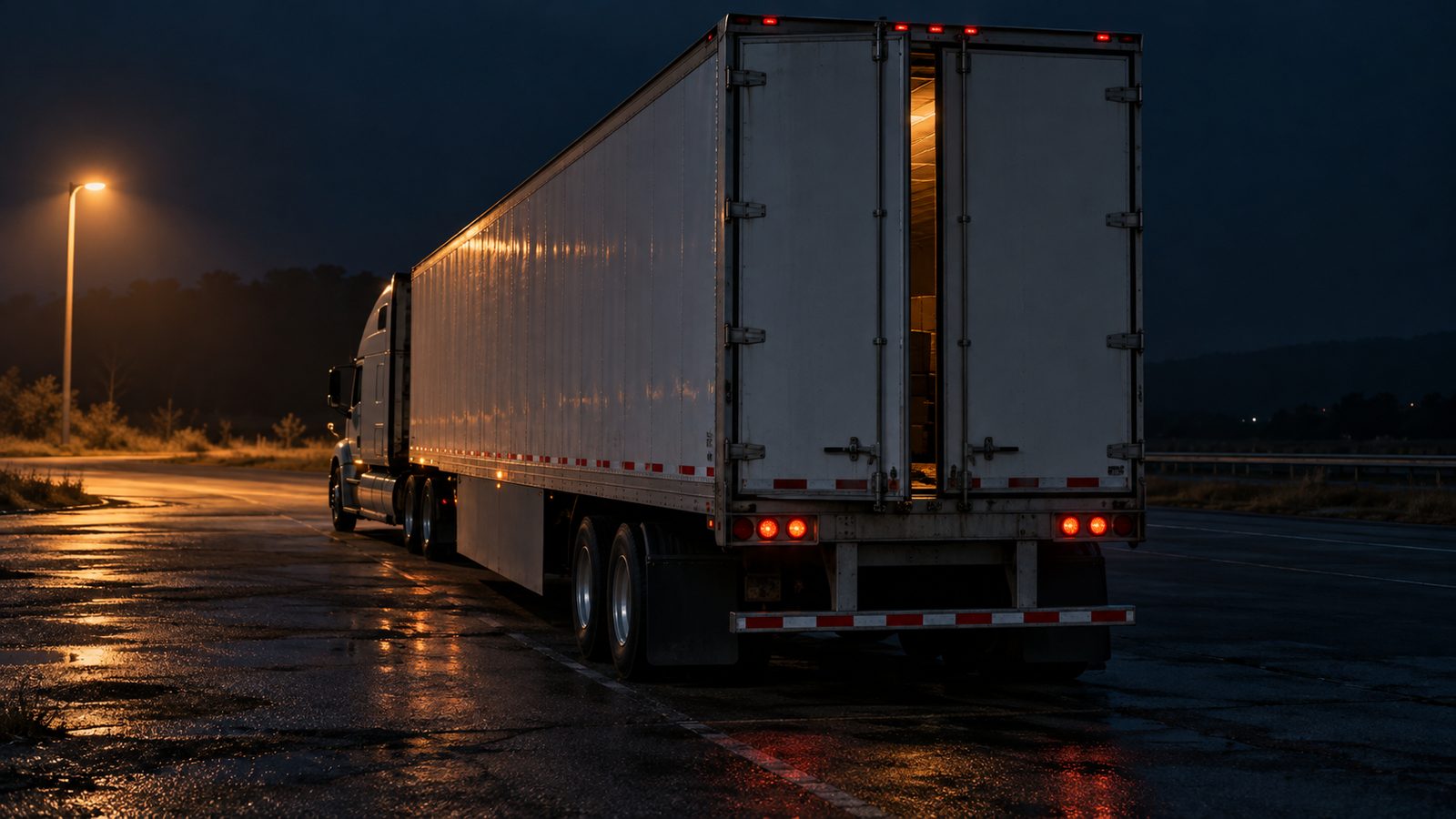
According to the IRS Criminal Investigation announcement of May 20, 2025, members and associates of the Artuni Enterprise “enrolled with Amazon as carriers, contracted for trucking routes,” then diverted from those routes and stole all or part of the shipments. FreightWaves and CDL Life reported the same pattern.
In plain terms, the alleged scheme ran in four steps:
- Register real carriers. The companies were reportedly real, DOT- and MC-numbered motor carriers, not borrowed identities.
- Win real freight. They used Amazon Relay to get legitimately contracted loads and routes.
- Diverge in transit. Prosecutors allege that drivers diverged from the assigned route while hauling a contracted load.
- Take part of the load, sometimes all of it. A portion of the shipment, and in some cases the whole thing, allegedly never reached its destination. CNBC reported that the goods were allegedly resold or given to associates.
No source describes how the freight was physically removed, and we won’t guess. The record does show why the alleged scheme could repeat. A load that arrives a few cases light looks like a counting error. A late arrival looks like traffic. Spread across separate loads, separate days and several carriers over four years, those shortfalls read as ordinary shrinkage: noise every large shipper expects and absorbs.
It took a broader federal organized-crime investigation, led by Homeland Security Investigations in Los Angeles with IRS-CI, the LAPD and other agencies, to bring charges. Shipper-side loss detection did not stop it. “This transnational criminal organization operated with the structure and brutality of an international cartel,” an HSI official said in the announcement.
The cargo theft is one strand of a larger case. The same announcement covered separate attempted-murder and kidnapping charges arising from a power struggle between two rival leaders. Prosecutors describe that strand as distinct from the Amazon scheme. Ara Artuni, 41, of Porter Ranch, is named as the alleged leader of the Artuni Enterprise and is charged with attempted murder in aid of racketeering. Prosecutors allege that he and his enterprise have also committed crimes since at least 2021 including bank fraud, wire fraud and cargo theft. No other defendant is publicly tied to the Amazon scheme in the sources we reviewed. All defendants were charged by complaint and are presumed innocent unless proven guilty in court.
Timeline of the case
| Date | Event | Source |
|---|---|---|
| Since at least 2021 | The Artuni Enterprise allegedly begins using registered trucking companies to win Amazon Relay freight, then diverting and stealing all or part of shipments | IRS-CI; FreightWaves; CDL Life |
| May 20, 2025 | Thirteen alleged members and associates arrested in California and Florida on five federal criminal complaints; about $100,000 in cash, 14 firearms and three armored vehicles seized; one more defendant still sought | IRS-CI |
| May 20–21, 2025 | U.S. Attorney’s Office (Central District of California), ICE and IRS-CI announce the charges; CNBC and trade press report the $83M Amazon figure | IRS-CI; CNBC; FreightWaves; CDL Life |
| As of Oct 2026 | No plea, trial date or conviction reported in the sources we reviewed | Level5Fleet review of public reporting |
The numbers
| Figure | What it measures | Source |
|---|---|---|
| $83M+ | Value of goods allegedly stolen from Amazon since at least 2021, “according to estimates provided by Amazon” | IRS-CI |
| 13 | People arrested on May 20, 2025 (all strands of the case) | IRS-CI |
| 5 | Federal criminal complaints | IRS-CI |
| 10 years to life | Range of statutory maximum sentences across all charges, if convicted | IRS-CI |
| $725M | Estimated U.S. and Canada cargo theft losses in 2025, up 60% from 2024 | Verisk CargoNet |
| $273,990 | Average value per cargo theft incident in 2025, up 36% | Verisk CargoNet |
| 1,218 | California cargo theft incidents in 2025, the most of any state | Verisk CargoNet |
The $83 million is Amazon’s estimate, cited by prosecutors, not a figure proven in court. The CargoNet numbers are industry-wide estimates that give context but are not tied to this case, and the seizures relate to the whole operation, not specifically the Amazon strand.
Amazon Relay requirements: what onboarding checks, and what it can’t
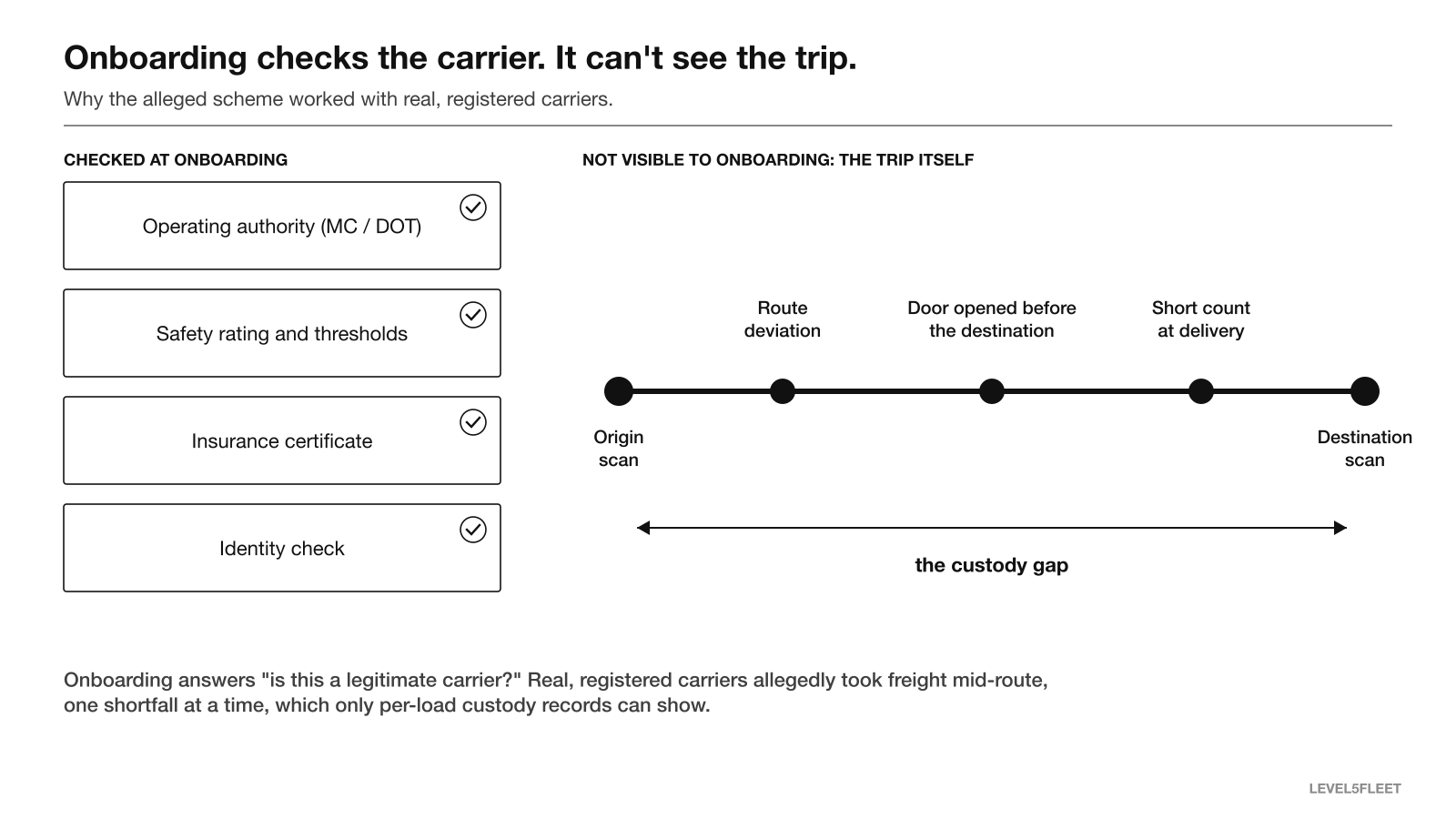
Most people search Amazon Relay requirements to get on the load board. For shippers and brokers, the better question is what those requirements prove. Amazon’s current get-started page lists:
- Authority: a valid MC number and a DOT number with interstate authority, registered as a “Carrier” entity “Authorized for Property and for Hire.”
- Safety rating: an FMCSA safety rating of “Satisfactory,” “None,” or “Not Rated.”
- BASIC scores: Unsafe Driving and HOS Compliance below 60%; Vehicle Maintenance, Controlled Substances/Alcohol and Driver Fitness below 75%. Amazon says its thresholds are 5% stricter than federal ones.
- Inspection history: driver violation rate at or below 35% and vehicle violation rate at or below 50%, based on the past 12 months of FMCSA inspection data.
- Insurance: $1M per occurrence / $2M aggregate commercial general liability; $1M auto liability with $50,000 trailer replacement; at least $100,000 cargo; workers’ compensation; and $100,000 employer liability.
- Identity: Amazon says it uses personal information “to confirm your identity and your company’s eligibility,” through the identity provider Persona.
These are today’s published requirements; we don’t know exactly which checks applied to the carriers in this case from 2021 on. The point holds either way. Every item on that list describes the company, its paperwork and its safety record. None of them describes what happens to a particular load between the origin dock and the destination door.
| Onboarding check | What it proves | What it doesn’t prove |
|---|---|---|
| Active MC and DOT authority | The carrier is a registered, for-hire motor carrier | That this load will arrive complete |
| Safety rating and BASIC scores | The carrier’s safety and compliance history | Anything about cargo custody or theft risk |
| Insurance certificates | Coverage exists for a claim | That a loss will be detected, or attributed |
| Identity verification of the applicant | The applicant is who they say they are | That a real, verified carrier is honest |
| Booking through the platform | The load was assigned to a vetted account | Where the trailer went, or when the doors opened |
According to prosecutors, a real carrier with clean paperwork was the method, not a way around the check. That is why the fix for impersonation schemes, verifying the carrier’s identity, would not have caught this one.
Warning signs of an organized cargo theft ring inside your carrier base
When the carriers are real, the warning signs are in the load data, not the onboarding file. Watch for:
- Repeat short counts from the same MC number, each small enough to be closed out as a counting error.
- Shortages that cluster on certain lanes, product types or delivery windows with the same small group of carriers.
- Unplanned stops or dwell time on a contracted route, especially between the last scan at origin and the first scan at destination.
- Routes that leave the expected corridor with no matching explanation in the driver or dispatch record.
- Seal numbers at delivery that don’t match the bill of lading, or seals reported as “missing” more often from one carrier than its peers.
- Several carriers sharing contacts, addresses or equipment while presenting as unrelated companies.
- Shrinkage booked in aggregate so that no one can tell which carrier was responsible for which shortfall.
Pro Tip: Close no short-shipment claim as “counting error” until it has been logged against the carrier’s MC number. A pattern you can’t attribute is a pattern you will never see.
How to prevent cargo theft by a vetted carrier: 7 steps
- Reconcile every load at both ends. Compare piece count, weight and seal ID at origin against the destination scan, automatically, on every load. Why: in our analysis of this case, reconciliation is the control that would have caught a partial diversion on the load where it happened.
- Attribute every shortfall to a carrier. Store each short shipment against the MC number that hauled it. Why: one short load is noise; the same carrier showing up across many is a signal.
- Set a carrier-level shortfall threshold that triggers review. Define a count or value over a rolling window, and review automatically when a carrier crosses it. Why: it turns pattern detection from a hunch into a process.
- Compare live position against the contracted route. Review deviations and long stops while the load is still moving, not at delivery. Why: a deviation flagged in transit can still be acted on; one found at the dock can’t.
- Treat seal and door events as custody records. Record who opened the trailer, where and when, against the load. Why: an access event away from the consignee is evidence, not a mystery.
- Look for links between “unrelated” carriers. Check shared contacts, addresses and equipment across your carrier base. Why: as alleged here, one network can operate several real companies.
- Report suspected theft to law enforcement and keep the records. Preserve scans, seal logs and location history. Why: in this case, charges came from a federal investigation, and evidence from shippers helps those cases.
| Control | Catches identity fraud | Catches a real carrier stealing in transit |
|---|---|---|
| Carrier onboarding and vetting | Yes, often | No |
| Delivery-only counts | No | Late, and only if attributed |
| Origin-to-destination reconciliation | No | Yes, on the affected load |
| Live route and dwell review | Sometimes | Earlier, while the load is moving |
| Carrier-level shortfall tracking | No | Yes, as a pattern |
Perspective: the paperwork was never the weak point
The industry has spent years getting better at one question: is this carrier who they say they are? That’s the right question for impersonation fraud. This case, as prosecutors describe it, shows its ceiling. If the alleged facts hold, the carriers were real, the authority was real and the contracts were real. Every check pointed at the company. None pointed at the load.
My view is that we have mixed up vetting with custody. Vetting is a decision you make once, at the door. Custody is a fact that has to be true at every mile of every load. A carrier can pass every onboarding test honestly and still be the wrong party to have unsupervised access to a trailer’s contents.
The second lesson is about measurement. Every large shipper carries some shrinkage, and the easy move is to treat it as a cost of doing business. But a loss you can’t attribute is a loss you can’t learn from. The alleged scheme didn’t need to beat a control. It only needed nobody to connect small shortfalls across many loads.
No product dismantles a criminal enterprise; that took a federal investigation. What the industry can do is make sure that a short load is noticed on the day it happens, against the carrier that hauled it, with a record of when and where the doors opened.
— Gwagsi Glenn, Growth Analyst, Level5Fleet
Where Admiral fits, and where it doesn’t
We’d rather be exact than flattering here. Our episode analysis sorts the controls for this case into three groups: what would have prevented it (per-load origin-to-destination reconciliation), what would have shortened it (mid-route deviation and dwell review, and carrier-level shortfall tracking) and what would not have helped (carrier identity verification at booking). Here’s how Admiral maps to that.
| Admiral capability | Effect in this case | Why |
|---|---|---|
| Admiral Resolve (free identity verification for pickup, access and change requests) | Would not have helped | Resolve confirms that a request comes from the real person, acting for the correct company, authorized for that load. Here, the carriers reportedly were the real, authorized party. |
| Admiral Lock with digital seal history | Shortened | The Lock records who broke a seal, where and when, and can unlock automatically at the authorized consignee. A door event recorded away from the consignee is per-load evidence. Configured to stay locked in transit, a mid-route opening would need an authorization the carrier didn’t have, which is the closest Admiral comes to prevention here. The sources don’t say how goods were removed, so we don’t claim it would have prevented this case. |
| Admiral Hub location and event record | Shortened | The Hub uses GPS, motion and vibration sensing and keeps “a record of what was permitted and what actually happened,” which supports reviewing deviations and stops against the contracted route. |
| Custody records attributed to an actor | Aided detection | Records that name who acted, where and when let shortfalls be tied to a carrier over time, the pattern view this case was missing. |
| Trailer Immobilizer | Not the relevant control | It stops unauthorized hookups and movement. In this case, the carrier was authorized to move the load. |
| Piece-count reconciliation at the dock | Outside Admiral | Count and weight reconciliation belongs in the shipper’s dock and warehouse systems. Admiral’s custody record adds the door and location history around those counts. |
Admiral would not have replaced the federal investigation, and it doesn’t count cartons. It adds a custody record for each load: whether the doors opened before the destination, and who opened them. If you ship high-value freight with third-party carriers, see how Admiral works for cargo owners, or ask about the Enforce Pilot.
FAQ
What is cargo theft?
Cargo theft is the theft of goods while they are moving through the supply chain: from trucks, trailers, containers, rail cars, warehouses or terminals. It ranges from opportunistic break-ins to strategic schemes built on fraud, like fictitious pickups. In the case above, prosecutors allege theft by the carriers hired to haul the freight.
What is a cargo theft ring?
A cargo theft ring is an organized group that steals freight repeatedly, usually with roles split between people who get access to the load, move it and sell the goods. Prosecutors describe the Artuni Enterprise as one such alleged network, operating several real trucking companies over multiple years. The charges are allegations, not findings.
What federal law covers theft from an interstate shipment?
The main federal statute is 18 U.S.C. § 659, which makes it a crime to steal or embezzle goods moving as part of an interstate or foreign shipment, or to knowingly receive or possess them. The maximum is 10 years in prison, or 3 years if the value is under $1,000. The sources we reviewed don’t specify which statutes underlie the cargo-theft allegations in this case.
How common is cargo theft in California?
California recorded 1,218 cargo theft incidents in 2025, more than any other state, according to Verisk CargoNet. Across the U.S. and Canada, CargoNet estimated $725 million in losses in 2025, up 60% from 2024.
What is load diversion?
Load diversion is when freight is sent somewhere other than its contracted destination, in whole or in part, by someone with access to it. In this case, prosecutors allege that drivers diverged from assigned routes and stole all or part of shipments. Route deviation review and origin-to-destination reconciliation are the main ways to detect it.
Sources
- IRS Criminal Investigation, “Thirteen members and associates of rival Armenian syndicates arrested on federal complaints alleging attempted murder, kidnapping, theft,” May 20, 2025. https://www.irs.gov/compliance/criminal-investigation/thirteen-members-and-associates-of-rival-armenian-syndicates-arrested-on-federal-complaints-alleging-attempted-murder-kidnapping-theft
- U.S. Attorney’s Office, Central District of California, press release, May 2025. https://www.justice.gov/usao-cdca/pr/13-members-and-associates-rival-armenian-syndicates-arrested-federal-complaints
- FreightWaves, “Armenian crime rings charged with attempted murder, $83M Amazon cargo theft,” May 2025. https://www.freightwaves.com/news/armenian-crime-rings-charged-with-attempted-murder-83m-amazon-cargo-theft
- CDL Life, “Armenian crime ring members accused of fraudulently contracting with Amazon for trucking routes to steal $83 million in goods,” 2025. https://cdllife.com/2025/armenian-crime-ring-members-accused-of-fraudulently-contracting-with-amazon-to-steal-83-million-in-goods/
- CNBC, “Armenian organized crime rings charged with stealing $83 million in Amazon cargo,” May 20, 2025. https://www.cnbc.com/2025/05/20/doj-charges-armenian-crime-ring-in-amazon-theft-worth-over-83-million.html
- Amazon Relay, “Apply to Amazon Relay” (carrier requirements), accessed October 14, 2026. https://relay.amazon.com/get-started
- Verisk, “Cargo Theft Losses Surge to Estimated $725 Million in 2025, Verisk CargoNet Analysis Reveals,” January 2026. https://www.verisk.com/company/newsroom/cargo-theft-losses-surge-to-estimated-$725-million-in-2025-verisk-cargonet-analysis-reveals/
- 18 U.S.C. § 659, Interstate or foreign shipments by carrier; State prosecutions (Cornell LII). https://www.law.cornell.edu/uscode/text/18/659
- Courthouse News Service, “13 Armenian mafia members arrested in connection to murder, $83M Amazon cargo theft,” May 2025. https://www.courthousenews.com/13-armenian-mafia-members-arrested-in-connection-to-murder-83m-amazon-cargo-theft/
- ABC7 Chicago, “13 suspects in Armenian organized crime ring arrested in federal bust,” May 2025. https://abc7chicago.com/post/13-suspects-armenian-organized-crime-ring-arrested-sun-valley-california-home-among-locations-raided/16488395/