
Carrier Vetting Passed. The Freight Was Gone Anyway: Inside a $4.49M Impersonation Ring

Carrier vetting confirms that a motor carrier is real, registered and authorized to haul freight. It does not confirm that the driver and truck at your dock work for that carrier. In a case the Manhattan District Attorney announced in June 2026, prosecutors allege eight men took about $4.49 million in freight using real carriers’ genuine MC and DOT numbers, so every registration check came back clean.
TL;DR
- Prosecutors allege an eight-person crew picked up six loads worth about $4.49 million between October 2025 and April 2026 by presenting as legitimate, registered carriers.
- The crew allegedly used real carriers’ names, MC numbers and DOT numbers rather than fake ones, so a standard FMCSA lookup would have returned an active, legitimate carrier.
- The failure point was authorization, not registration: nobody confirmed that this driver and this truck had been dispatched by the real carrier for this load.
- The FBI’s April 2026 cargo-theft alert tells shippers and brokers to verify pickups independently, using secondary methods, before releasing any load.
- A complete carrier vetting process ends at the dock with a check of the person and the equipment, through a channel the driver did not supply.
Table of Contents
- What is carrier vetting?
- The case: how an alleged ring passed carrier verification
- Case timeline
- The numbers
- What each vetting check proves, and what it doesn’t
- Warning signs of carrier impersonation at pickup
- How to close the gap: a pickup verification checklist
- Perspective: vet the handoff, not just the company
- Where Admiral fits, and where it doesn’t
- FAQ
- Sources
What is carrier vetting?
Carrier vetting is the process shippers and brokers use to confirm a motor carrier is legitimate before giving it freight. A typical process checks the carrier’s USDOT and MC numbers with FMCSA, its operating authority, its insurance and its safety record. It establishes that a company exists. It does not establish who arrives to collect the load.
Most carrier vetting happens at onboarding or tender, and it is built to catch a fake trucking company: an invented name, a fake MC number, revoked authority, missing insurance. Those checks still matter. GAO has described “chameleon carriers” that register under a new identity “to disguise their former identity and evade detection by FMCSA.”
Impersonation is a different problem. The carrier is real and its records are clean, because the impostor borrows them. Verisk CargoNet’s Q1 2026 report says “criminal networks have largely settled on impersonating legitimate motor carriers and logistics brokers.” A vetting process that stops at the database lookup is built for the older threat.
The case: how an alleged ring passed carrier verification
A tractor-trailer pulls up to a loading dock. The name on the door, the MC number and the DOT number all match the paperwork. Staff check the numbers, get a clean result and load the freight.
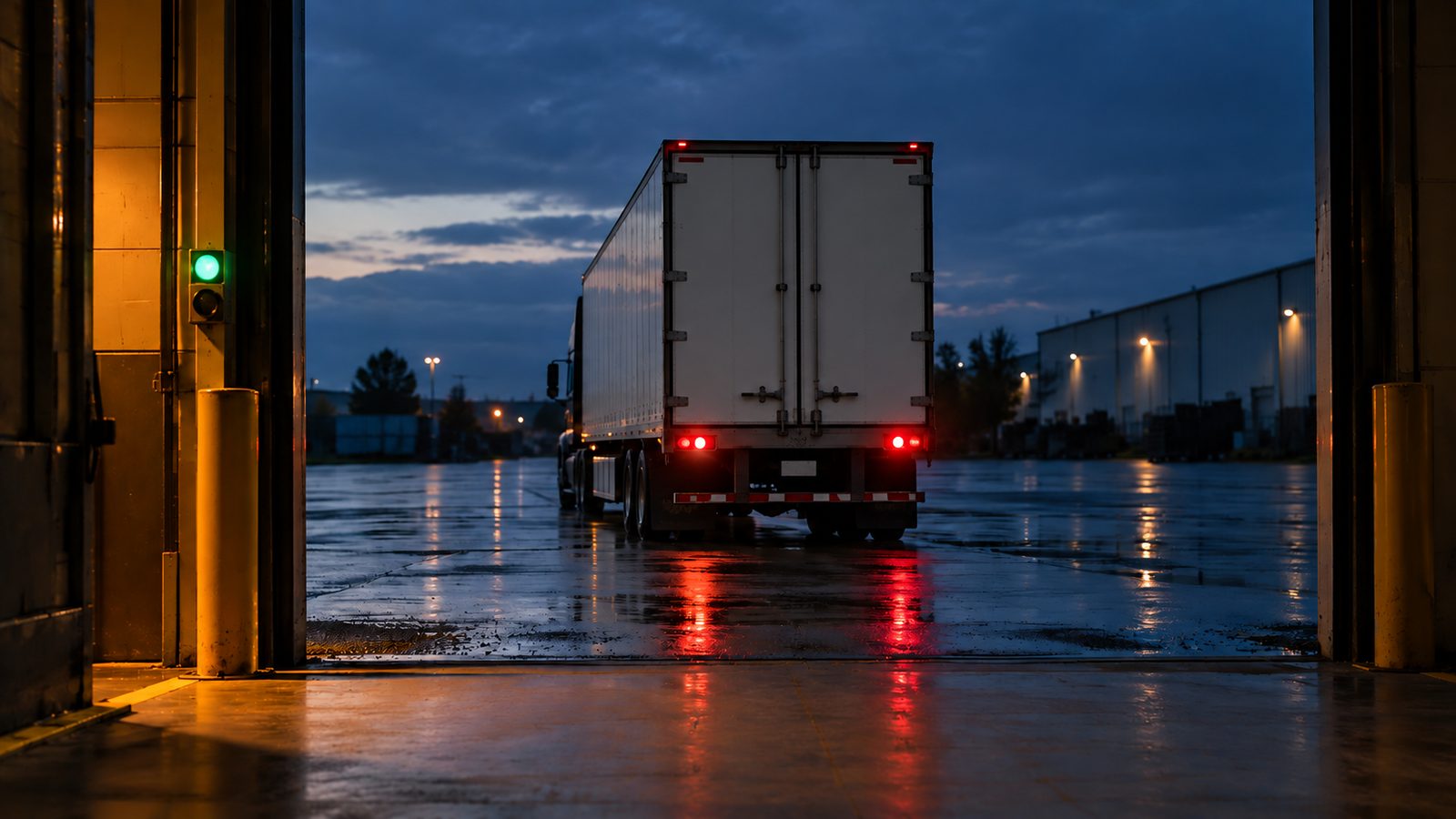
According to an indictment announced by Manhattan District Attorney Alvin L. Bragg, Jr. on June 3, 2026, that is how eight men allegedly moved about $4.49 million in cargo over roughly seven months, without forging a credential.
The Manhattan DA’s Office, working with the NYPD and the NYC Business Integrity Commission, charged Murodullo Khasanov, Nodir Kobilov, Shavkatbek Mamadjanov, Rakhmiddin Abdullaev, Aleksey Vorobyev, Nizom Ismoilov, Doston Mardoev and Dilshod Nabiev in New York County Supreme Court under case IND-71638-26. Port Authority police were also reported to be part of the investigation. Bragg called it “a wide-ranging and brazen, multimillion-dollar interstate retail theft conspiracy.” All eight are presumed innocent, and no trial date has been reported.
According to case reporting, prosecutors allege that load information came from phishing operations run by associated criminal groups; how those worked has not been made public. The crew then allegedly displayed the actual name, MC number and DOT number of an existing, legitimately registered carrier on a leased tractor-trailer and collected the freight as that carrier. Khasanov, the alleged organizer, is accused of using WhatsApp and Telegram to relay load information and documents and to dispatch drivers. Prosecutors allege the loads were driven into the Bronx and Manhattan, moved to other vehicles, stored and sold.
The borrowed identity is what makes this case worth studying. Onboarding checks are good at catching a fake MC number. Here, prosecutors allege, the identity was genuine and only the people using it were not.
Case timeline
| Date | Event | Source |
|---|---|---|
| October 2025 | Alleged scheme activity begins | Manhattan DA indictment, via FreightWaves and Transport Topics |
| November 2025 | About $165,000 in frozen lamb collected by a truck allegedly impersonating a carrier at a logistics center in Oldmans Township, NJ | FreightWaves; Transport Topics |
| December 2025 | About $432,000 in cheese (parmesan, pecorino, Manchego; about 25,395 lbs) taken from Elizabeth, NJ; the load was bound for Georgia | FreightWaves; Transport Topics |
| December 2025 | About $295,000 in frozen beef stolen | FreightWaves; Transport Topics |
| About Feb. 3, 2026 | More than $266,000 in copper rod (43,100 lbs) taken from a facility in Newark, NJ | Recycling Today; FreightWaves |
| March 2026 | Two cigarette loads taken from one Virginia facility, bound for Tennessee and Florida: $709,923 and $2.6 million | FreightWaves; Transport Topics |
| April 2026 | Alleged scheme activity ends | Manhattan DA indictment, via FreightWaves |
| June 3, 2026 | DA Bragg announces the eight-defendant indictment (IND-71638-26) | Manhattan DA press release |
| June 2026 | Prosecutors seek $1.5 million cash bail for Khasanov, who is ordered held pending a June 11 hearing | New York Post |
Exact dates within each month have not been disclosed, except for the copper load.
The numbers
The six itemized loads add up to the $4.49 million total reported by FreightWaves and Transport Topics. Verisk and others rounded it to “nearly $5 million,” which is a rounding difference, not a conflicting fact. The $2.6 million cigarette load alone is more than half the total.
No cargo recovery has been reported. The DA’s office has said it believes other, uncharged incidents may be tied to the same conduct and that the investigation is continuing. Verisk CargoNet says its analysts identified theft patterns that supported the case.
The case reflects a wider trend in organized cargo theft:
- $725 million: estimated U.S. and Canadian cargo theft losses in 2025, up 60% from 2024. The average value per theft rose 36% to $273,990 (FBI IC3, April 30, 2026).
- $131.58 million across 767 events: Verisk CargoNet’s Q1 2026 totals. Losses were essentially flat year over year while event counts fell 5.3%.
- +119%: New Jersey’s rise in Q1 2026 incidents, from 27 to 59. At least three of the six loads in this case left New Jersey facilities.
- $304.6 million: Verisk’s Q2 2026 loss estimate.
The pattern is fewer thefts, each worth more. “Criminal groups are investing more time in impersonation schemes,” said Ralph Pepe, senior intelligence analyst at Verisk CargoNet.
What each vetting check proves, and what it doesn’t
Most vetting steps prove something true about a company and nothing about the person at the dock. Here is how standard checks would have performed against this alleged scheme:
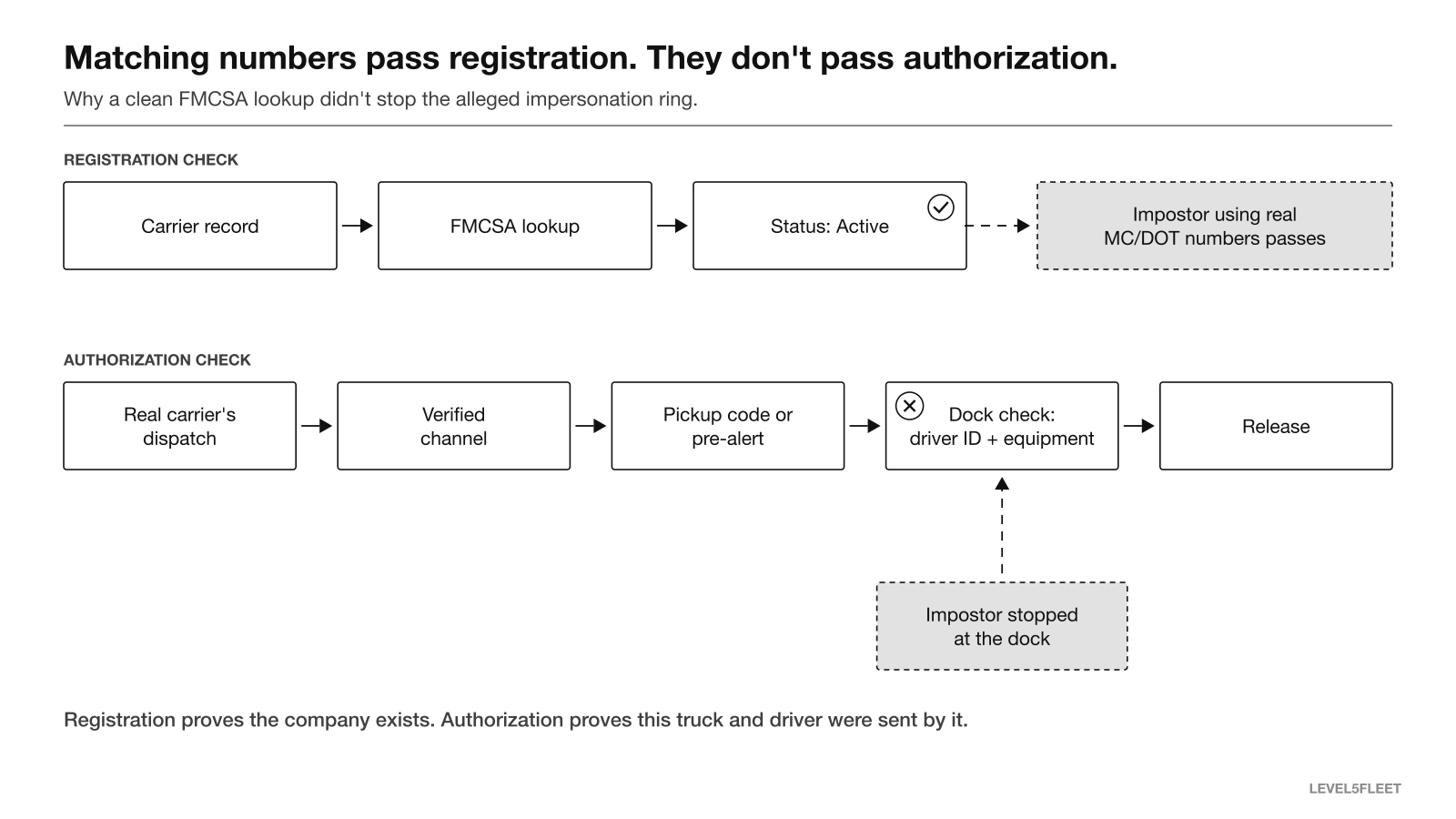
| Vetting check | What it proves | What it doesn’t prove | Would it have caught this scheme? |
|---|---|---|---|
| FMCSA lookup of the MC/DOT number | A carrier with that number is registered and active | That the truck presenting the number belongs to that carrier | No. The numbers were allegedly real |
| Operating authority and insurance on file | The carrier may legally haul for hire and is insured | That the carrier sent anyone to this pickup | No |
| Name and numbers on the truck door | Someone marked the truck with those details | Who controls the truck | No. They allegedly matched |
| Carrier packet, rate confirmation, BOL | Documents were exchanged and look consistent | That the documents came from the real carrier | Unlikely, if load data was compromised |
| Callback to a number the driver or email provides | Someone answers that number | That the person answering works for the carrier | No. The callback can reach the impostor |
| Callback to the carrier’s number on file in SAFER | The real carrier can confirm or deny the dispatch | Nothing on its own about the driver’s ID | Likely. The real carrier knows it didn’t send a truck |
| Pre-alert match (driver name, tractor and trailer numbers) plus ID check at the gate | The person and equipment match what the real carrier assigned | That the pre-alert itself wasn’t spoofed, unless it came through a verified channel | Yes, if the pre-alert came from the verified carrier |
| Pickup code sent shipper-to-carrier through a verified channel | The driver got the code from the real carrier’s dispatch | Driver identity on its own | Yes, if the channel is independent of the driver |
The checks that work confirm authorization through a channel the impostor doesn’t control. FMCSA’s fraud guidance makes the same point: if the number a carrier or broker gives you does not match the one posted in SAFER, call the SAFER number to discuss the load.
Warning signs of carrier impersonation at pickup
When the paperwork is clean, the warning signs show up in the process instead:
- The driver’s phone number, or the dispatch number on the paperwork, differs from the number listed for the carrier in FMCSA’s SAFER system.
- No pre-alert arrived from the carrier, or the driver’s name, tractor number or trailer number doesn’t match the pre-alert.
- The driver can’t name the carrier’s dispatcher, or the dispatcher can be reached only by text or a messaging app.
- Pickup is requested early, outside the appointment window, or with pressure to skip a step “because the receiver is waiting.”
- The trailer or tractor numbers on the equipment differ from those on the rate confirmation or BOL.
- The carrier contact uses a free email address or a domain one character off from the real one.
- A contact changes mid-load, or someone asks to reroute after tender.
Any one of these is a reason to hold the load and verify.
How to close the gap: a pickup verification checklist
- Keep onboarding vetting, but treat it as necessary, not sufficient. Check MC/DOT status, authority, insurance and safety record. Why: it filters out fake trucking companies and chameleon carriers, which still exist.
- Get dispatch contact details from SAFER or your own verified records, never from the load paperwork. Why: a callback to a number the impostor supplied only confirms the impostor.
- Require a pre-alert from the carrier’s verified dispatch for every pickup. It should include the driver’s name, tractor and trailer numbers and the arrival window. Why: it gives the dock something specific to match against besides the door placard.
- At the gate, match the driver’s government ID and the equipment numbers against the pre-alert before loading. Why: this is the step that turns registration into authorization.
- Use a one-time pickup code sent from shipper to the real carrier’s dispatcher, not to the driver. Why: a driver can only present the code if the real carrier gave it to him.
- Escalate every mismatch to a named supervisor, and allow no front-line overrides. Why: impostors rely on urgency and on staff not wanting to hold up a truck.
- Record who approved the release, when, and on what evidence. Why: a timestamped decision record gives investigators and insurers something to act on.
- Report attempts as well as losses. File with local police and IC3, and use FMCSA’s National Consumer Complaint Database for identity misuse. Why: in this case, patterns across incidents helped connect separate losses into one indictment.
Pro Tip: At onboarding, record the dispatch number each carrier wants you to call, confirmed against SAFER, so the dock never relies on a number from the driver.
Perspective: vet the handoff, not just the company
I think the freight industry has merged two questions that need to stay separate: “Is this a real carrier?” and “Did this real carrier send this truck, for this load, right now?” Our tools are very good at the first. This case, as prosecutors describe it, was built to exploit the second.
The fix isn’t a better database, since every database in this story would have returned the right answer. The fix is moving part of vetting to the moment custody changes hands, through a channel the person at the dock can’t influence. The FBI already says to “independently verify shipment requests and pickups using secondary methods prior to releasing any loads.”
The release decision usually falls to the person with the least context and the most time pressure. If their only tool is a lookup impostors are built to pass, we are asking them to stop organized theft with a checkbox. They should get a clear yes or no, decided by the real carrier, and recorded.
— Gwagsi Glenn, Growth Analyst, Level5Fleet
Where Admiral fits, and where it doesn’t
Admiral ties verified identity to what can happen to the freight. Here is how each part maps to this case, without overclaiming.
| Admiral capability | Effect in this case | Why |
|---|---|---|
| Admiral Resolve (identity, company and authorization check on pickup, access and change requests) | Could have prevented, if used at the release decision | Resolve shows whether the requester is the real person, acts for the correct carrier, and “is allowed to make this change for this load, right now,” which is the gap this case exposed. The named party confirms or declines the request itself, so a matching MC/DOT number and a marked truck aren’t treated as proof. Requests can be forwarded to verify@ with no pre-enrollment, and each decision leaves an audit trail. |
| Admiral Enforce (Trailer Immobilizer, Admiral Lock) | Would not have applied as reported | The crew allegedly brought its own leased tractor-trailer, and on-asset enforcement only controls Admiral-equipped trailers. In a drop-trailer program using equipped trailers, the immobilizer keeps the spring brakes engaged until an authorized driver’s fob or app talks to the Hub. That is a different scenario. |
| Admiral Execute | Only aids | It carries an approved carrier, appointment or swap to the dock, so staff see who approved what. In-transit restrictions still depend on equipped trailers. |
| Route-deviation alerting | Not an Admiral claim | Lane monitoring could have flagged diversions toward New York City sooner, shortening detection. Admiral’s location rules control where an equipped trailer’s doors and brakes may release, and the Hub records unplanned stops, but off-route alerting is a tracking function we don’t claim. |
| Trailer locks and seals | Would not have helped | The freight left through the front door with legitimate-looking paperwork. |
The control that matters most here is an authorization check at the moment of release, and that is what Resolve is for. Our Admiral platform brochure calls it the one unverified link: every other check can return yes while the person acting for the carrier was never verified. No platform would have dismantled a ring that prosecutors say ran for about six months across several states; investigators and cross-incident pattern analysis did that. A verified release decision makes each pickup harder to fake.
Resolve is free to use, within fair usage limits, with no hardware or contract. Start verifying pickups with Admiral Resolve, and request an Enforce Pilot when you want those decisions enforced on your own trailers.
FAQ
What is the carrier vetting process?
The carrier vetting process is a set of checks a shipper or broker runs before tendering freight. It usually covers USDOT and MC registration, operating authority, insurance and safety history. A complete process adds a pickup-time check that the driver and truck were dispatched by the real carrier, confirmed through contact details you sourced yourself.
How does carrier verification differ from carrier vetting?
Vetting usually means qualifying a carrier before you work with it; verification means confirming a specific transaction, such as this pickup. This case shows a carrier can pass vetting while a pickup made in its name is fraudulent.
What is a fake MC number, and does a valid one mean the carrier is legitimate?
A fake MC number is one that doesn’t belong to the company presenting it: either invented, or borrowed from a real carrier. A valid MC number shows only that some carrier holds that authority. In this case, prosecutors allege, the numbers were genuine and belonged to real carriers who never sent the trucks.
What is the FMCSA vetting process?
FMCSA registers motor carriers and publishes registration, authority and safety data that shippers and brokers can check through SAFER. It does not confirm who shows up at a particular pickup. In its 2012 review, GAO reported that FMCSA’s new-applicant vetting program covered passenger and household goods carriers, not freight carriers. Pickup-level verification remains the job of the shipper and broker.
How do you report FMCSA fraud or carrier identity theft?
File a police report for any stolen cargo, then report to the FBI’s IC3 at ic3.gov or your local FBI field office. FMCSA’s fraud guidance also points to its National Consumer Complaint Database for misuse of registration information and to the USDOT Inspector General hotline.
How can you spot a fake trucking company?
Look for recent changes to contact details, a phone number that differs from SAFER, free email domains and no verifiable dispatch office. Because impostors now often pose as real, established carriers, a long clean record isn’t proof. Confirm the specific dispatch with the carrier directly.
Sources
- Manhattan District Attorney’s Office, “D.A. Bragg, NYPD & BIC: Eight Indicted For Impersonating Shipping Carriers In Multi-State Retail Theft Ring,” June 3, 2026. https://manhattanda.org/d-a-bragg-nypd-bic-eight-indicted-for-impersonating-shipping-carriers-in-multi-state-retail-theft-ring/
- FreightWaves, “Eight indicted in alleged carrier impersonation scheme; prosecutors allege $4.49 million in cargo losses,” June 8, 2026. https://www.freightwaves.com/news/eight-indicted-in-alleged-carrier-impersonation-scheme-prosecutors-allege-4-49-million-in-cargo-losses
- Transport Topics, “Grand jury indicts 8 in cargo theft scheme tied to hacked data,” June 2026. https://www.ttnews.com/articles/cargo-theft-hacked-data
- Claims Journal, “Eight Indicted for Impersonating Shipping Carriers in Multi-State Retail Theft Ring,” June 10, 2026. https://www.claimsjournal.com/news/national/2026/06/10/338068.htm
- Recycling Today, “Copper included in goods stolen by alleged cargo theft ring, New York officials say,” June 2026. https://www.recyclingtoday.com/news/copper-included-in-goods-stolen-by-alleged-cargo-theft-ring-new-york-officials-say/
- Verisk, “Verisk CargoNet Assists in Manhattan DA Cargo Theft Indictment Targeting Multi-State Impersonation Ring,” June 9, 2026. https://www.verisk.com/company/newsroom/verisk-cargonet-assists-in-manhattan-da-cargo-theft-indictment-targeting-multi-state-impersonation-ring/
- New York Post (syndicated via Yahoo News), “Wannabe Uzbek mobsters staggering $4.5M ‘Goodfellas’ scheme,” June 3, 2026. https://www.yahoo.com/news/us/articles/wannabe-uzbek-mobsters-staggering-4-172247793.html
- FBI Internet Crime Complaint Center, “Cyber-Enabled Strategic Cargo Theft Surging,” PSA I-043026-PSA, April 30, 2026. https://www.ic3.gov/PSA/2026/PSA260430
- Verisk CargoNet, “2026 First Quarter Supply Chain Risk Trends Analysis.” https://www.cargonet.com/news-and-events/cargonet-in-the-media/2026-q1-theft-trends/
- Verisk, “Cargo theft losses more than double to $304 million in Q2,” 2026. https://www.verisk.com/company/newsroom/cargo-theft-losses-more-than-double-to-$304-million-in-q2-despite-a-drop-in-thefts-driven-by-high-value-metals-and-technology-heists/
- U.S. GAO, “Motor Carrier Safety: New Applicant Reviews Should Expand to Identify Freight Carriers Evading Detection,” GAO-12-364, March 2012. https://www.gao.gov/products/gao-12-364
- FMCSA, “Broker and Carrier Fraud and Identity Theft.” https://www.fmcsa.dot.gov/mission/help/broker-and-carrier-fraud-and-identity-theft