
Freight Broker Fraud: 11 Aliases, $10.1M in Freight, and a 5-Year Sentence

Freight broker fraud is when someone poses as a legitimate broker or motor carrier to get freight released to them, then diverts it. In one of the clearest recent cases, a Chicago-area man used at least 11 aliases to impersonate real and fictitious carriers and brokers from 2020 to 2023. He pleaded guilty to wire fraud and was sentenced in May 2026 to five years in federal prison for a scheme that took more than $10.1 million in copper and liquor.
TL;DR
- Aivaras Zigmantas of Elk Grove Village, Illinois, posed as an agent of real and invented carriers and brokers under at least 11 aliases between March 2020 and September 2023.
- Shippers, brokers and carriers released loads to him because his paperwork looked legitimate, and the freight was diverted away from its real destination.
- He was indicted on 13 federal counts in May 2024, pleaded guilty to wire fraud in December 2025, and was sentenced to 60 months in federal prison on May 6, 2026.
- The failure point was identity at booking, not security on the road, so trailer locks and seals would not have stopped this scheme on their own.
- The strongest defense is verifying who you are handing freight to through a channel the counterparty did not supply, and recording that decision.
Table of contents
- What is freight broker fraud?
- The case: how one man became 11 carriers and brokers
- Case timeline
- The numbers
- How freight broker fraud cases get prosecuted
- Warning signs of a fake carrier or fake broker
- How to prevent freight broker fraud: a 7-step checklist
- What carrier vetting actually proves
- Perspective: the check that matters happens before the truck arrives
- Where Admiral fits, and where it does not
- FAQ
- Sources
What is freight broker fraud?
Freight broker fraud is any scheme in which someone poses as, or hijacks the identity of, a freight broker or motor carrier to obtain loads or payments they are not entitled to. Common forms include carrier impersonation, fake trucking companies, double brokering and compromised FMCSA records. The usual goal is to get freight released, then divert it.
The core weakness: most freight changes hands between parties who never meet. A carrier is chosen on a company name, a DOT or MC number and an email address, and every one of those can be copied or invented.
The FBI’s Internet Crime Complaint Center (IC3) described the same pattern in an April 2026 public service announcement on “cyber-enabled strategic cargo theft.” It reports that threat actors spoof brokers, use compromised carrier accounts to post or accept loads, and update a carrier’s contact and insurance information with federal regulators so they can take loads the real carrier never accepted. IC3 estimates US and Canadian cargo-theft losses reached nearly $725 million in 2025, a 60% increase over 2024, with the average value per theft up 36% to $273,990.
Freight broker scams are rarely a single load. They are a repeatable process, as the Zigmantas case shows.
The case: how one man became 11 carriers and brokers
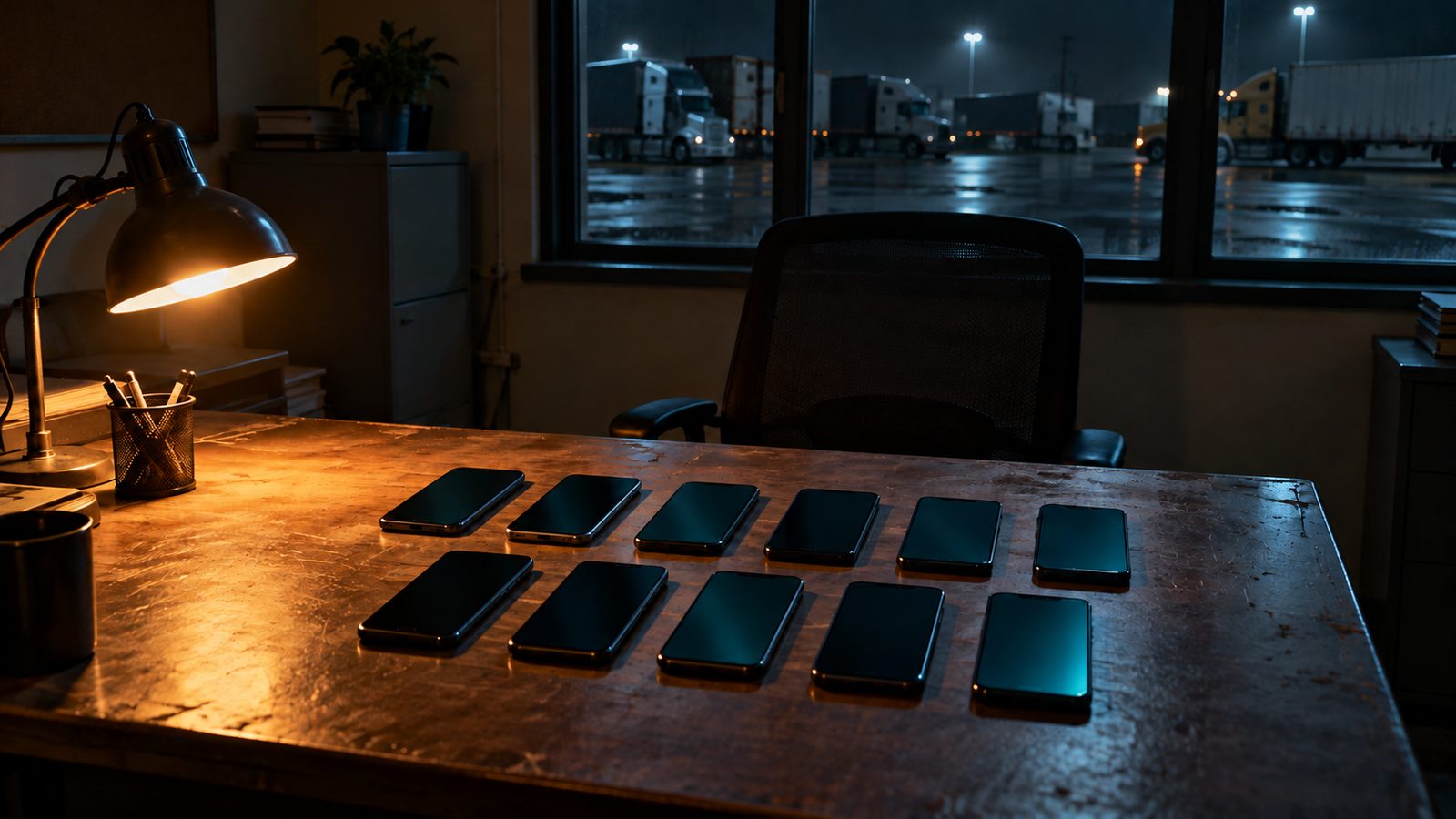
Between March 2020 and September 2023, Aivaras Zigmantas of Elk Grove Village, Illinois, built what looked like legitimate transportation businesses: fraudulent bank accounts, email addresses and business mailboxes under fictitious names, plus counterfeit identification. He presented himself as a representative of real motor carriers and brokers, and of entirely fictitious ones, using at least 11 aliases, male and female, including a persona named “Kathy Stone.”
The mechanism was simple, which is part of why it lasted:
- A credible identity. A company name, a contact person and paperwork that looked like a real carrier or broker.
- A load awarded. Shippers, carriers or brokers accepted that identity and awarded him shipments, handing over legitimate pickup and routing information.
- A diversion. Once the freight was released, it was diverted away from its intended destination with the help of others who have not been publicly identified.
- Repeat under a new name. Some identities were real companies he impersonated, others he invented outright, so no single red flag repeated the same way twice.
What he took was specific and valuable. Assistant U.S. Attorney Kate McClelland said he “stole more than $10 million in shipments of copper and liquor by fraudulently posing as employees” of carriers and brokers. Transport Topics reported the scheme involved roughly 90 shipments; no other outlet has confirmed that figure.
We are deliberately not describing how the documents were made or how the goods moved after pickup. The pattern is what matters: a fabricated identity, accepted at face value, used again and again.
A note on precision. Zigmantas pleaded guilty to wire fraud. The indictment also charged bank fraud and theft of interstate shipments, and no public source we reviewed states how those remaining counts were resolved. This article does not say he was convicted on them.
Case timeline
| Date | Event | Source |
|---|---|---|
| March 2020 | Scheme begins, according to the federal indictment | USAO-NDIL charging release; CBS News Chicago |
| March 2020 – September 2023 | Zigmantas uses at least 11 aliases to pose as an agent of real and fictitious carriers and brokers, obtains interstate freight and diverts it | USAO-NDIL; CBS News Chicago; FreightWaves |
| May 14, 2024 | Federal grand jury in the Northern District of Illinois returns a 13-count indictment (case 1:24-cr-00243): 6 counts of wire fraud, 5 of bank fraud, 2 of theft of interstate shipments | USAO-NDIL; PacerMonitor docket |
| June 2024 | Initial appearance in federal court in Chicago; pleads not guilty | CBS News Chicago; FreightWaves |
| December 2025 | Pleads guilty to wire fraud | CDL Life; FreightWaves; Transport Topics; Carrier Atlas |
| May 6, 2026 | U.S. District Judge Elaine E. Bucklo sentences him to 60 months in federal prison | USAO-NDIL sentencing release; CDL Life |
The numbers
| Figure | What it measures | When |
|---|---|---|
| $9.5 million+ | Amount stolen, as alleged at indictment | May 2024 |
| $13.5–13.6 million | Amount the scheme allegedly intended to steal, at indictment | May 2024 |
| $10.1 million+ | Amount stolen, per sentencing-stage figures | May 2026 |
| $14.6 million | Amount intended, per sentencing-stage figures | May 2026 |
| 11+ | Aliases used | 2020–2023 |
| 60 months | Prison sentence imposed | May 6, 2026 |
| $10.3 million | Restitution to 24 companies (reported by Transport Topics only) | May 2026 |
The totals grew between charging and sentencing, from $9.5 million to $10.1 million stolen, consistent with continued loss accounting. The first number in a freight fraud case is rarely the final one.
No public source says whether any of the copper or liquor was physically recovered. Restitution is a financial order, not a returned load. That matters, because the American Transportation Research Institute (ATRI) found in October 2025 that 74% of stolen freight is never recovered.
How freight broker fraud cases get prosecuted
Freight broker fraud usually crosses state lines and runs on email, phone and bank transfers, which makes it federal. Here, the U.S. Attorney’s Office for the Northern District of Illinois prosecuted, Homeland Security Investigations (Chicago) and U.S. Customs and Border Protection investigated, and the case was handled as part of the Department of Justice’s Trade Fraud Task Force.
The indictment named three offenses, and it cites the statute for each count: wire fraud under 18 U.S.C. § 1343 (Counts 1–6), theft of interstate shipments under § 659 (Counts 7–8), and bank fraud under § 1344(1) (Counts 9–13).
| Offense charged | Federal statute | What it covers | Statutory maximum per count |
|---|---|---|---|
| Wire fraud | 18 U.S.C. § 1343 | A scheme to defraud, or to obtain money or property by false pretenses, carried out using interstate wire communications (email, phone, electronic transfers) | 20 years; 30 years and a $1 million fine if it affects a financial institution |
| Bank fraud | 18 U.S.C. § 1344 | A scheme to defraud a financial institution, or to obtain its money or property by false pretenses | 30 years and a $1 million fine |
| Theft of interstate shipments | 18 U.S.C. § 659 | Stealing, or obtaining “by fraud or deception,” goods moving in an interstate or foreign shipment, including from a truck, trailer or warehouse | 10 years (3 years if the value is under $1,000) |
The timeline is the lesson. The scheme ran about three and a half years before the 2024 indictment and took two more years to reach sentencing. Statutory maximums are ceilings, not predictions: the court imposed 60 months here. Prosecution closes cases; it does not stop the next load from leaving the dock.
Warning signs of a fake carrier or fake broker
Drawn from this case and the IC3 advisory. None proves fraud alone; each is a reason to verify through a second channel.
- The contact details on the rate confirmation or carrier packet differ from those listed for the same company in FMCSA records, or from what you have on file from earlier loads.
- A familiar company name or email address arrives from a new domain, a lookalike domain or a free webmail account. IC3 warns that familiar names or email addresses alone do not confirm authenticity.
- A carrier’s FMCSA contact or insurance information changed recently, especially just before it asks for high-value loads.
- The same phone number, bank account or remittance details appear under two different company names in your system.
- A “dispatcher” or “agent” claims to represent a real, established carrier, but cannot be reached through the carrier’s published main line.
- Pressure to release a load quickly, skip a step, or change pickup details by phone or text.
How to prevent freight broker fraud: a 7-step checklist
- Look up every carrier and broker in FMCSA’s SAFER Company Snapshot before tendering. Why: it confirms the USDOT or MC number exists and shows its status and operating authority, which filters out invented companies.
- Call back on a number you sourced yourself. Why: an impersonator controls the phone number and email they give you, but not the real company’s published main line.
- Treat recent changes to contact, insurance or banking details as a hold, not a formality. Why: IC3 reports that thieves update a hijacked carrier’s information with regulators to take loads the real carrier never accepted.
- Cross-check identity data across bookings. Why: repeated bank, phone or email details under different names are a pattern a database catches and a busy rep misses.
- Confirm the driver, tractor and trailer at pickup against what the carrier sent in advance. Why: IC3 recommends independently verifying pickups with secondary methods before releasing any load.
- Record who approved each release and how they verified it. Why: a decision trail speeds investigations and claims and shows where the process broke.
- Report suspected fraud quickly to law enforcement and IC3. Why: cases like this span many victims, and early reports help investigators connect them.
Pro Tip: Make “verify through a channel the counterparty did not give you” a hard rule for every new carrier and every changed detail. It is the one check that defeats both invented companies and impersonated real ones.
What carrier vetting actually proves
Most carrier vetting confirms that a company exists. It does not confirm that the person you are talking to works for it. That gap is where this scheme lived.
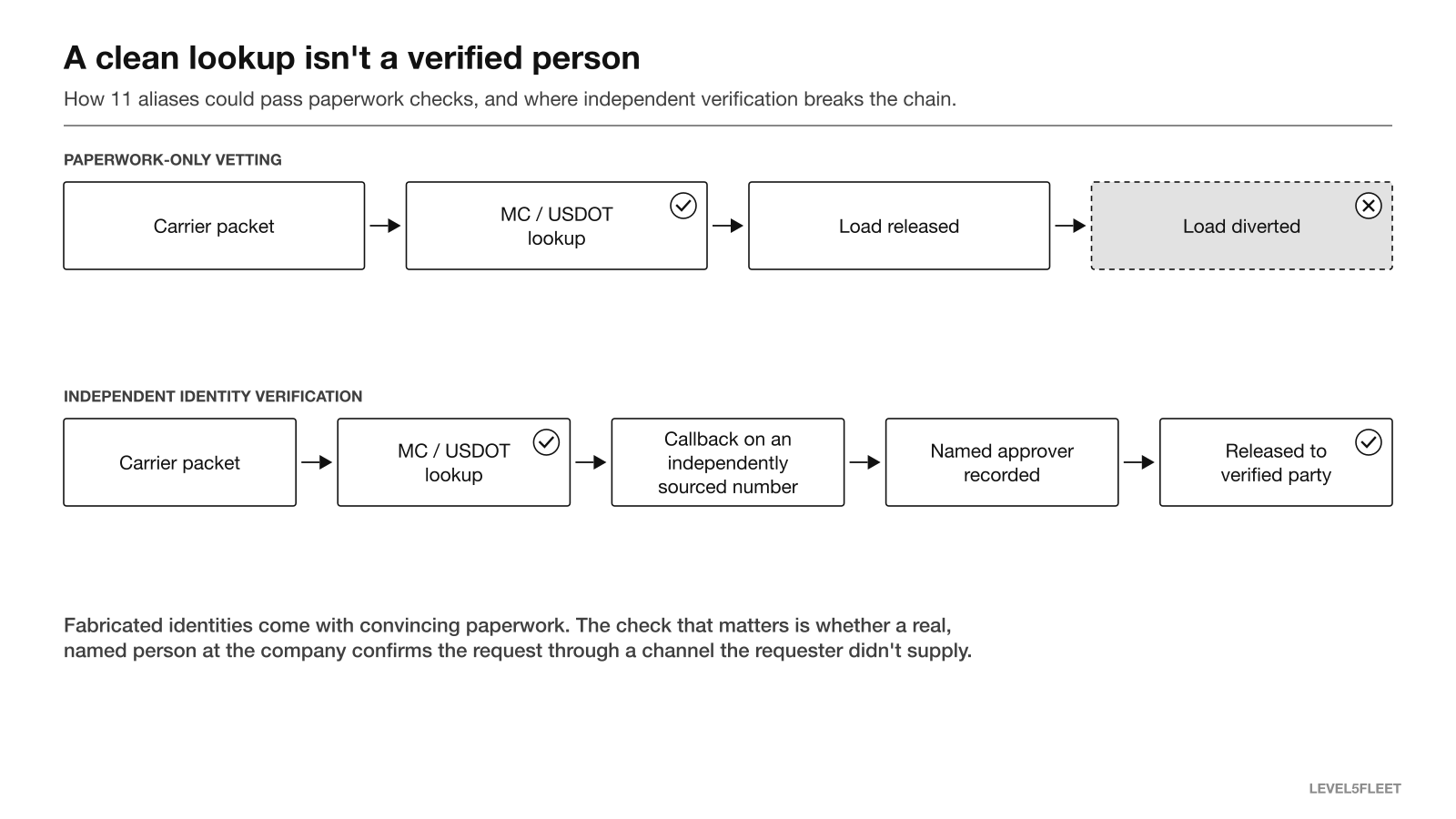
| Vetting check | What it proves | What it does not prove |
|---|---|---|
| MC or USDOT number is active in FMCSA records | A registered company with that number exists | That the person emailing you represents it |
| Certificate of insurance on file | A policy was issued to that company | That the certificate is current or genuine, or that the sender controls it |
| Company name and logo on paperwork | Someone has those documents | Anything at all; logos and letterheads are easy to copy |
| Email from the company’s usual domain | The message came from that domain | That the account is not compromised; IC3 warns familiar addresses are not proof |
| Callback on a number you looked up independently | The real company confirms the request | Identity of the driver who shows up at pickup |
| Verified identity recorded against the specific load | A named, confirmed person approved this release | Nothing about route integrity after pickup |
Perspective: the check that matters happens before the truck arrives
Most cargo theft coverage focuses on the moment freight disappears. This case is a useful correction. Nothing went wrong on the road. Every load in this scheme left the dock exactly as the shipper or broker intended, because someone had already decided the person on the other end was legitimate.
That is why I don’t think the answer to freight broker fraud is more tracking. A GPS ping tells you where the freight went, not whether the party you released it to should have had it.
The second thing I take from this case is the timeline. Three and a half years of operation, two more years to sentencing. Prosecution worked, and it matters that it did, but it is not a prevention strategy. The only point where a shipper or broker controls the outcome is the moment of the decision to release. That decision deserves the same rigor we give to a wire transfer: independent confirmation, a named approver, and a record.
— Gwagsi Glenn, Growth Analyst, Level5Fleet
Where Admiral fits, and where it does not
This case was unwound by a multi-year federal investigation, not a product, and no platform would have “caught” Zigmantas on its own.
Would have prevented: identity verification before release. The whole scheme depended on counterparties accepting a fabricated carrier or broker identity before freight was handed over. That checkpoint is what Admiral Resolve is built for. Resolve verifies pickup, access and change requests before they are approved: whether the request came from the real person, whether that person acts for the company they claim, and whether they are authorized for that specific load. The named party confirms or declines the request itself, so a fabricated identity with convincing paperwork doesn’t pass on documents alone. Approvals and denials are recorded as an audit trail, and Resolve is free to start (fair usage limits apply). Combined with independent FMCSA lookups, this is the step that closes the opening used here.
Would have shortened detection: pattern checks across bookings. Flagging the same bank details or phone numbers under different company names could have surfaced this scheme far sooner. Resolve’s decision records keep who-approved-what in one place, which helps that review, but alias detection depends on your own booking data; Admiral does not detect aliases automatically.
Would not have helped on its own: physical locks and immobilization. Admiral Enforce embeds authorization rules on trailers and containers so doors stay locked and trailers stay immobilized until an action is authorized. That stops unauthorized hookups and cargo access. But in this case the freight was handed over to someone who had been wrongly approved. A lock enforces a decision; it cannot fix a wrong one. Enforce adds value only when the approval behind it has been verified, which is why Resolve comes first.
If your team still decides who gets a load from paperwork the counterparty supplied, start there. Start using Resolve free on your next pickup request, and request an Enforce Pilot later if you also need physical enforcement on trailers or containers.
FAQ
What is a fake carrier in trucking?
A fake carrier is a person or company that presents itself as a legitimate motor carrier to obtain loads it never intends to deliver. It may be an invented company or an impersonation of a real one using copied names and numbers. In the Zigmantas case, both types were used under at least 11 aliases.
How do you spot a fake MC number?
Look the MC or USDOT number up in FMCSA’s SAFER Company Snapshot, then confirm the contact details match the record and your own history with that carrier. A real number is not enough, because impersonators borrow real carriers’ numbers and, according to the FBI’s IC3, sometimes change the carrier’s contact details with regulators. Call back on a number you found yourself.
What is the carrier vetting process?
Carrier vetting is the set of checks a broker or shipper runs before tendering a load: registration and authority status, insurance, safety history and contact verification. Strong processes add independent callbacks, holds on recently changed records, and a recorded approval for each release. Vetting proves a company exists; identity verification proves you are dealing with it.
What is 18 U.S.C. 659?
18 U.S.C. § 659 is the federal law against theft from interstate or foreign shipments. It covers stealing goods, or obtaining them “by fraud or deception,” from trucks, trailers, warehouses and other points in an interstate shipment, with a maximum of 10 years in prison per count. The Zigmantas indictment included two counts of theft of interstate shipments.
Sources
- U.S. Attorney’s Office, Northern District of Illinois, “Suburban Chicago Man Charged in Federal Court With Stealing More Than $9.5 Million in Interstate Shipments” (May 2024): https://www.justice.gov/usao-ndil/pr/suburban-chicago-man-charged-federal-court-stealing-more-95-million-interstate
- U.S. Attorney’s Office, Northern District of Illinois, “Suburban Chicago Man Sentenced to Five Years in Prison for Stealing More Than $10 Million in Interstate Shipments” (May 2026): https://www.justice.gov/usao-ndil/pr/suburban-chicago-man-sentenced-five-years-prison-stealing-more-10-million-interstate
- PacerMonitor, USA v. Zigmantas, 1:24-cr-00243 (N.D. Ill.): https://www.pacermonitor.com/public/case/53896636/USA_v_Zigmantas
- CBS News Chicago, “Chicago area man charged with stealing $9.5 million from shipments” (June 2024): https://www.cbsnews.com/chicago/news/aivaras-zigmantas-charged-theft-copper-liquor-interstate-shipments/
- FreightWaves, “Man charged with posing as carrier agent, nabbing $9.5M in goods” (2024): https://www.freightwaves.com/news/man-charged-with-posing-as-carrier-agent-nabbing-9-5m-in-goods
- CDL Life, “Man sentenced for impersonating carriers and freight brokers to steal $10.1 million worth of interstate shipments” (May 2026): https://cdllife.com/2026/man-sentenced-for-impersonating-carriers-and-freight-brokers-to-steal-10-1-million-worth-of-interstate-shipments/
- FreightWaves, “Inside the $10m freight fraud that rocked Chicago” (2026): https://www.freightwaves.com/news/inside-the-10m-freight-fraud-that-rocked-chicago
- Transport Topics, “Inside a $10.1M cargo theft ring” (2026): https://www.ttnews.com/articles/inside-cargo-theft-ring
- Carrier Atlas, “Chicago Man Gets 5 Years for $10M Freight Fraud Using Fake Carrier IDs” (May 2026): https://carrieratlas.com/news/chicago-man-gets-5-years-for-10m-freight-fraud-using-fake-carrier-ids
- FBI Internet Crime Complaint Center, “Cyber-Enabled Strategic Cargo Theft Surging,” PSA (April 30, 2026): https://www.ic3.gov/PSA/2026/PSA260430
- ATRI, “New ATRI Research Confirms the High Costs of Cargo Theft to Industry” (October 2025): https://truckingresearch.org/2025/10/new-atri-research-confirms-the-high-costs-of-cargo-theft-to-industry/
- 18 U.S.C. § 1343 (wire fraud), Legal Information Institute: https://www.law.cornell.edu/uscode/text/18/1343
- 18 U.S.C. § 1344 (bank fraud), Legal Information Institute: https://www.law.cornell.edu/uscode/text/18/1344
- 18 U.S.C. § 659 (interstate or foreign shipments by carrier), Legal Information Institute: https://www.law.cornell.edu/uscode/text/18/659
- FMCSA, Company Safety Records (SAFER Company Snapshot): https://www.fmcsa.dot.gov/safety/company-safety-records