
Freight Diversion: The $31K FedEx Case With No Break-In

Freight diversion is when someone with legitimate custody of a load, usually the assigned driver, takes it somewhere it was never authorized to go and part or all of the cargo disappears there. No fake carrier and no cut lock are involved, so identity checks and physical barriers do little against it. The controls that work are a baseline of authorized stops, fast alerts when a load leaves it, and cargo doors that only open where they are supposed to.
TL;DR
- Freight diversion is an insider problem: the person moving the load is the person you hired and assigned to move it.
- In a case investigated by police in Medley, Florida, an active FedEx Freight driver is accused of diverting his trailer into a Pinecrest alley on two days in November 2025, where police say about $31,165 in Apple products was transferred to a former driver’s pickup.
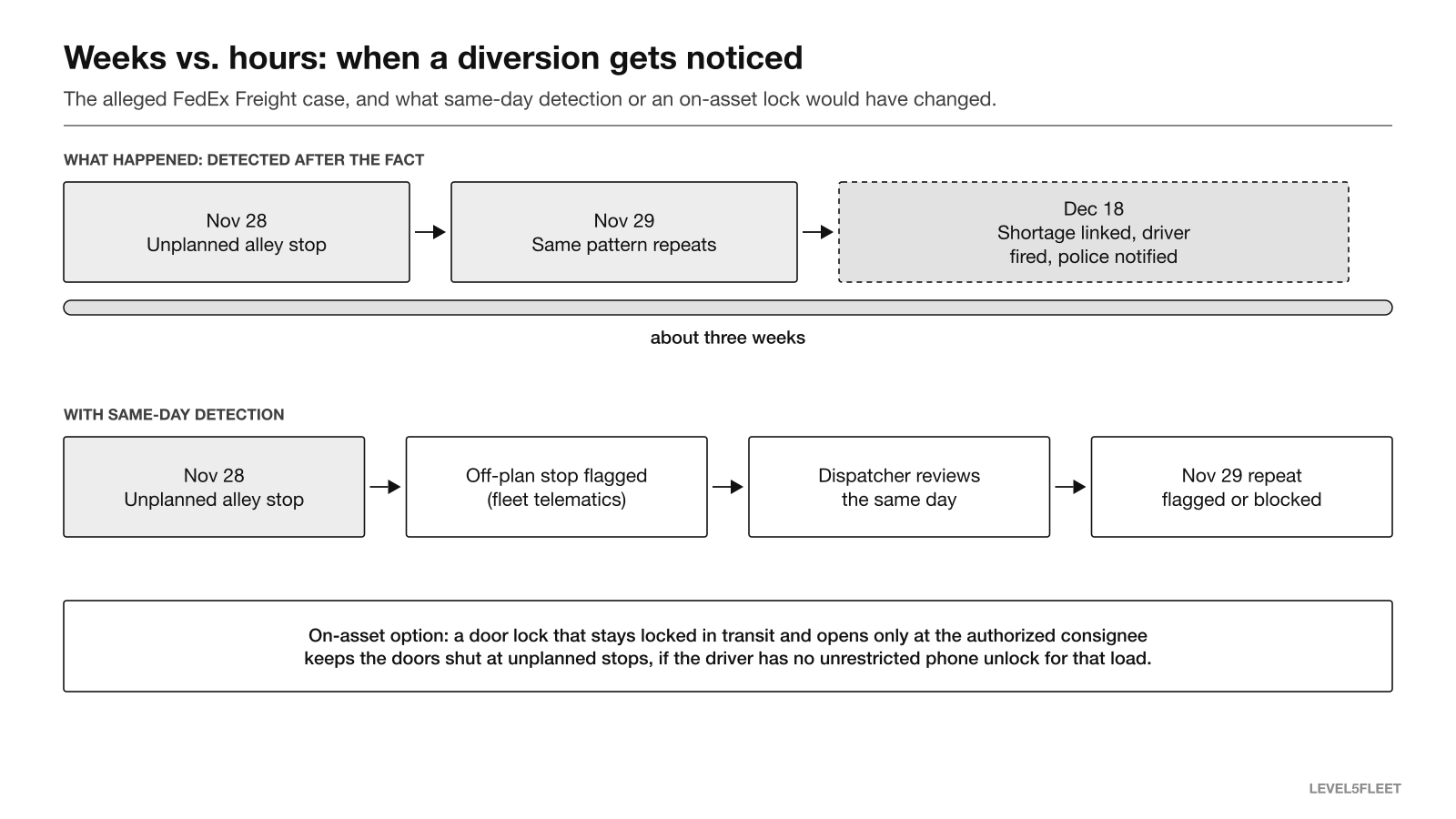
- Nobody caught the alleged diversions on the day they happened; they came to light about three weeks later, after Apple reported shortages and FedEx Freight’s internal review connected them to unexplained stops and time-record anomalies.
- Route-deviation alerts would most likely have shortened that detection gap from weeks to hours, but only an enforced control, such as a cargo door that stays locked away from authorized stops, could plausibly have prevented the stop from paying off.
- Both men are presumed innocent; the case is pre-trial, and no one has been convicted.
Table of contents
- What is freight diversion?
- The case: an alleged diversion in Pinecrest, Florida
- Case timeline
- The numbers
- Route alerts vs on-asset enforcement: what each would have done
- Warning signs of freight diversion
- How to prevent freight diversion: a 7-step checklist
- An operational perspective on insider diversion
- How Admiral maps to this case
- FAQ
- Sources
- Recommended
What is freight diversion?
Freight diversion, also called load diversion or shipment diversion, is the movement of cargo away from its authorized route or destination by someone who has legitimate access to it, usually so that some or all of the freight can be stolen. Unlike a fictitious pickup, nobody impersonates a carrier. The driver, the trailer and the paperwork are all real.
That distinction decides which controls work. Most cargo-security controls are designed to keep the wrong people away from freight: carrier vetting, identity checks at pickup, locks, seals and fenced yards. A diversion skips all of it. The person doing it is the one the checks were designed to let through.
It is also different from parcel interception at the doorstep. Diversion happens upstream, while the freight is still in the carrier’s custody, and in the case below it surfaced only when the consignee counted the delivery and found it short.
The case: an alleged diversion in Pinecrest, Florida
Most cargo theft stories need a way in: a forged bill of lading, a spoofed carrier profile, a driver who was never supposed to be at the dock. According to Medley Police, the alleged theft in Pinecrest, Florida, in late November 2025 didn’t need any of that. The man behind the wheel was exactly who his badge said he was.

Michael Turro-Cabrera, 43, was an active FedEx Freight driver on November 28, 2025, assigned to a route carrying Apple phones, tablets and watches bound for retail delivery in South Florida. Police say he pulled his assigned trailer into a Pinecrest alley that was not on his authorized route. Nobody stopped him, and from the system’s point of view there was no reason to: a real driver was driving his real trailer on a scheduled workday.
According to police, surveillance video shows a gray Dodge pickup backing up to the trailer in a way consistent with cargo moving between the two vehicles, and phone records show a call between Turro-Cabrera and the pickup’s driver at the moment he arrived. Police cite the call as evidence of coordination, not coincidence. The same pattern allegedly repeated the next day. Using FedEx personnel records, police identified the pickup’s driver as Yasmany Aguiar-González, 39, a former FedEx Freight driver with about eight years at the company.
The alleged mechanism is almost unremarkable, which is the point. As the assigned driver, Turro-Cabrera didn’t have to defeat any security measure, because in practice he was the security measure. The exact stop location and the method allegedly used to move the merchandise have been reported elsewhere, but repeating them would amount to a playbook. What matters for prevention is the pattern: an insider with legitimate access, a short unauthorized stop, and a long gap before anyone noticed.
That gap is the core of the case. Nobody caught the stops in real time. Apple reported shortages against its shipment manifests, and FedEx Freight’s internal investigation then flagged “unexplained extended stops” and “timeclock manipulation” on the two dates: his time records didn’t account for the stops. On December 18, 2025, about three weeks after the alleged thefts, FedEx fired Turro-Cabrera for policy violations and reported the theft to police. “FedEx Freight does not tolerate illegal activity within our network,” a spokesperson said. “The security of our customers’ shipments is a top priority, and we fully cooperate with law enforcement on investigations. This individual is no longer employed by the company.”
Medley Police spent the following months pulling surveillance video, GPS data and phone records. Turro-Cabrera was arrested on June 23, 2026, and charged with grand theft of cargo (under $50,000) and organized fraud ($20,000 to $50,000). Aguiar-González’s attorney, Salvedo Jauregui, then arranged his voluntary surrender on July 15, 2026: “The minute that my client found out that they were looking for him, we immediately called the detective.” Reports say Aguiar-González faces at least a grand theft charge; his full charges have not been itemized publicly.
Both cases are pre-trial. Neither man has been convicted, and both are presumed innocent. No source has confirmed that the products were recovered.
Medley Police spokesperson Andres Oviedo summed up the department’s message: “We want to let everyone know that if you’re going to do cargo theft, don’t do it in Medley.”
Case timeline
| Date | Event | Source |
|---|---|---|
| Prior years | Aguiar-González works about eight years as a FedEx Freight driver; when that employment ended is not reported | Local10, NBC6 [1][4] |
| Nov 28, 2025 | Police say Turro-Cabrera makes an unauthorized stop in a Pinecrest alley with his assigned trailer; video shows a pickup backing up to it; shortage later confirmed at $22,507.28 | Local10, NBC6 [1][3] |
| Nov 29, 2025 | Police say the same pattern repeats; shortage later confirmed at $8,658.20 | Local10, NBC6 [1][3] |
| Dec 18, 2025 | After Apple’s shortage report, FedEx Freight’s review flags unexplained extended stops and timeclock manipulation; Turro-Cabrera is fired and the theft is reported to police | Local10, NBC6 [1][3] |
| Dec 2025 to Jun 2026 | Medley PD pulls surveillance video, GPS data and phone records, and identifies the second suspect through FedEx personnel records | Local10, NBC6 [1][3] |
| Jun 23, 2026 | Turro-Cabrera arrested; charged with grand theft of cargo and organized fraud | Local10, Pembroke Pines FL News [1][5] |
| Jul 15, 2026 | Aguiar-González surrenders voluntarily through his attorney; faces at least a grand theft charge | Local10, WSVN [2][6] |
| As of Aug 2026 | Pre-trial; no convictions; recovery of the products not confirmed | Local10 [2] |
The numbers
| Figure | What it measures |
|---|---|
| $31,165.48 | Total alleged loss across both days |
| $22,507.28 | November 28 shortage |
| $8,658.20 | November 29 shortage |
| ~3 weeks | Time from the first alleged diversion to FedEx’s report to police |
| 2 | Felony charges against Turro-Cabrera |
Next to national figures, this is a small loss. Verisk CargoNet estimates that cargo theft losses in the U.S. and Canada reached about $725 million in 2025, up 60% from 2024, across 2,646 confirmed incidents, with an average value of $273,990 per theft [7]. The FBI’s Internet Crime Complaint Center cited the same trend in an April 2026 public service announcement [8].
Those headline figures describe a different pattern. CargoNet notes that theft of consumer-grade electronics actually fell in 2025, while enterprise hardware and organized full-truckload theft drove the surge [7]. The national numbers describe the climate, not this crime. The figure from this case that should worry an operator is not $31K. It is the three weeks.
Route alerts vs on-asset enforcement: what each would have done
Insider diversion separates seeing a deviation from stopping one. Here is each control applied to what police allege happened.
| Control | What it does against an insider with legitimate custody | Effect in this case |
|---|---|---|
| Carrier vetting / identity verification at pickup | Confirms the driver is who he says he is. He was. | None. No one was impersonated. |
| Conventional locks and seals | Keep out people without the key or the authority to break the seal. The assigned driver had both. | None. |
| Trailer immobilizer | Stops unauthorized hookups and movement. The driver was authorized to move this trailer. | None. |
| GPS tracking reviewed after the fact | Provides a record investigators can reconstruct later. | Aided the investigation months later. |
| Real-time route-deviation / unplanned-stop alert | Flags a stop outside the authorized corridor within minutes, if a person sees it and acts. | Would likely have shortened detection from three weeks to the same day, and plausibly prevented the November 29 repeat. |
| Cargo door that only unlocks at authorized stops | Being the assigned driver is not enough to open the doors at an unplanned location; an off-plan opening needs an override. | Could plausibly have prevented the transfer itself, depending on configuration and override policy. |
Alerts are the realistic improvement for most fleets. Only location-conditioned door access addresses the act itself.
Warning signs of freight diversion
Diversion leaves traces, usually spread across systems nobody compares until a claim forces it.
- Stops outside the planned route or corridor, especially in alleys, lots or other locations with no customer.
- Extended dwell time that doesn’t appear in the driver’s time records. A GPS stop with no matching timeclock entry is the signal FedEx’s review eventually found.
- The same unplanned location on consecutive days or shifts, which suggests a repeat arrangement rather than a one-off detour.
- Consignee shortage claims that cluster on one driver, route or set of dates, particularly on high-value, easy-to-resell freight like phones and tablets.
- Cargo-door events at a non-delivery location, if your trailers record door state.
- Former employees who still know the operation. Knowledge of routes, schedules and freight mix doesn’t expire when employment ends. Credentials and system access should.
How to prevent freight diversion: a 7-step checklist
- Define the authorized stops for every high-value run. Why: a deviation can’t be flagged without a baseline of where the load is allowed to be.
- Alert on unplanned stops in near real time and name who responds. Why: an alert that nobody owns adds nothing to the case file; the cost in this case came from three weeks of silence.
- Reconcile GPS stop data against time records daily, not after a claim. Why: the mismatch that exposed this case was available from the start; nobody checked it until Apple reported the shortage.
- Make cargo-door access conditional on location. Why: custody of the trailer should not mean access to the freight at any address.
- Connect shortage claims to route data the day they arrive. Why: the consignee’s count is often the first hard evidence, and every day of delay weakens the video and phone trail.
- Offboard completely and on the same day. Why: you can’t revoke a former driver’s knowledge, but you can revoke every credential, fob, app login and system account he had.
- Set evidence-retention rules for telematics and video before you need them. Why: police built this case from surveillance, GPS and phone records months after the fact, and data that’s been overwritten can’t be pulled.
Pro Tip: Measure your detection lag. For every shortage claim in the past year, count the days between the event and your first internal flag. If the average is in weeks, that is your real exposure to diversion.
An operational perspective on insider diversion
Most theft prevention is built around a gate, and the gate asks one question: is this the right person? Diversion is what happens when the answer is yes. Vetting, credentials and seals all did their jobs here and still made no difference, because every one of them is designed to keep outsiders out.
I think the industry has quietly accepted a trade-off it shouldn’t: once a driver is verified, we trust him with the freight everywhere, all day. Visibility tools helped make that acceptable, because we can always look later. But “look later” is exactly what happened in this case, and later meant three weeks, two alleged losses and nearly seven months from the first alleged diversion to the first arrest.
Visibility shortens the time to detection, which is worth a lot. It doesn’t change what the driver is able to do. The shift I’d push for is to tie access to the freight to the plan for the freight, so that the right person at the wrong place is still a no until someone with authority says yes. That isn’t distrust of drivers; an honest driver benefits from a record that proves the doors stayed shut.
— Gwagsi Glenn, Growth Analyst, Level5Fleet
How Admiral maps to this case
Could plausibly have prevented, in a narrow sense: location-conditioned door access. Admiral’s trailer door lock can stay locked in transit, unlock automatically at the authorized consignee, then relock once the door is shut, and the Admiral Hub can authorize access based on location, time, user, operating plan and other conditions. On a load configured this way, being the assigned driver would not by itself open the cargo doors in an unplanned alley. This is the on-asset version of the real-time hard block on unplanned stops described above. It is not a guarantee: it depends on every legitimate stop on the run being in the plan, on who can approve an override, and on the unlock policy. Authorized drivers can also open the lock from their phone, so the assigned driver must not hold an unrestricted phone unlock for that load.
Would have shortened detection: the event record. The Hub reports physical events and asset state back to Admiral, and the lock records who performed an action, where and when. The Hub also records an unplanned stop and every attempt on the doors. An attempted or overridden door event at an unplanned location becomes a same-day record rather than something reconstructed three weeks later. A person still has to review it and act. Route-deviation alerting for the tractor’s path belongs to your telematics stack, and Admiral doesn’t claim to replace it.
Would not have helped: the immobilizer and identity verification. The Admiral Immobilizer keeps a parked trailer’s parking brakes applied until movement is authorized. It does not stop a trailer already moving under its authorized driver, and this driver was authorized to move it. Admiral Resolve, which is free to use, verifies who is behind a pickup, access or change request. Nobody was impersonated here, so Resolve has nothing to catch.
If your current answer to “can my driver open the doors anywhere?” is yes, see how Admiral Enforce ties door access to the plan and request an Enforce Pilot on your highest-value lane.
FAQ
What is load diversion?
Load diversion is another term for freight diversion: someone with legitimate custody of a shipment moves it away from its authorized route or destination so that the cargo can be stolen. It differs from a fictitious pickup because nobody impersonates the carrier.
Do FedEx drivers steal packages?
Theft by delivery drivers does happen, but every individual case is an allegation until a court decides it. In the Pinecrest case, a FedEx Freight driver is accused of diverting freight shipments, not parcels, and the case is pre-trial. Reports of outsiders posing as delivery workers to intercept iPhone parcels describe a different mechanism and are not connected to this case [10].
Is cargo theft a federal crime?
It can be. Under 18 U.S.C. § 659, stealing goods from a truck or trailer that are part of an interstate or foreign shipment is a federal offense punishable by up to 10 years in prison, or up to 3 years if the value is under $1,000 [9]. Many cases, including this one, are charged under state law.
How do you prevent delivery driver theft?
Set a baseline of authorized stops, alert on deviations in near real time with a named responder, and make cargo-door access depend on location. Hiring screens help, but they can’t stop someone who passed every check.
What does cargo theft mean?
Cargo theft is the theft of goods while they are in the supply chain, whether in transit, in a yard or at a facility. It ranges from organized fictitious pickups to insider diversion like the Pinecrest case, and each type calls for different controls.
Sources
- Local10 (WPLG), “Former FedEx Freight employees accused of stealing scores of Apple products, Medley police say,” June 25, 2026. https://www.local10.com/news/local/2026/06/25/former-fedex-freight-employees-accused-of-stealing-scores-of-apple-products-medley-police-say/
- Local10 (WPLG), “Police: Second man arrested in theft of $31K in Apple products from FedEx truck,” July 15, 2026. https://www.local10.com/news/local/2026/07/15/police-second-man-arrested-in-theft-of-31k-in-apple-products-from-fedex-truck/
- NBC6 South Florida, “FedEx driver accused of stealing more than $31K in Apple products in Pinecrest, police say,” June 2026. https://www.nbcmiami.com/news/local/fedex-driver-accused-of-stealing-more-than-31k-in-apple-products-in-pinecrest-police-say/3825242/
- NBC6 South Florida, “Man accused of working with FedEx driver to steal $30K worth of Apple products arrested, cops say,” July 2026. https://www.nbcmiami.com/news/local/man-accused-of-working-with-fedex-driver-to-steal-30k-worth-of-apple-products-arrested-cops-say/3834335/
- Pembroke Pines FL News, “Pembroke Pines FedEx driver charged in alleged $30K Apple product theft, cops say,” June 2026. https://www.pembrokepinesflnews.com/news/local/article316265710.html
- WSVN 7News, “Man surrenders to police after stealing $31K in Apple products in Medley, authorities say,” July 2026. https://wsvn.com/news/local/miami-dade/man-surrenders-to-police-after-stealing-31k-in-apple-products-in-medley-authorities-say/
- Verisk CargoNet, “Cargo Theft Losses Surge to Estimated $725 Million in 2025,” January 2026. https://www.cargonet.com/news-and-events/cargonet-in-the-media/2025-theft-trends/
- FBI Internet Crime Complaint Center, Public Service Announcement, April 30, 2026. https://www.ic3.gov/PSA/2026/PSA260430
- 18 U.S. Code § 659 (Legal Information Institute, Cornell Law School). https://www.law.cornell.edu/uscode/text/18/659
- ABC7 New York, “Urgent nationwide iPhone theft warning; FedEx deliveries targeted by criminal groups,” 2026. https://abc7ny.com/iphone-theft-fedex-warning-att/15594258/