
Strategic Cargo Theft: How Fake Documents Released a $2.86M Tungsten Load

Strategic cargo theft is freight theft by deception: instead of breaking into a trailer, the thief convinces someone in the supply chain to hand the load over. In June 2026, prosecutors allege, a driver used fraudulent identity and registration documents to collect $2,857,500 of tungsten oxide powder from a Pennsylvania dock. The load was released because the paperwork looked right. Nobody confirmed that the person holding it was the booked carrier.
TL;DR
- Strategic cargo theft uses impersonation, fake documents, or hijacked identities to get freight released, so the theft happens at the dock with the shipper’s cooperation.
- On June 25, 2026, about 40,000 lbs of tungsten oxide worth $2,857,500 left Global Tungsten & Powders in Bradford County, Pennsylvania, released to a driver who prosecutors allege presented fraudulent documents.
- The load was recovered in Indiana two days later because a police license-plate camera network flagged the truck, not because any freight-side system noticed the diversion.
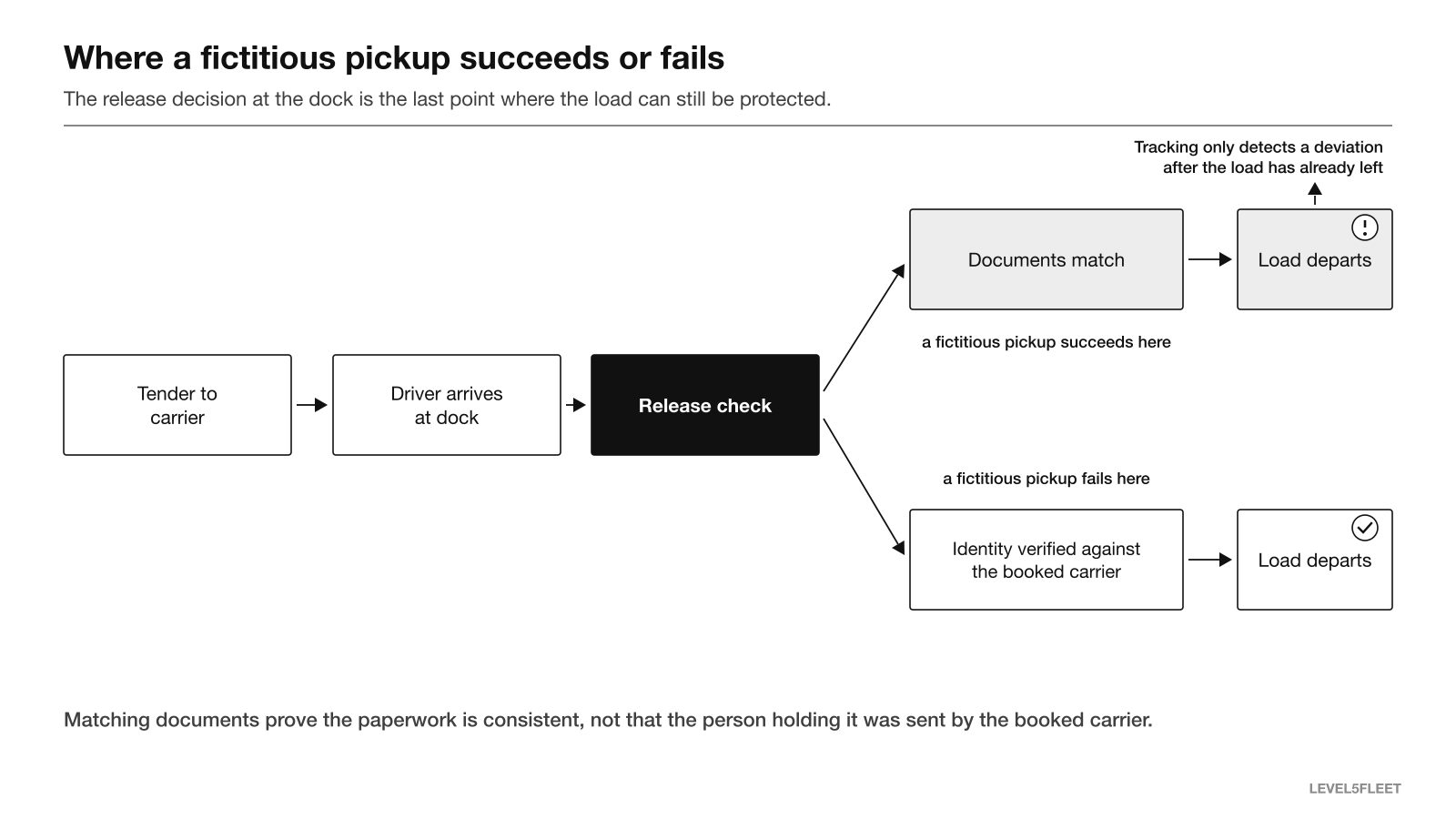
- A dock release check that confirms documents match the load does not prove the driver works for the booked carrier; only independent verification against the booked carrier does that.
- The highest-leverage fix is identity-verified release at pickup, while route tracking can only shorten the time it takes to notice a theft that has already happened.
Table of contents
- What is strategic cargo theft?
- The case: a $2.86M tungsten load released on paperwork
- Case timeline
- The numbers: why metals and Pennsylvania are in the frame
- How a fictitious pickup works at the dock
- Dock release check vs what it proves
- Warning signs of a fictitious pickup
- How to prevent strategic freight theft: a 7-step checklist
- An operational perspective on paperwork-based release
- Where Admiral fits, and where it doesn’t
- FAQ
- Sources
What is strategic cargo theft?
Strategic cargo theft is the theft of freight by deception rather than force. Criminals pose as a legitimate carrier, broker, or driver, often with fake IDs, fictitious businesses, or compromised accounts, and persuade a shipper or broker to release or redirect the load. Verisk CargoNet classifies the pickup version of this fraud as a “fictitious pickup.”
CargoNet defines fictitious pickups as “criminal schemes that result in the theft of cargo by deception,” carried out by carriers using “fake IDs and/or fictitious businesses set up for the purpose of diverting and stealing cargo.” Its analysts describe groups “increasingly using strategic theft methods, including impersonation and targeted commodity selection.” The FBI uses the same term: its April 30, 2026 public service announcement is titled “Cyber-Enabled Strategic Cargo Theft Surging.”
The distinction matters operationally. A trailer stolen from a truck stop is a physical security problem. A strategic theft is an authorization problem: every lock, seal, and gate can work as designed and the freight still leaves with the wrong person, because someone with authority to release it was deceived.
The case: a $2.86M tungsten load released on paperwork
On June 25, 2026, a shipment of tungsten oxide powder left the dock at Global Tungsten & Powders (GTP) in North Towanda Township, Bradford County, Pennsylvania. Ten pallets, roughly 40,000 pounds, valued at $2,857,500, bound for Mitsubishi Materials Corp. in Japan. The powder is used in batteries, electronics, and defense-grade materials. According to Fox56/WOLF-TV, an authorized trucking company was to collect it and move it toward JFK International Airport for an air shipment overseas.
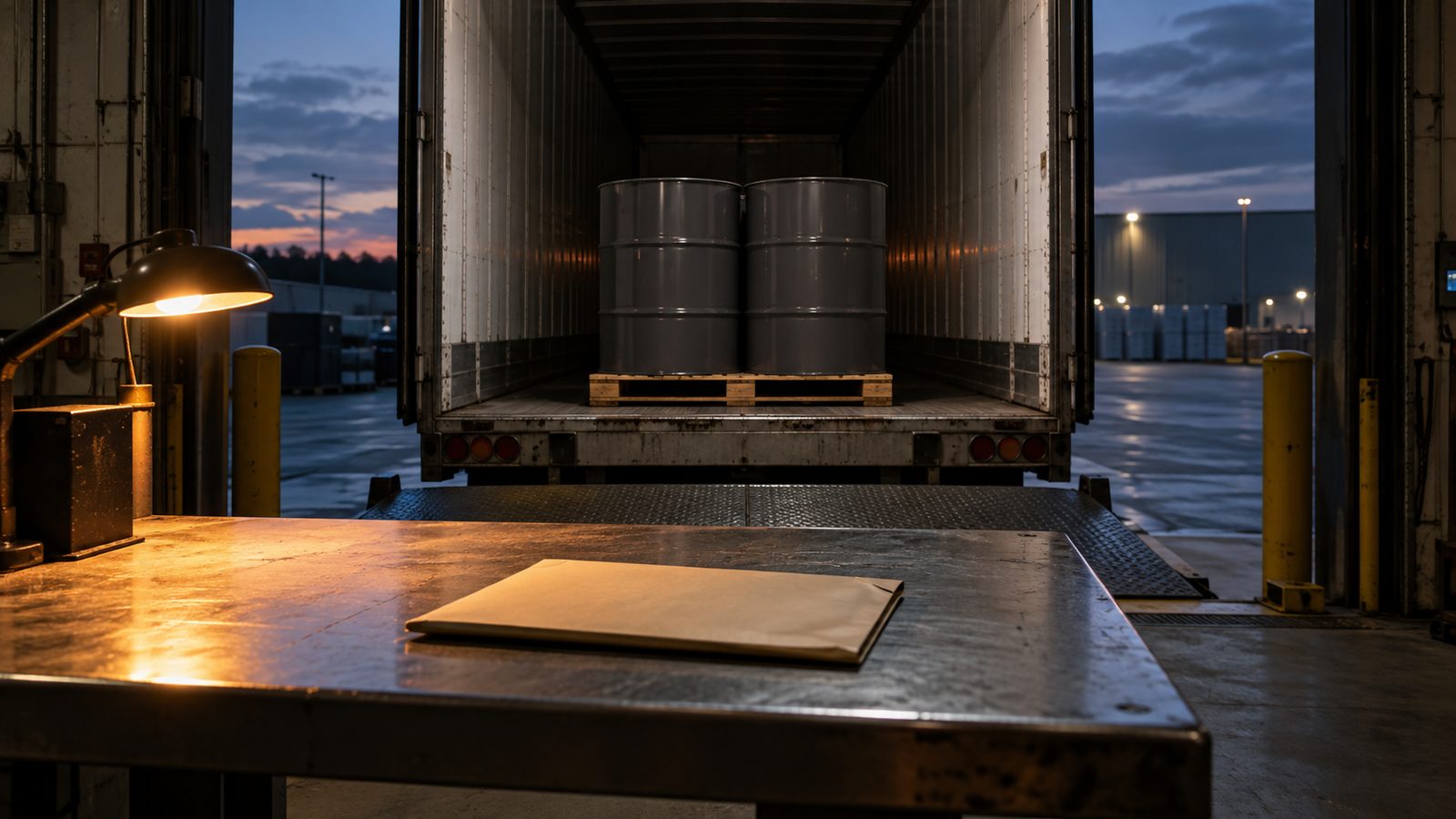
It never got there. Prosecutors allege that Deepak Kumar, 31, of Fresno, California, presented fraudulent identity and vehicle-registration documents at the GTP dock and had the load released to him as if he were the carrier booked to collect it. Nobody broke into anything. The freight left through the front door.
Two days later, police in Greenfield, Indiana, received an automated alert at around 6 a.m. from the Flock Safety license-plate camera network, flagging a wanted semi tied to the Pennsylvania warrant. Officers stopped the truck on Interstate 70 near Greenfield, in Hancock County, roughly 500 miles west of the plant and nowhere near any route to JFK. No source has explained why, and we won’t guess.
A search warrant confirmed the tungsten oxide was still in the trailer, intact, and a Mitsubishi Materials representative took possession of it in Greenfield. Indiana charges were dismissed pending extradition. In Pennsylvania, Kumar was held in Bradford County Jail on $200,000 bail and charged with felony theft by unlawful taking of movable property and felony criminal use of a communication facility. These are allegations. At the time of our last review of public reporting, Kumar had not been convicted, and we could not confirm the outcome of his preliminary hearing.
“With the use of modern technology and diligent police work, Mr. Kumar is in jail,” Greenfield Police Deputy Chief Chuck McMichael told CDL Life. The technology was a police camera network. Nothing in the freight chain caught the diversion.
The second attempt: Operation Heavy Metal
On August 5, 2026, in a separate case, an undercover Pennsylvania State Police and federal operation called “Operation Heavy Metal” intercepted an attempted theft of about 18,000 kilograms (roughly 20 tons) of tungsten oxide powder from GTP before it left the property. The defendant, Rohit Ruhal, 29, of Rancho Cucamonga, California, is a different person on a different court track, charged with first-degree felony theft by unlawful taking and two counts of third-degree felony identity theft, and was denied bail. Outlets have reported conflicting dollar values for that load, from $500,000–$750,000 to “more than $5 million,” so we don’t state one. Police have not said whether the cases are connected, but one plant’s tungsten was targeted twice in about six weeks.
Case timeline
| Date | Event | Source |
|---|---|---|
| June 25, 2026 | About 40,000 lbs (10 pallets) of tungsten oxide powder, valued at $2,857,500, released from GTP’s North Towanda Township, PA dock; prosecutors allege fraudulent documents were used | FreightWaves, CDL Life, Transport Topics |
| June 27 or 28, 2026 (reports differ) | Flock Safety camera alert to Greenfield, IN police; traffic stop on I-70; Kumar arrested on the Pennsylvania warrant | FreightWaves, CDL Life, WISH-TV |
| June 28–29, 2026 | Search warrant confirms the load is in the trailer; Mitsubishi Materials representative takes possession | WISH-TV, CDL Life |
| July 1, 2026 | Indiana charges dismissed pending extradition to Pennsylvania | Transport Topics, The Daily Reporter |
| July 2026 | Kumar extradited, held in Bradford County Jail on $200,000 bail, charged with two felonies | Transport Topics, MyHometownToday.com |
| August 5, 2026 | Separate case: Operation Heavy Metal intercepts an attempted theft of ~18,000 kg of tungsten oxide at GTP; Rohit Ruhal charged and denied bail | Fox56, Rocket-Courier |
The numbers: why metals and Pennsylvania are in the frame
Tungsten was not a random target. Verisk CargoNet estimated U.S. and Canada cargo theft losses at nearly $725 million in 2025, up 60% from 2024, while the average value per theft rose 36% to $273,990. Incident volume barely moved. The losses grew because thieves picked bigger loads.
The pattern sharpened in 2026. CargoNet recorded 677 supply chain theft incidents in Q2 2026, down 26% year over year, yet estimated losses more than doubled to $304.6 million from $135.7 million. Metal theft rose from 54 incidents to 80, and CargoNet named tungsten among the specialized industrial metals with rising theft. Fictitious pickups barely declined, from 165 to 158 events, even as events classified as theft fell from 488 to 378.
For cargo theft in Pennsylvania specifically, CargoNet’s 2025 analysis lists the state among those with significant increases, up 24%, with Indiana, where this load was recovered, up 30%. A single $2.86 million load fits the selective, high-value targeting CargoNet describes, which its vice president of operations, Keith Lewis, called a “strategic shift.”
How a fictitious pickup works at the dock
A shipper tenders a load to a carrier, directly or through a broker. The carrier’s name, a load number, and an appointment window now sit in emails, portals, and phone logs across several companies. On the day, a driver arrives and dock staff run a release check, which in most operations asks whether the paperwork the driver presents matches the paperwork the shipper expects: the right load number, a carrier name that matches the booking, a license, a truck with plausible markings. If it all lines up, the bill of lading gets signed and the freight goes.
A fictitious pickup succeeds when someone who is not the booked carrier’s driver can make that check line up. Prosecutors allege that is what happened at GTP, with fraudulent identity and registration documents. Public reporting does not describe GTP’s procedure, so we won’t speculate about which step failed. The structural point holds anyway: the dock is checking consistency, and consistency can be manufactured. What the dock rarely checks is the one fact that matters: that the booked carrier itself sent this driver and this truck for this load. The FBI’s first recommendation in its 2026 PSA targets exactly that gap: “Independently verify shipment requests and pickups using secondary methods prior to releasing any loads.”
Dock release check vs what it proves
| Dock release check | What it proves | What it does not prove |
|---|---|---|
| Driver quotes the correct load number | Someone has seen the load details | That the person works for the booked carrier |
| Driver presents a license | A document was presented | That it is genuine, or that the holder was dispatched for this load |
| Truck displays a carrier name and USDOT number | The truck carries those markings | That the truck belongs to, or is operating for, that carrier |
| Carrier’s authority is active in FMCSA records | The carrier exists and has authority | That this driver represents it |
| Call to the phone number on the paperwork | Someone answers that number | Anything; the number came from the person you are trying to verify |
| Call-back to the booked carrier on a number you sourced independently | The carrier confirms it dispatched a driver | That the person at your dock is that driver, unless driver and truck details are matched |
| Identity-verified release tied to the booked carrier and load | The requester is a verified person acting for the booked company and authorized for this load | Cargo safety after departure; that still needs in-transit controls |
Pro Tip: Source every verification contact from your own records, never from the pickup paperwork or the email that arranged it. A check that uses contact details supplied by the requester only tests whether the requester answers their own phone.
Warning signs of a fictitious pickup
- A last-minute change of driver, truck, or trailer that arrives without an update from the booked carrier through its usual channel.
- Contact details that differ from your records: a new phone number, a free webmail address, or an email domain that mimics the carrier’s real one with a small change, a red flag the FBI lists in its 2026 PSA.
- Pressure to release quickly, especially around holidays or on short-staffed shifts, when CargoNet warns that reduced staffing and time pressure create “verification exposure.”
- Truck markings, plates, or registration that don’t match the carrier on the booking.
- Requests to move communication to a personal phone or text thread, or to change the delivery address after pickup.
- Recent changes to a carrier’s FMCSA contact or insurance information. The FBI’s PSA describes criminals changing a legitimate carrier’s FMCSA contact details and insurance information to take loads in its name.
How to prevent strategic freight theft: a 7-step checklist
- Make release a decision, not a document match. Why: in this case the documents matched well enough.
- Verify every pickup with the booked carrier through a channel you sourced yourself. Why: the FBI recommends secondary-method verification before any load is released.
- Match driver, tractor, and trailer details to what the carrier confirmed before the truck arrives. Why: confirming that a driver is coming means little if anyone can claim to be that driver.
- Treat high-value commodities as a separate risk tier. Why: CargoNet’s data shows organized groups selecting specific high-value shipments, including metals.
- Freeze changes at the dock. Why: any driver, truck, or destination change should go back through the booked carrier, not be approved on the spot.
- Track the freight, not just the truck, and alert on deviation. Why: it won’t stop a fraudulent release, but it can shrink the gap between theft and discovery from days to hours.
- Log every release decision with who approved it and on what evidence. Why: a record speeds recovery and shows where the process broke.
An operational perspective on paperwork-based release
The industry has spent years improving carrier vetting at the tender stage. That work matters, but this case shows where it stops. The loading dock is still where custody actually changes hands, and in most operations the dock’s final question is whether the paperwork matches. Paperwork is the easiest thing in the chain to fake, and it gets easier as document tools improve.
I don’t read this case as a failure by the people on that dock. They ran the check they were given. The failure is that the check verifies documents rather than people, and that no one downstream would have noticed a $2.86 million load heading the wrong way if a police camera hadn’t flagged the truck. Nobody should plan on that kind of luck.
My view is that release should work like a payment: nothing moves until the party asking has been verified against the party who was booked, and the decision is recorded. That costs minutes at the dock. Even a recovered load costs far more.
— Gwagsi Glenn, Growth Analyst, Level5Fleet
Where Admiral fits, and where it doesn’t
Public reporting doesn’t say whose trailer carried the load, and the arrest came from police infrastructure, not a freight platform. So we’ll be exact.
| Intervention | Effect in this case | Admiral capability |
|---|---|---|
| Identity-verified release at pickup, checked against the booked carrier | Would have prevented. The person at the dock was not the booked carrier; that is where this theft could have been stopped. | Admiral Resolve checks whether a pickup or access request comes from a real person, acting for the right company, and authorized for that specific load, then records the approval or denial. The named party confirms or declines the request itself, so matching documents alone don’t pass. Resolve is free to use. |
| Location tracking with alerts on route deviation | Would have shortened detection, likely from days to hours, but only after the fraudulent pickup had already succeeded. | Admiral includes GPS tracking with its immobilization and fortification solutions, but only on Admiral-equipped assets. It would not have helped if the load left in unfitted equipment. |
| Trailer door locks and immobilization | Would not have helped if the load was released into the thief’s own equipment. Locks don’t screen who is allowed to drive away. | Admiral Enforce keeps doors locked and trailers immobilized until an authorized credential is presented. It matters most where the equipment is yours, such as drop-trailer and yard handoffs. |
| Cargo insurance | Would not have helped; it covers the financial loss only. | Not applicable. |
In short: Resolve addresses the moment this case turned on, the release decision. When the booked carrier runs Admiral-equipped trailers, the access you approve is also physically enforced by the trailer.
If your release process still ends with “the paperwork matched,” start by putting Admiral Resolve in front of your next high-value pickup. If you control the trailers, you can request an Enforce Pilot through Admiral Enforce.
FAQ
What is a fictitious pickup in cargo theft?
A fictitious pickup is a strategic cargo theft in which someone poses as the legitimate carrier or driver to collect a load. CargoNet defines it as a criminal scheme that results “in the theft of cargo by deception,” often using fake IDs or fictitious businesses. CargoNet counted 158 fictitious pickup events in Q2 2026, almost unchanged from 165 a year earlier.
Why is tungsten a target for cargo theft?
Tungsten oxide is valuable in bulk: the GTP load in this case was worth $2,857,500 for 10 pallets. CargoNet named tungsten among the specialized industrial metals with rising theft in Q2 2026, when overall metal theft rose from 54 to 80 incidents.
How common is cargo theft in Pennsylvania?
Verisk CargoNet’s 2025 annual analysis lists Pennsylvania among the states with significant increases, with incidents up 24% from 2024. Neighboring New Jersey rose 50% and Indiana 30%. The GTP plant in Bradford County was targeted twice in about six weeks in 2026, in two separate cases.
Is cargo theft a federal crime?
It can be. Under 18 U.S.C. § 659, stealing goods that are part of an interstate or foreign shipment, including obtaining them “by fraud or deception,” carries up to 10 years in prison, or up to 3 years if the value is under $1,000. Many cases, including this one, are charged under state law instead.
Sources
- FreightWaves, “Truck driver accused of using fake documents to steal $2.9M cargo”: https://www.freightwaves.com/news/truck-driver-accused-of-using-fake-documents-to-steal-2-9m-cargo
- CDL Life, “Truck driver accused of using fake documents to steal $2.8 million in industrial product bound for Japan, Indiana police say”: https://cdllife.com/2026/truck-driver-accused-of-using-fake-documents-to-steal-2-8-million-in-industrial-product-bound-for-japan-indiana-police-say/
- Transport Topics, “Trucker jailed in Indiana in alleged $2.8M tungsten theft” (July 9, 2026): https://www.ttnews.com/articles/trucker-jailed-tungsten
- WISH-TV, “Driver arrested in Hancock County after police find $3 million worth of chemical compound bound for Japan”: https://www.wishtv.com/news/crime-watch-8/3-billion-tungsten-oxide-powder-shipment-seized-in-hancock-county-califonia-man-arrested/
- MyHometownToday.com, “California man accused of trying to steal nearly $3 million in tungsten oxide powder from GTP”: https://www.myhometowntoday.com/news/regional-news/bradford-county/california-man-accused-of-trying-to-steal-nearly-3-million-in-tungsten-oxide-powder-from-gtp/
- Fox56/WOLF-TV, “Man accused of stealing $2.9 million in specialized cargo from Bradford Co. warehouse”: https://fox56.com/news/local/man-accused-of-stealing-29-million-in-specialized-cargo-from-bradford-co-warehouse
- The Daily Reporter (Greenfield, IN), “Arrests — June 29”: https://www.greenfieldreporter.com/2026/06/29/arrests-june-29-3/
- Fox56/WOLF-TV, “Troopers: Undercover operation stops attempted theft of 18,000 kilos of tungsten oxide”: https://fox56.com/news/local/troopers-undercover-operation-stops-attempted-theft-of-18000-kilos-of-tungsten-oxide
- northcentralpa.com, “Arrest announced in Towanda 20-ton precious metal theft bust”: https://www.northcentralpa.com/news/arrest-announced-in-towanda-20-ton-precious-metal-theft-bust/article_41662c7a-eb4b-4b70-9059-e49d4a8ffabf.html
- Rocket-Courier, “Second GTP Materials Theft Results in Arrest”: https://www.rocket-courier.com/articles/second-gtp-materials-theft-results-in-arrest/
- Verisk CargoNet, “Cargo Theft Losses Surge to Estimated $725 Million in 2025” (January 22, 2026): https://www.verisk.com/company/newsroom/cargo-theft-losses-surge-to-estimated-$725-million-in-2025-verisk-cargonet-analysis-reveals/
- Verisk CargoNet, “Cargo Theft Losses More Than Double to $304 Million in Q2” (August 6, 2026): https://www.verisk.com/company/newsroom/cargo-theft-losses-more-than-double-to-$304-million-in-q2-despite-a-drop-in-thefts-driven-by-high-value-metals-and-technology-heists/
- Verisk CargoNet, “Verisk CargoNet Assists in Manhattan DA Cargo Theft Indictment Targeting Multi-State Impersonation Ring” (June 9, 2026): https://www.verisk.com/company/newsroom/verisk-cargonet-assists-in-manhattan-da-cargo-theft-indictment-targeting-multi-state-impersonation-ring/
- Verisk CargoNet, “Verisk CargoNet Reports Persistent Labor Day Cargo Theft Exposure Across U.S. Freight Networks” (2026): https://www.verisk.com/company/newsroom/verisk-cargonet-reports-persistent-labor-day-cargo-theft-exposure-across-u.s.-freight-networks/
- Verisk CargoNet, fictitious pickup / identity theft submission form: https://campaigns.verisk.com/CNET_IDTheft
- FBI IC3, “Cyber-Enabled Strategic Cargo Theft Surging,” Alert I-043026-PSA (April 30, 2026): https://www.ic3.gov/PSA/2026/PSA260430
- 18 U.S.C. § 659, Interstate or foreign shipments by carrier (Cornell LII): https://www.law.cornell.edu/uscode/text/18/659