
Truck Hijacking: Lessons From the $1.2M Apple Delivery Heist

Truck hijacking is the theft of a truck or its cargo by force or the threat of force, with the driver present. It is rarer than fraud-based cargo theft but far more dangerous, and the January 2026 Apple delivery robbery on Long Island shows why: no software stops an armed ambush, so the real defenses are driver safety, less predictability, and faster detection and response.
TL;DR
- On January 3, 2026, three masked, armed men ambushed two delivery workers outside the Apple Store at Americana Manhasset and took more than $1.2 million in Apple products, according to federal prosecutors.
- Three men were indicted in May 2026 on Hobbs Act robbery and related charges; they have pleaded not guilty and are presumed innocent.
- Truck hijacking differs from fraud-based cargo theft because the load, driver, and delivery are all legitimate, and the criminal uses force instead of deception.
- The first rule for any crew facing an armed robbery is to comply and not resist, a principle reflected in OSHA and police guidance; cargo is replaceable, people are not.
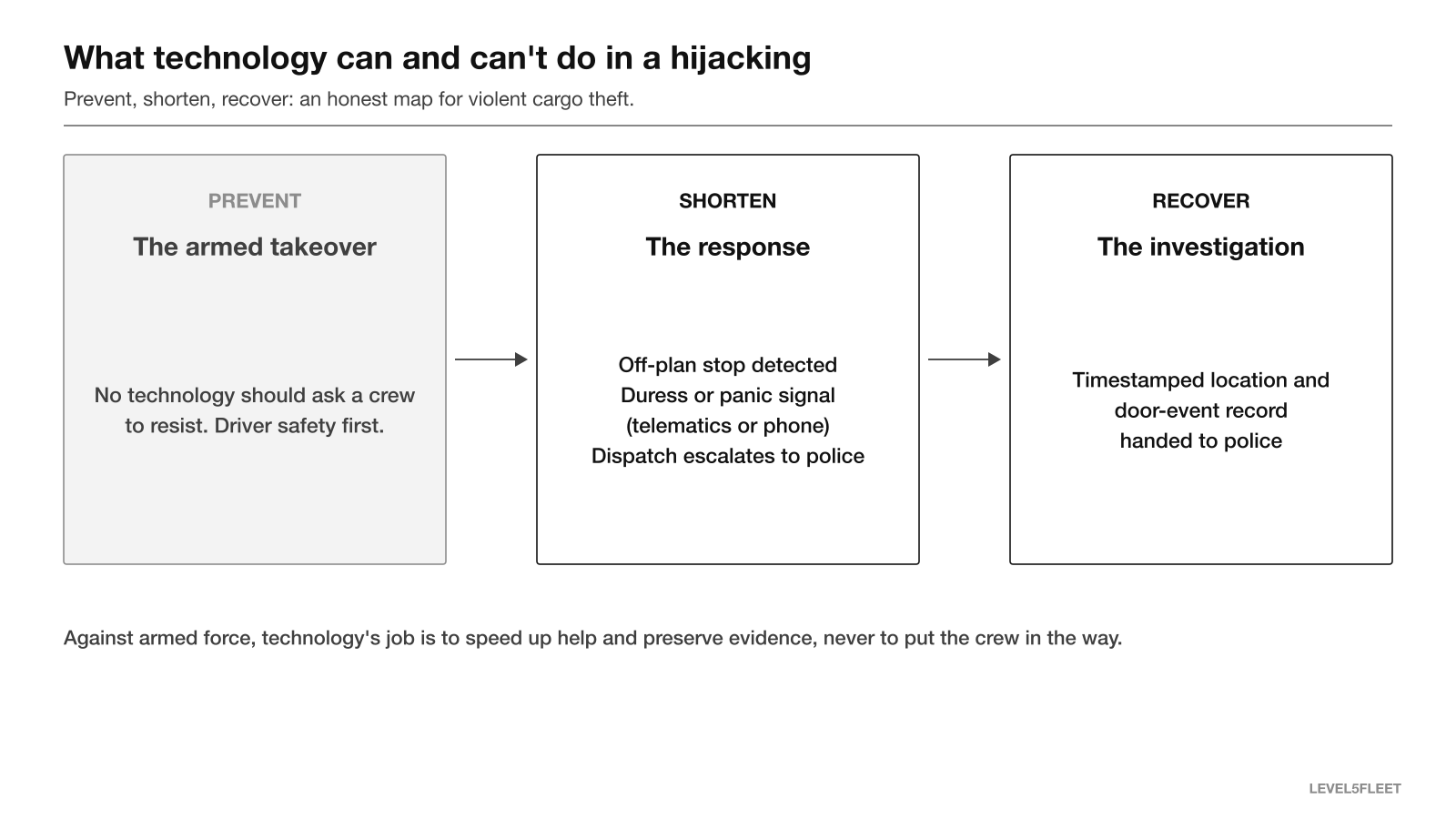
- Technology cannot prevent an armed robbery already in progress, but duress signals, off-plan stop detection, and a clean event record can shorten the response and help investigators.
Table of contents
- What is truck hijacking?
- The Apple truck robbery at Americana Manhasset
- Case timeline
- The numbers
- Truck hijacking vs fraud-based cargo theft
- Warning signs of a planned hijacking
- How to reduce truck hijacking risk: a 7-step checklist
- Perspective: stop selling heroics
- Where Admiral fits, and where it doesn’t
- FAQ
- Sources
What is truck hijacking?
Truck hijacking is the taking of a truck, its cargo, or both from the people operating it by force or the threat of force, usually at gunpoint. Unlike fraud-based cargo theft, nothing about the shipment is fake: the carrier, driver, and delivery are real. The criminal skips the paperwork and overpowers the crew.
Legally, a hijacking is a robbery. Federal law defines robbery as “the unlawful taking or obtaining of personal property from the person or in the presence of another, against his will,” by force, violence, or fear of injury (18 U.S.C. § 1951). When the robbery affects interstate commerce, the Hobbs Act makes it a federal crime with a maximum of 20 years in prison. Theft from interstate shipments, including from trucks and trailers, is separately covered by 18 U.S.C. § 659, and moving stolen goods worth $5,000 or more across state lines is covered by 18 U.S.C. § 2314.
That distinction matters operationally. Most of the cargo theft conversation in 2025 and 2026 has centered on strategic, cyber-enabled fraud: fictitious pickups, hijacked carrier identities, spoofed emails. The FBI’s Internet Crime Complaint Center warned in April 2026 that estimated U.S. and Canada cargo theft losses reached nearly $725 million in 2025, in a warning focused on those schemes (IC3). A truck hijacking is the opposite failure mode. Identity checks and vetting don’t apply, because nobody needs to fool anyone. The risk sits with the people on the truck.
The Apple truck robbery at Americana Manhasset
Just after 8 a.m. on January 3, 2026, two delivery workers were preparing to unload Apple merchandise outside the Apple Store at Americana Manhasset, a shopping center in Nassau County on Long Island. According to the U.S. Attorney’s Office for the Eastern District of New York, three masked men armed with handguns approached them.
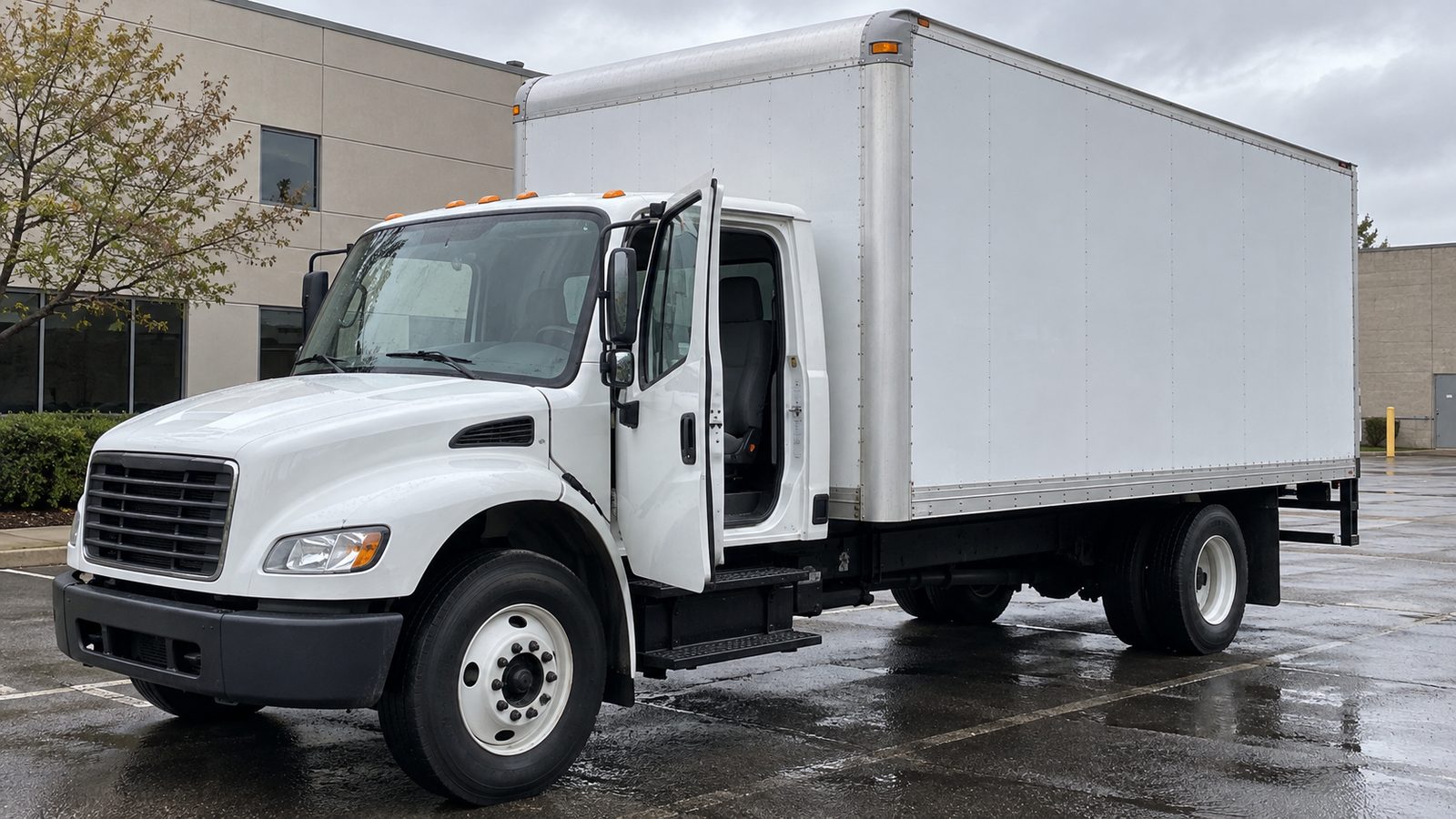
Prosecutors allege the men forced one worker into the truck’s cargo area and restrained him, and made the second worker drive the truck to a secluded spot behind an office building on Northern Boulevard. There, more than $1.2 million in MacBooks, iPhones, iPads, Apple Watches, and accessories was allegedly moved into a Home Depot box truck that had been rented in advance with a fraudulent driver’s license. A U-Haul was also used to move the goods onward.
Both workers were left restrained inside the original truck’s cargo area, in freezing temperatures, with the door closed. One freed himself and called 911.
Nothing in this case depended on a forged rate confirmation or a cloned carrier profile. The Apple delivery was real, the drivers were legitimate, and the truck was exactly where it was supposed to be. The tool was force, applied in daylight at a busy retail address. Sources do not explain how the crew knew when the delivery would arrive or what it carried, and we won’t speculate.
The rented box truck turned up abandoned in the Bronx on January 5. From there, the investigation took about four months. Investigators recovered fingerprints from the truck rental agreement, and surveillance footage placed two of the men at a self-storage facility in Paterson, New Jersey, where the stolen goods were allegedly moved.
On May 7, 2026, the FBI, Nassau County Police Department, and NYPD arrested three men, ages 24, 27, and 29, from the Bronx and Manhattan. The next day, federal prosecutors announced an indictment charging all three with Hobbs Act robbery, Hobbs Act robbery conspiracy, and interstate transportation of stolen property. AppleInsider, citing ABC News, reported that all three pleaded not guilty and were ordered held without bail. They are presumed innocent unless proven guilty. No public source we reviewed says whether any of the merchandise was recovered.
Case timeline
| Date | Event | Source |
|---|---|---|
| Jan 3, 2026, ~8:00 a.m. | Three masked, armed men confront two delivery workers unloading at the Apple Store, Americana Manhasset | DOJ EDNY, via Transport Topics and News 12 Long Island |
| Jan 3, 2026 | Truck moved to a secluded spot on Northern Boulevard; more than $1.2M in Apple products allegedly transferred to a rented box truck; workers left restrained in the cargo area | DOJ EDNY, via amNY and Greater Long Island |
| Jan 3, 2026 | One worker frees himself and calls 911 | News 12 Long Island |
| Jan 5, 2026 | Rented box truck found abandoned in the Bronx | 9to5Mac, amNY |
| Jan–May 2026 | Fingerprints recovered from the rental agreement; surveillance places two men at a Paterson, NJ storage facility | 9to5Mac, Greater Long Island |
| May 7, 2026 | Three men arrested by FBI, Nassau County PD, and NYPD | Greater Long Island, citing DOJ EDNY |
| May 8, 2026 | Indictment announced: Hobbs Act robbery, conspiracy, interstate transportation of stolen property | DOJ EDNY, via Transport Topics |
| On or around May 8, 2026 | Not-guilty pleas; defendants held without bail | AppleInsider, citing ABC News |
The numbers
| Figure | What it measures |
|---|---|
| $1.2M+ | Value of Apple merchandise taken, per prosecutors |
| 2 | Delivery workers held at gunpoint |
| 2 days | Robbery to the getaway truck being found in the Bronx |
| ~4 months | Robbery to arrests |
| 30 years | Maximum combined prison exposure if convicted, per DOJ |
| Not reported | Whether any merchandise was recovered |
The case sits inside a broader shift toward high-value loads. Verisk CargoNet estimated $304.6 million in U.S. and Canada cargo theft losses in Q2 2026, more than double the same quarter of 2025, even though incident counts fell. The average theft value reached $564,009, driven by high-value metals and technology loads (Claims Journal). CargoNet’s Q1 2026 report counted 59 cargo theft incidents in New Jersey, up from 27 a year earlier (CargoNet). Those reports do not mention this case. They describe the market it happened in: compact, high-value electronics moving through the New York and New Jersey metro.
Truck hijacking vs fraud-based cargo theft
| Truck hijacking (armed) | Fraud-based cargo theft | |
|---|---|---|
| How control is taken | Force or threat of force against the crew | Deception: fake carrier, spoofed email, fictitious pickup |
| Is the shipment legitimate? | Yes, fully | Yes, but released to the wrong party |
| Where it happens | Delivery points, stops, staging areas | At booking and pickup, often days before loss is noticed |
| Who is at physical risk | Drivers and dock workers | Usually no one at the moment of theft |
| What prevents it | Physical security, less predictability, law enforcement presence | Identity verification, authorization tied to the asset |
| What technology does best | Faster detection, response, and evidence | Blocking the release before it happens |
| The wrong lesson | “A better lock would have stopped them” | “Our carrier vetting checked out, so we’re fine” |
Warning signs of a planned hijacking
Most armed cargo robberies need some planning, and planning leaves traces. Train crews and receivers to report:
- Repeat faces or vehicles at the dock across several delivery windows, especially occupied vehicles with engines running and no business at the location.
- Rental box trucks or unmarked vans idling near receiving areas before a scheduled high-value arrival.
- Questions about loads, timing, or routes from people with no reason to ask, in person, by phone, or on social media.
- A vehicle that appears at more than one stop. Police warn that carjackers sometimes use a “follow vehicle” driven by an accomplice (DC MPD).
- Last-minute requests to change the delivery door, dock, or meeting point that don’t come through your normal channel.
- A truck that goes quiet: a missed check-in, an unscheduled stop, or doors opening somewhere other than the delivery address. This is the signal that something is already happening.
How to reduce truck hijacking risk: a 7-step checklist
- Make “never resist” written policy and train it. Why: OSHA’s workplace violence guidance recommends specific instructions on how to respond to a robbery, “such as turning over money or valuables without resistance” (OSHA 3153), and DC police advise, “Don’t resist or argue, especially if there is a weapon involved.”
- Give every crew a duress signal that reaches a person who will act. Why: OSHA recommends panic buttons and personal alarms where risk is apparent, and “a reliable response system when an alarm is triggered.” A button nobody monitors is decoration.
- Vary high-value delivery windows where the receiver allows it. Why: the same high-value truck at the same well-known address at the same time each week is a known risk factor in armed cargo robbery.
- Treat load value and schedules as need-to-know. Why: every person and system that knows what’s on the truck and when it arrives widens the circle of people who could leak it.
- Agree the stop plan in advance, and flag any stop outside it. Why: in this case the cargo was transferred at a second location. An off-plan stop is often one of the earliest signs a system can detect.
- Set a check-in cadence with an escalation rule. Why: if a crew misses a check-in at a high-value drop, dispatch should call, then escalate on a fixed timer, rather than waiting for a victim to reach a phone.
- Keep timestamped records ready to hand to police. Why: this case was built on records (a rental agreement, storage-facility footage), and time, location, and door-event data give investigators a starting point.
Pro Tip: Build a duress code word into your normal check-in script. A driver forced to answer the phone can say everything is fine and still tell dispatch it isn’t, without doing anything an armed robber would notice.
Perspective: stop selling heroics
I’ll be direct about this case, because our industry has a habit of answering every cargo theft story with a product pitch.
Nothing we build would have stopped three armed men at that loading dock, and nothing anyone else sells would have either. When someone is holding a gun on your driver, the only acceptable outcome is that the driver goes home. Any security design that requires a driver or dock worker to refuse, delay, or argue at that moment is a bad design. A lock that “can’t be opened” is a liability if the people who can open it are standing in front of a weapon.
I think the right question for a violent case like this is different from the fraud cases we usually write about. For fraud, the question is: could we have refused the release? For a hijacking, it’s: how fast did anyone know, and what evidence did we have when they did? In this case, the alarm was a restrained worker freeing himself in the cold. That gap, between the moment the truck leaves its plan and the moment someone acts, is the part of the problem fleets can actually own.
So my advice is to spend on people first: training, duress signals, someone who answers them. Then make sure the asset can tell you when it’s somewhere it shouldn’t be, and keep a record that holds up afterward.
— Gwagsi Glenn, Growth Analyst, Level5Fleet
Where Admiral fits, and where it doesn’t
Admiral is built for trailers and containers. It ties authorization to the asset so doors stay locked and trailers stay immobilized until movement or access is authorized. That design is strongest against fraud and unauthorized pickups. This case was an armed robbery of a delivery truck that was already at its legitimate drop point, so here is an honest map:
| Admiral capability | Effect in this case | Why |
|---|---|---|
| Interior trailer door lock (via Admiral Enforce) | Would not have prevented | The workers were at gunpoint at an authorized delivery point. Physical locks don’t stop armed, forced access, and we don’t want crews in a position where they have to refuse. |
| Trailer immobilizer | Would not have prevented | A legitimate, authorized driver was forced to drive. Coercion doesn’t change who is authorized. |
| Admiral Resolve identity verification | Not applicable | There was no fraudulent pickup or change request to verify. |
| Admiral Hub location and motion sensing, with location-based rules | Could have shortened | The Hub knows where the asset is and what it’s doing and reports physical events back to Admiral when connected. An unplanned stop behind an office building, with doors opening there instead of at the store, is the kind of event that could reach an ops team sooner than a 911 call from a restrained victim, provided someone is watching. |
| Door-event record (who, when, where) | Aided recovery and investigation | Each seal event on the Admiral lock carries its location and time, giving police a precise transfer location and time window. |
| Duress or panic button | Not an Admiral feature | Use your telematics, phone, or personal-alarm tools for this, and connect them to a monitored response. |
Three caveats. Admiral is installed on trailers, chassis, containers and tractors, and a straight delivery truck isn’t one of those, so the Hub and lock rows describe what a trailer configured with Admiral would do. No source says whether the Apple delivery vehicle had any tracking or duress capability, so this is not a claim about what was or wasn’t on that truck. And once the cargo was moved into a separate rented truck, anything installed on the original truck would only tell investigators where the transfer happened, not where the goods went next.
If your exposure is mostly fraud-based theft and unauthorized pickups, which the FBI’s 2026 warning focuses on, that’s where on-asset enforcement does its real work. You can start with Admiral Resolve, which is free within fair usage limits, or request an Enforce Pilot. See how the pieces fit on our cargo security page.
FAQ
What happened in the Apple truck robbery at Americana Manhasset?
On January 3, 2026, three masked, armed men ambushed two delivery workers unloading at the Apple Store at Americana Manhasset on Long Island and took more than $1.2 million in Apple products, according to federal prosecutors. Three men were indicted in May 2026 and have pleaded not guilty.
What is the difference between truck hijacking and cargo theft?
Cargo theft is the broad category for stealing freight, by any method. Truck hijacking is one type of cargo theft, where the truck or load is taken from its crew by force or threat of force. Fraud-based cargo theft, like fictitious pickups, uses deception and usually involves no confrontation.
Is truck hijacking a federal crime?
It often is. Robbery that affects interstate commerce falls under the Hobbs Act (18 U.S.C. § 1951, up to 20 years), and theft from interstate shipments falls under 18 U.S.C. § 659. The Apple case defendants were charged under the Hobbs Act and the interstate stolen-property statute, 18 U.S.C. § 2314.
What should a driver do if their truck is hijacked?
Comply, don’t resist, and don’t argue, especially if a weapon is involved. Try to remember descriptions of the people and vehicles, get to safety as soon as you can, and call 911. Washington, DC police put it simply: give up your property rather than put your life at risk.
Was the stolen Apple merchandise recovered?
No public source we reviewed says whether any of the merchandise was recovered. The rented getaway truck was found abandoned in the Bronx two days after the robbery, and investigators later linked two of the defendants to a self-storage facility in Paterson, New Jersey.
Sources
- U.S. Attorney’s Office, Eastern District of New York. “Three Men Indicted for the Armed Hijacking of a Delivery Truck Loaded With Apple Products at the Americana Manhasset Mall on Long Island.” May 8, 2026. https://www.justice.gov/usao-edny/pr/three-men-indicted-armed-hijacking-delivery-truck-loaded-apple-products-americana
- Transport Topics. “3 Charged in Armed Hijacking of Apple Devices in New York.” May 8, 2026. https://www.ttnews.com/articles/armed-hijacking-apple
- News 12 Long Island. “3 Accused Of Gunpoint Hijacking Of Apple Delivery Truck At Americana Manhasset.” May 8, 2026. https://longisland.news12.com/2026/05/08/3-accused-of-gunpoint-hijacking-of-apple-delivery-truck-at-americana-manhasset/3ZqsplnCsU7FzodMnubIyN
- Greater Long Island. “3 indicted in $1.2M Apple store delivery truck hijacking in Manhasset.” May 8, 2026. https://greaterlongisland.com/apple-delivery-truck-hijacking-americana-manhasset-indictment/
- amNY. “NYC men indicted for hijacking truck full of Apple devices on Long Island.” May 8, 2026. https://www.amny.com/news/nyc-men-indicted-hijacking-truck-apple-devices/
- 9to5Mac. “Three men charged in armed hijacking of truck carrying $1.2 million in Apple gear.” May 8, 2026. https://9to5mac.com/2026/05/08/three-men-charged-in-armed-hijacking-of-truck-carrying-1-2-million-in-apple-gear/
- AppleInsider. “Federal prosecutors bust suspects in violent Apple delivery truck heist.” May 8, 2026. https://appleinsider.com/articles/26/05/08/federal-prosecutors-bust-suspects-in-million-dollar-apple-delivery-truck-heist
- FBI Internet Crime Complaint Center. “Cyber-Enabled Strategic Cargo Theft Surging” (I-043026-PSA). April 30, 2026. https://www.ic3.gov/PSA/2026/PSA260430
- Claims Journal. “Verisk: Cargo Theft Losses Hit $304M on Organized Crime Cyber Schemes.” August 10, 2026. https://www.claimsjournal.com/news/national/2026/08/10/339388.htm
- Verisk CargoNet. “2026 First Quarter Supply Chain Risk Trends Analysis.” April 23, 2026. https://www.cargonet.com/news-and-events/cargonet-in-the-media/2026-q1-theft-trends/
- 18 U.S.C. § 1951 (Hobbs Act). https://www.law.cornell.edu/uscode/text/18/1951
- 18 U.S.C. § 659. https://www.law.cornell.edu/uscode/text/18/659
- 18 U.S.C. § 2314. https://www.law.cornell.edu/uscode/text/18/2314
- OSHA. “Recommendations for Workplace Violence Prevention Programs in Late-Night Retail Establishments” (OSHA 3153-12R). 2009. https://www.osha.gov/sites/default/files/publications/osha3153.pdf
- Metropolitan Police Department, Washington, DC. “MPD Reminds Public of Safety Tips to Avoid Carjackings.” December 1, 2023. https://mpdc.dc.gov/release/mpd-reminds-public-safety-tips-avoid-carjackings